


ReviewSeptember 2, 2026
Can singing help stuttering
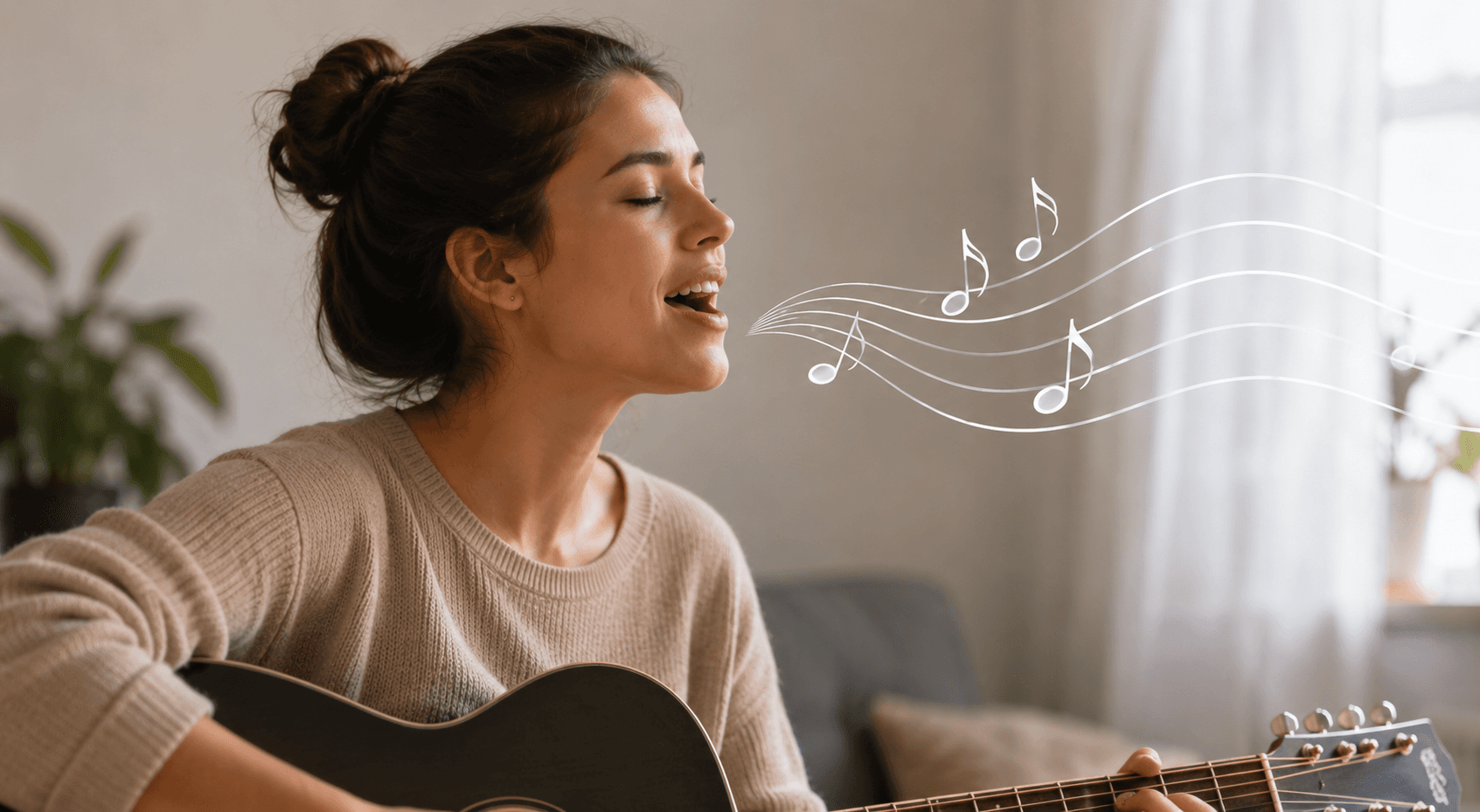
Does singing help with stuttering? Yes, for most people it does, and often the change is instant. When you sing, the melody sets the rhythm, your voice flows without stopping, and the fear of getting stuck on a word fades into the background. Someone who blocks on their own name can often sing a whole song without a single pause. That tells you something important: your speech system is fully capable of fluency. Singing isn't a cure by itself, but it's clear proof that smooth speech is already inside you. Understanding why it works is a great first step if you want to learn how to stop stuttering in everyday conversations too.
Does singing help with stuttering, and why does it work so fast
Singing works because it removes almost every pressure that speech places on a person who stutters. There is no scramble to find the next word. The melody has already decided the pace, the pitch and the pause. Your job is only to ride it.
Speech researchers have studied this for decades, and the finding is consistent across languages and age groups: stuttering nearly disappears during singing, choral reading, whispering and speaking in rhythm. Those conditions are grouped together as fluency inducing conditions, and singing is the easiest one to test at home.
The four things singing quietly fixes
Continuous voicing. In song, the vocal folds stay switched on across syllables instead of stopping and restarting, and restarts are exactly where blocks live.
Slower, longer vowels. Melody stretches vowels naturally, which gives the articulators more room.
Predictable timing. The beat handles the rhythm, so the brain is not managing motor planning and word choice at once.
Zero anticipation. You already know the next word, so the fear loop never starts.
What it does not fix
Singing does not retrain how you speak on the phone, in a meeting or during introductions. That transfer has to be built deliberately, which is where structured practice comes in.
Singing stuttering: what is happening in the brain
The phrase "singing stuttering" describes one of the strangest and most hopeful patterns in speech science. Speaking and singing do not run on identical circuits. Ordinary speech leans heavily on left hemisphere networks that handle sequencing, motor planning and language retrieval. Singing pulls in a broader network, including right hemisphere regions tied to melody, pitch contour and rhythm.
For someone who stutters, that shift matters. Research using brain imaging has repeatedly shown differences in timing and connectivity between motor planning and auditory feedback areas in people who stutter. Singing appears to route around the bottleneck rather than clear it.
A useful way to picture it
Think of a narrow bridge with heavy traffic. Speech sends every car across that one bridge. Singing opens a second road with a traffic light already set to green. The cars still arrive. They just take a calmer route.
This is also why external rhythm helps. Tapping a finger, walking to a beat or reading along with a recorded voice produces a similar smoothing effect, and it is why so many members inside our daily practice for stuttering start their sessions with rhythm and reading aloud before moving to conversation.
Can people with stutters sing without any blocks at all
Can people with stutters sing cleanly? Most can, and many discover it by accident in a car or a shower. But honesty matters more than a neat story here, and this is where a lot of online content oversells.
What is typical
Complete or near complete fluency while singing familiar songs.
Fluency that holds in choirs, karaoke and worship groups.
Sudden return of blocks the moment the song ends and normal talking resumes.
What is less common but real
A smaller group of people report disfluency while singing, especially when improvising lyrics, singing unfamiliar material or performing under intense pressure. Speech-language pathologists have documented this, and it usually points to the same underlying trigger: the moment singing starts to require spontaneous language planning, it starts to behave a little more like speech.
That distinction is genuinely useful. It tells you the fluency is not coming from the melody by magic. It is coming from reduced planning load, steady airflow and the absence of fear.
Singer that stutters: names that changed the conversation
Every so often a singer that stutters becomes public about it, and the effect on young stutterers is enormous. It reframes stuttering from a ceiling into a detail.
Ed Sheeran has spoken openly about stuttering as a child and about how rapping along to Eminem records helped him find rhythm and confidence in his voice. Scatman John, born John Larkin, stuttered severely for most of his life and built an entire scat singing style that turned his disfluency into his signature. Carly Simon has discussed stuttering since childhood and has described singing as the place her voice moved freely. Noel Gallagher and Bill Withers have both been open about stuttering as well.
Why these stories matter more than statistics
They prove the vocal apparatus is not damaged.
They show that public speaking careers are possible with a stutter, not in spite of hiding it.
They shift the goal from "never stutter" to "speak anyway, and speak well."
Our community collects that same evidence at a smaller and more personal scale. The stopped stuttering stories from members are not famous names, and that is exactly why they land differently.
Music and stuttering: what actually transfers to conversation
Music and stuttering have a long shared history in therapy rooms. Metronome pacing, rhythmic speech, melodic intonation therapy and choral reading all draw on the same principles a song uses. The practical question is what survives the trip from melody to real conversation.
Techniques worth borrowing from music
Breath first. Singers exhale before phonating. Beginning a sentence on a released breath instead of a held one prevents the classic hard block.
Legato speech. Let words connect within a phrase rather than punching each one separately.
Phrasing. Songs break into short musical phrases. Speech can too. Five to seven words, then a natural pause.
Voice onset. Start softly rather than hitting the first consonant hard.
The honest limitation
Rhythm based methods can fade once the beat is removed, which is why singing alone rarely produces lasting change. The methods that hold up long term combine physical speech tools with mental training, because most of the daily struggle sits in anticipation, avoidance and fear rather than in the mouth. That combination is the core of the Neuroscience Method used in our online stuttering therapy for adults, delivered by certified therapists who are themselves ex-stutterers.
Does singing help stuttering enough to be used as therapy
Does singing help stuttering as a standalone treatment? On its own, no. As a training tool inside a wider program, absolutely.
How to use singing productively this week
Warm up with it. Two or three minutes of singing before speaking practice loosens breath and lowers tension.
Sing, then speak the same line. Sing a lyric, then say it, then say it again slightly faster. You are transferring the feel, not the tune.
Read aloud with recordings. Reading in unison with an audio voice mimics choral speech and is one of the strongest fluency inducers available at home.
Practise with people, not just alone. Fluency in a shower does not predict fluency in a group. Live speaking practice, like our weekly speech club meetings, is where the transfer actually gets tested.
Track it
Log what happened, not how you felt afterwards. Members who record daily wins and setbacks consistently move faster, because the pattern becomes visible instead of emotional.
Frequently Asked Questions
Why can I sing without stuttering but not talk?
Singing removes spontaneous word planning, keeps voicing continuous and sets the rhythm externally. Conversation asks your brain to choose words and control motor timing at the same moment, which is where stuttering surfaces.
Do all people who stutter become fluent while singing?
Most do, but not everyone. Improvised lyrics or high pressure performance can bring disfluency back for some singers.
Can joining a choir reduce my stutter?
It can build confidence, breath control and comfort using your voice in front of others. It will not automatically transfer to conversation without targeted speech practice.
Is rapping as useful as singing?
Rhythmic speech works on similar principles and some people find it easier to carry into everyday speech because it sits closer to talking than to melody.
How long before singing based practice shows results?
Used as a warm up alongside structured daily practice and live speaking sessions, many people notice easier onsets within a few weeks.
Can singing help stuttering become permanent fluency
Can singing help stuttering turn into everyday fluent speech? Not by itself, but it is one of the most encouraging signposts you will ever get. If your voice runs clean through a three minute song, the hardware works. What remains is retraining the habit, the anticipation and the fear that sit around ordinary conversation. That work is learnable, it is repeatable, and thousands of ex-stutterers have already done it. Sing because it feels good and because it proves a point, then take the breath control, the phrasing and the calm you found in that song and put it to work in the next real conversation you have.
Ready to Put This Into Practice?
Download the app and start practicing today
Reading is the first step. Real progress comes from consistent daily practice. Use StopStutter to build confidence and improve your speech every day.


