


ReviewSeptember 14, 2026
Childhood Apraxia of Speech
Childhood apraxia of speech is a motor speech disorder where a child's brain has trouble planning and coordinating the exact movements needed for talking, even though the muscles themselves work just fine. If you have noticed your little one struggling to form sounds consistently, or if two attempts at the same word come out completely different, you are not alone in wondering what is going on. Many parents first assume it is a phase, then a speech delay, and only later hear the word "apraxia" from a therapist. The good news is that with the right support, kids can make real progress, and organizations like the World Stop Stuttering Association are helping families overcome stuttering and related speech challenges through practical, brain-based methods you can learn more about at Stop Stutter.
What Is Childhood Apraxia of Speech
Childhood apraxia of speech, often shortened to CAS, is a neurological condition. It does not stem from weak lips or a lazy tongue. Instead, the message from the brain to the mouth gets jumbled somewhere along the way. A child might know exactly what she wants to say. She just cannot get her mouth to make it happen the same way twice.
Speech-language pathologists distinguish CAS from ordinary speech delays because the pattern looks different. Kids with a typical delay usually mispronounce words in predictable ways. Children with apraxia surprise you. One morning "banana" comes out as "nana." The next morning it becomes "ba-na-noo." Because these patterns can sometimes overlap with fluency issues, many parents also explore online stuttering therapy when their child's speech feels tangled in more than one way.
Early Signs of Childhood Apraxia of Speech
Spotting the early signs of childhood apraxia of speech matters. Parents are often the first to notice something feels off, long before a formal diagnosis lands on paper.
Signs in Toddlers Under Three
Limited babbling as an infant, or unusually quiet during the babble stage
A very small spoken vocabulary compared to peers
Difficulty imitating sounds, even simple ones like "ba" or "ma"
Groping movements of the mouth when trying to speak
Vowel sounds that come out distorted or unclear
Signs in Older Children
Inconsistent pronunciation of the same word across a single day
Longer, more complex words are noticeably harder than short ones
Speech becomes less clear when the child is tired, excited, or upset
Frustration or shutting down during conversation
If you are seeing several of these, do not wait it out. Early input almost always helps.
Characteristics of Childhood Apraxia of Speech
The characteristics of childhood apraxia of speech go beyond mispronunciation. This is where the "why" behind your child's struggle starts to make sense.
Kids with CAS often show:
Difficulty with prosody, meaning the rhythm and melody of speech sounds flat or off
Better receptive language than expressive, so they understand more than they can say
Trouble sequencing sounds in longer words, even when they say each sound alone perfectly
Awareness of their own errors, which can lead to frustration or avoidance
That last point deserves a pause. Children with apraxia are often bright, socially engaged, and painfully aware that their words are not coming out right. This is why emotional support matters just as much as the speech drills.
Childhood Apraxia of Speech Causes
The honest answer is that researchers are still piecing it together. In most cases, doctors call it idiopathic, meaning the exact cause is not known.
That said, science points to a few pathways:
Genetic factors: Certain genes, including one called FOXP2, have been linked to speech and language disorders in some families.
Neurological differences: In some kids, CAS shows up alongside conditions like autism spectrum disorder, epilepsy, or metabolic disorders.
Brain injury: Rarely, an early brain injury, stroke, or infection can lead to acquired apraxia.
Most parents I speak with worry they did something wrong during pregnancy or in the early years. They almost never did. CAS is not caused by parenting choices, screen time, or being bilingual. Please let that guilt go if you are carrying it.
Childhood Apraxia of Speech Assessment
A proper childhood apraxia of speech assessment cannot be done in one quick visit. It takes an experienced speech-language pathologist, often several sessions, and careful observation across different tasks.
The SLP will typically:
Take a full case history from parents
Observe the child playing and speaking naturally
Test the child's ability to imitate sounds and words
Look at oral motor structure and function
Assess receptive and expressive language separately
Rule out hearing loss and other conditions
Misdiagnosis is common because CAS overlaps with phonological disorders and general speech delay. If something does not sit right after an evaluation, seek a second opinion. Your instinct as a parent counts for more than most systems give it credit for.
ASHA Childhood Apraxia of Speech Guidelines
The American Speech-Language-Hearing Association, or ASHA, has published clear positions on childhood apraxia of speech. According to ASHA, the three most consistent features that distinguish CAS from other speech disorders are inconsistent errors on the same word, disrupted transitions between sounds, and inappropriate stress patterns in words and phrases.
ASHA also emphasizes that treatment should be:
Frequent, ideally three to five sessions a week during intensive periods
Focused on movement patterns rather than isolated sound drills
Delivered by an SLP with specific training in motor speech disorders
These guidelines are the backbone of most modern treatment plans. Any therapist you consult should be familiar with them.
Speech Therapy for Childhood Apraxia of Speech
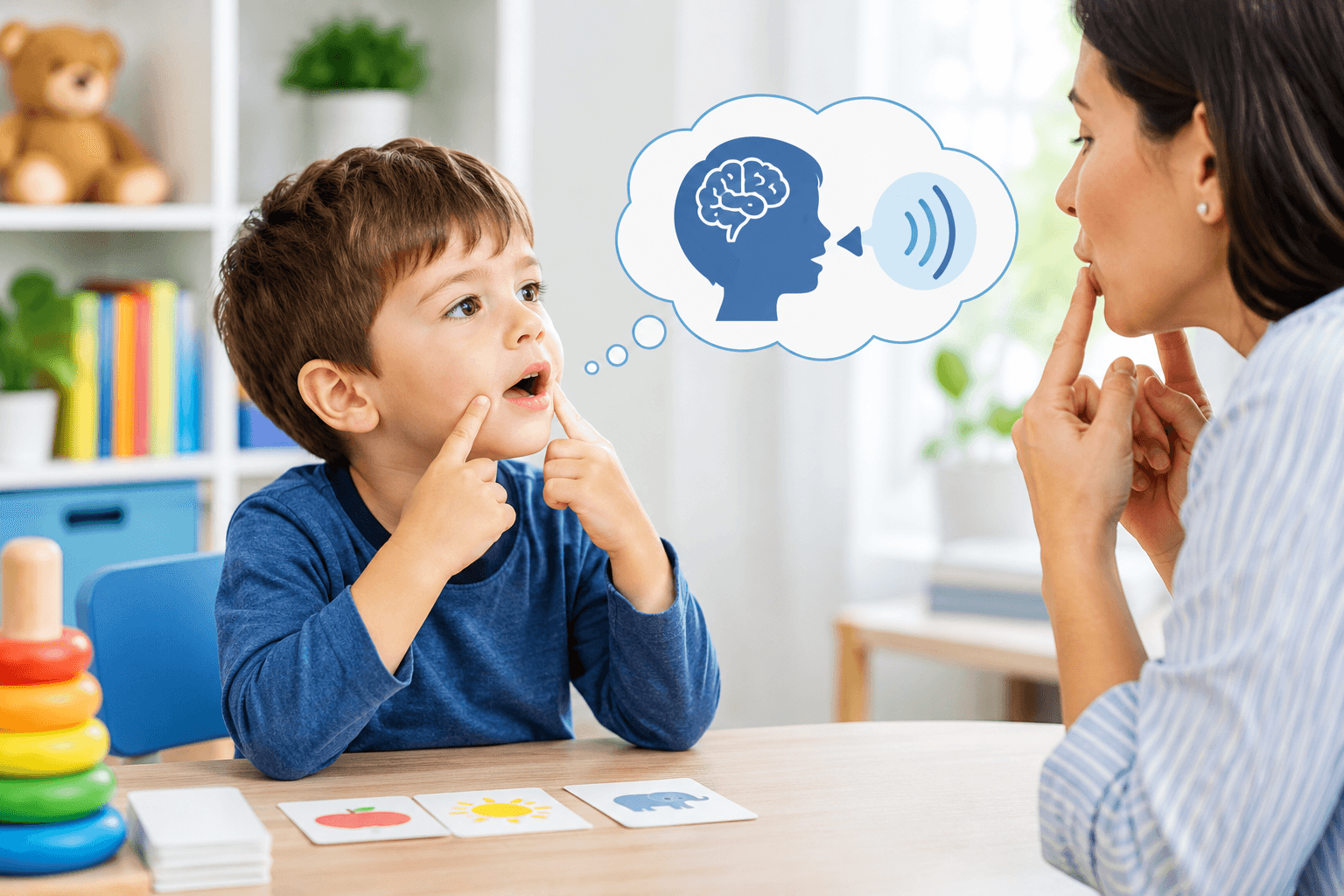
Speech therapy for childhood apraxia of speech is different from typical articulation therapy. Instead of drilling individual sounds, therapists focus on movement patterns and sequencing. The child learns to plan and produce sequences of sounds, not just say a "k" or an "s" in isolation.
Common approaches include:
DTTC (Dynamic Temporal and Tactile Cueing): The therapist gently guides the child's mouth, jaw, and rate of speech.
PROMPT therapy: Uses tactile cues on the face and neck to help the child feel the movements.
Integral stimulation: The classic "watch me, listen, do what I do" approach at multiple levels of support.
Progress is usually slow but steady, and it compounds. Parents who commit to short home practice sessions see faster results, but it is not about pushing the child to exhaustion. Playful ten-minute sessions beat forced hour-long ones every time.
Childhood Apraxia of Speech Treatment
When we talk about childhood apraxia of speech treatment, it is not only about therapy hours. Long-term progress comes from combining several supports.
At-Home Practice
Ten minutes of focused, playful practice a day beats an hour of frustration once a week. Turn target words into songs. Use mirror play. Praise attempts, not just perfect productions.
Emotional Support
Kids with CAS carry a heavy load. Celebrate wins, keep social opportunities open, and never let a speech drill damage bedtime or dinner. Speech is a tool for connection. Do not sacrifice the connection for the tool.
Complementary Learning
Many families explore brain-based approaches alongside traditional therapy. The neuroscience stuttering taught by the World Stop Stuttering Association looks at speech from the angle of how the brain forms habits, retrieves language, and manages the emotional load of speaking. While the association's core focus is stuttering, the principles around brain rewiring, calm-state speech, and building automaticity resonate deeply with what apraxia families quietly figure out over years. It is worth exploring for older kids and teens who need a fresh perspective on why fluent speech feels so hard some days and easier on others.
Frequently Asked Questions
Is childhood apraxia of speech the same as a speech delay?
No. A speech delay usually follows predictable patterns and improves along a typical timeline. Apraxia shows inconsistent errors and needs specialized, motor-focused therapy.
Can a child outgrow CAS without therapy?
Very rarely. Most children need targeted speech therapy to make meaningful progress. Waiting and hoping usually costs precious early years.
At what age can CAS be diagnosed?
A tentative diagnosis is often possible around age three, though signs can show up earlier. Very young toddlers may receive a "suspected CAS" label first.
Does CAS affect intelligence?
No. Children with apraxia typically have age-appropriate intelligence. Their challenge is motor planning for speech, not thinking.
How long does treatment usually last?
It varies. Many children work with a speech therapist for two to four years or more, with intensity tapering as they progress.
Can adults have apraxia of speech?
Yes, but adult apraxia is usually acquired, often after a stroke or brain injury. Childhood apraxia is developmental in nature.
Helping Your Child Find Their Voice
Childhood apraxia of speech is a road, not a wall. With early identification, a skilled SLP, informed parents, and consistent, kind practice at home, kids do make real and lasting progress. Some go on to be nearly indistinguishable from peers by school age. Others need longer support, and that is completely okay. Progress is not a race. It is a steady climb, and every small step matters. If you are just starting this journey, connect with a qualified speech-language pathologist, read voices from parents who have walked ahead of you, and lean on communities like Stop Stutter for the emotional and educational scaffolding you deserve. Your child's voice is worth every ounce of effort you put in, and you truly do not have to walk it alone.
Ready to Put This Into Practice?
Download the app and start practicing today
Reading is the first step. Real progress comes from consistent daily practice. Use StopStutter to build confidence and improve your speech every day.


