


ReviewOctober 2, 2026
Circumlocution in Stuttering
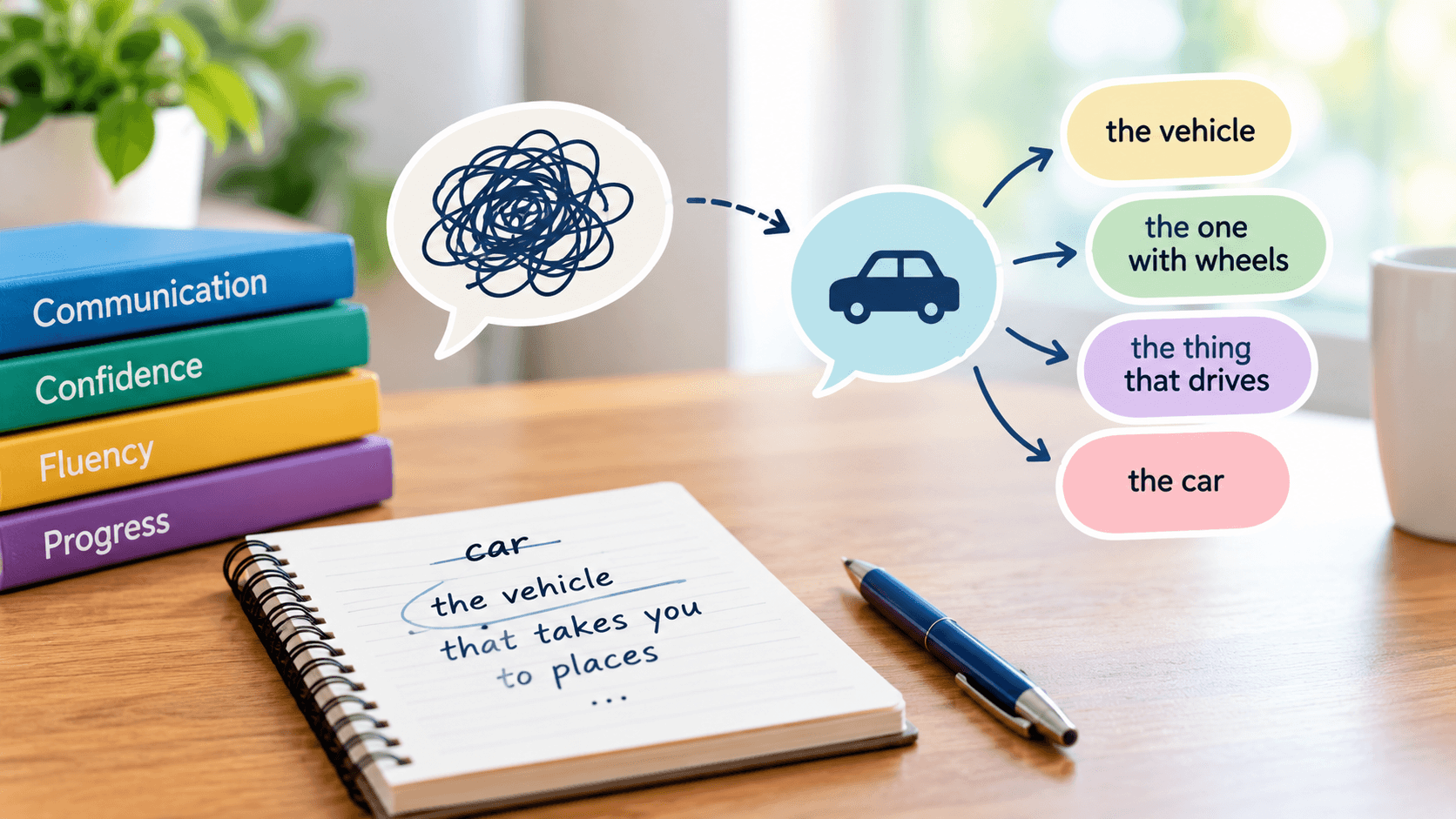
Circumlocution in stuttering is when you replace a word you're afraid to block on with a longer, more roundabout phrase just to get around the stutter you're expecting. Picture someone who wants to order a coffee but ends up saying "whatever your darkest hot drink is" because they know the hard /k/ sound is going to cause a block. Or someone who, when asked their name, says "you can just call me S" instead of saying it in full, because the first letter alone feels like a wall. This kind of verbal detour is one of the most widespread patterns in stuttering, and it tends to develop so naturally that the person doing it often has no idea how much of their speech it has quietly taken over. If you have been trying to figure out how to stop stuttering and feel like something keeps pulling you back, circumlocution might be a bigger piece of the puzzle than you have given it credit for.
What Is Circumlocution? A Closer Look at the Avoidance Pattern
In everyday language, circumlocution just means using more words than necessary to say something simple. A writer might do it for effect. But for someone who stutters, it is not a style choice. It is a coping tool, and it usually kicks in without asking permission.
Here is what actually happens. You are mid-sentence, heading toward a word you know is going to trip you up. Your brain, without pausing to consult you, starts rerouting. A longer phrase appears, a safer one, and you take it. The sentence still lands. Nobody around you notices. And for a moment, the relief is real.
The problem is not the rerouting itself. The problem is what the brain learns when that relief becomes the goal.
Why Circumlocuting Becomes Second Nature
Most people who stutter start circumlocuting long before they have a name for what they are doing. It usually begins in childhood or early adolescence, when the social cost of visible stuttering starts to feel genuinely threatening. A child figures out that swapping one word for another makes the stutter disappear, at least to everyone watching. The brain files that lesson away. The behavior gets repeated. Over time it stops being something you choose to do and becomes something that just happens.
There is also real neuroscience behind why this habit sticks so firmly. When you anticipate stuttering, your brain processes that anticipation as a threat, the same way it would process physical danger. Avoidance becomes the brain's fastest way out, and every time it works, the pattern gets reinforced a little more. If you have been noticing this cycle in yourself, getting into online stuttering therapy early can help interrupt it before the habit settles in even deeper.
Circumlocution Communication Strategies: When They Help and When They Hurt
Here is something that often gets missed in conversations about stuttering: not all rephrasing is avoidance. There is a real difference between choosing to reword something because it lands more clearly and rephrasing because your brain has flagged the original word as too risky. One is a deliberate communication strategy. The other is a fear response. They can feel almost identical in the moment, but they lead to very different places over time.
Using circumlocution as a calculated strategy in specific high-pressure situations is something a lot of people who stutter have done, and it is not something to be ashamed of. The shift happens when it is no longer something you can set aside. When every conversation is being pre-filtered for potential trigger words before it even begins, it has become the default rather than an option.
For parents, this shows up differently. Children who are still building their language and identity at the same time can start forming avoidance habits during a window when both of those things are quite malleable. If your child is finding ways to dodge specific sounds or words, knowing what is developmentally typical versus what might need attention is important. The resource on 2-year-old stuttering can help you make that call with more clarity.
The Hidden Cost of Leaning on Circumlocutions
What the people around a person who stutters rarely see is how much invisible work is happening underneath every conversation when circumlocutions are running things. Here is what that looks like day to day:
Before a single word comes out, the editing has already started. Every sentence gets scanned for potential blocks, and alternate routes are being planned in real time. This uses real mental energy and often means that what you actually say is not what you wanted to say.
Vocabulary shrinks over time without any fanfare. Whole categories of words get quietly flagged as too unpredictable. Some people stop saying their own name when they meet someone new. Others drop entire topics from conversation because the words that belong to those topics feel too risky. Over months and years, the range of what feels safe to say gets smaller.
Conversations stop being conversations. Instead of being present in what someone else is saying to you, you are running a parallel simulation of what you are about to say, spotting potential blocks, and planning detours before you have even opened your mouth.
The exhaustion builds slowly and without obvious cause. A lot of people who stutter describe leaving interactions feeling genuinely drained, not because of the content of what was discussed but because of the amount of managing they were doing underneath the whole time.
Circumlocution Speech Therapy: What Real Support Looks Like
The good news is that circumlocution in stuttering is not something you are stuck with. It is a learned behavior, and learned behaviors can genuinely be unlearned. But the approach matters. Deciding to use the "right" words and white-knuckle your way through the fear rarely works by itself, because avoidance is not a conscious choice in the first place. The fear underneath is still running things.
Real support works on both layers at the same time. It addresses the physical reality of stuttering and the emotional habits and behavioral patterns that have grown around it. Here is what that kind of structured work usually involves:
Pinpointing which specific sounds and words reliably trigger avoidance in your own speech
Practicing those exact words deliberately, in safe low-pressure environments, until they carry less emotional weight
Building genuine communication strategies that give you real options rather than better-disguised escape routes
Working through the emotional side of stuttering, including the shame that often sits underneath the avoidance for years without being named
Loosening the grip of fear through supported, repeated exposure rather than continued avoidance
For a clearer picture of what different approaches actually involve and which ones have real results behind them, this breakdown of stuttering therapy techniques that actually work is worth reading before you decide on a direction.
5 Examples of Circumlocution in Everyday Stuttering Situations
It is easier to recognize circumlocution in your own speech once you see it laid out in familiar situations.
Example of Circumlocution in Real Conversations
Instead of saying "My name is Patrick," a person says "most people just call me P" or "you can call me Pat" to avoid the /p/ sound they know will block.
At a café, rather than ordering a "cappuccino," someone describes it as "the small milky espresso drink" because the /k/ sound is a consistent trigger.
Instead of saying "Saturday," a speaker says "the first day of the weekend" because they have blocked on that word enough times that it now carries real dread.
A student responds to a question with "I think it is along the lines of what was already said" rather than giving their actual answer, because starting the real answer means leading with a feared sound.
Someone in a group introduction waits quietly, hoping their name comes up another way, rather than saying it directly and risking a block in front of everyone.
Taken on their own, each of these looks like a small adjustment. But added up across a full day of conversations, circumlocution in stuttering shapes how a person moves through the world, what they say, who they talk to, and what they believe they are capable of.
The Neuroscience Behind Why Circumlocution Feels So Natural
One of the most genuinely useful things to understand about stuttering is that avoidance behavior is not a personal weakness. It is a brain pattern. And brain patterns, unlike character flaws, can be worked with.
When you anticipate stuttering on a specific word, a region of the brain called the amygdala fires. This is the brain's alarm system, and it cannot distinguish between a conversation you are nervous about and a physical threat. So the body responds accordingly. Muscles tighten. Breathing becomes shallower. Self-monitoring spikes. Ironically, all of this increases the chances of actually blocking. Circumlocution becomes the fastest exit your brain knows, and each time it works, the brain commits to it a little more.
Breaking out of that loop means working with the brain, not just the behavior. The Neuroscience stuttering Method at Stop Stutter is built around exactly this. It helps speakers build new neural responses to feared sounds and steadily reduce the anticipatory fear that keeps avoidance locked in. This is not about performing fluency or hiding what is happening. It is about genuinely changing how the brain relates to speaking, which is a completely different kind of progress.
Frequently Asked Questions
What does circumlocution in stuttering actually mean?
It means replacing a word you expect to block on with a longer, roundabout phrase to avoid stuttering on the original word. If someone wants to say "coffee" but says "the hot drink I always have in the morning" to sidestep the /k/ sound, that is circumlocution. Many people who stutter do this daily without recognizing it as a pattern.
Is using circumlocution harmful?
Not always and not in isolation. Occasionally rephrasing something for clarity is just good communication. The concern is when it becomes automatic and starts narrowing your vocabulary and filtering every conversation without you consciously choosing it. At that point it is worth addressing with proper support.
Can the right support actually reduce circumlocution?
Yes. When both the fear driving the avoidance and the stuttering itself are addressed together, most people find the pull toward constant circumlocution reduces meaningfully over time. Working on both layers is what makes the difference.
Does every person who stutters use circumlocution?
Not every person, but it is one of the most common patterns, especially in people who have been stuttering for years without professional guidance. It tends to build gradually and can be well-established long before the person even recognizes it.
At what age should a parent start paying attention to word avoidance in a child?
If a child is consistently avoiding specific sounds or words by age 4 or 5, speaking with a speech-language professional is a sensible next step. These patterns are far easier to address before they become deeply established.
Moving Past Circumlocution: A Better Path to Communication
Circumlocution in stuttering is not a personality trait, and it is not a reason to be embarrassed. It is what the brain learned to do when speaking felt like a threat, and in that sense it made a kind of sense at the time. But carrying that habit forward into every conversation has a real cost, and it is not one you have to keep paying.
The goal is not to become someone who never stutters. It is to become someone who is no longer organizing their speech and their life around the fear of it. That shift is real, and it is available to you.
Whether you have been quietly navigating these patterns for years without ever naming them, or you are a parent trying to understand what your child is going through, the team at Stop Stutter is here. Book a free consultation and take the first step toward communication that actually feels like yours.
Ready to Put This Into Practice?
Download the app and start practicing today
Reading is the first step. Real progress comes from consistent daily practice. Use StopStutter to build confidence and improve your speech every day.


