


ReviewSeptember 15, 2026
Speech Delay vs Autism
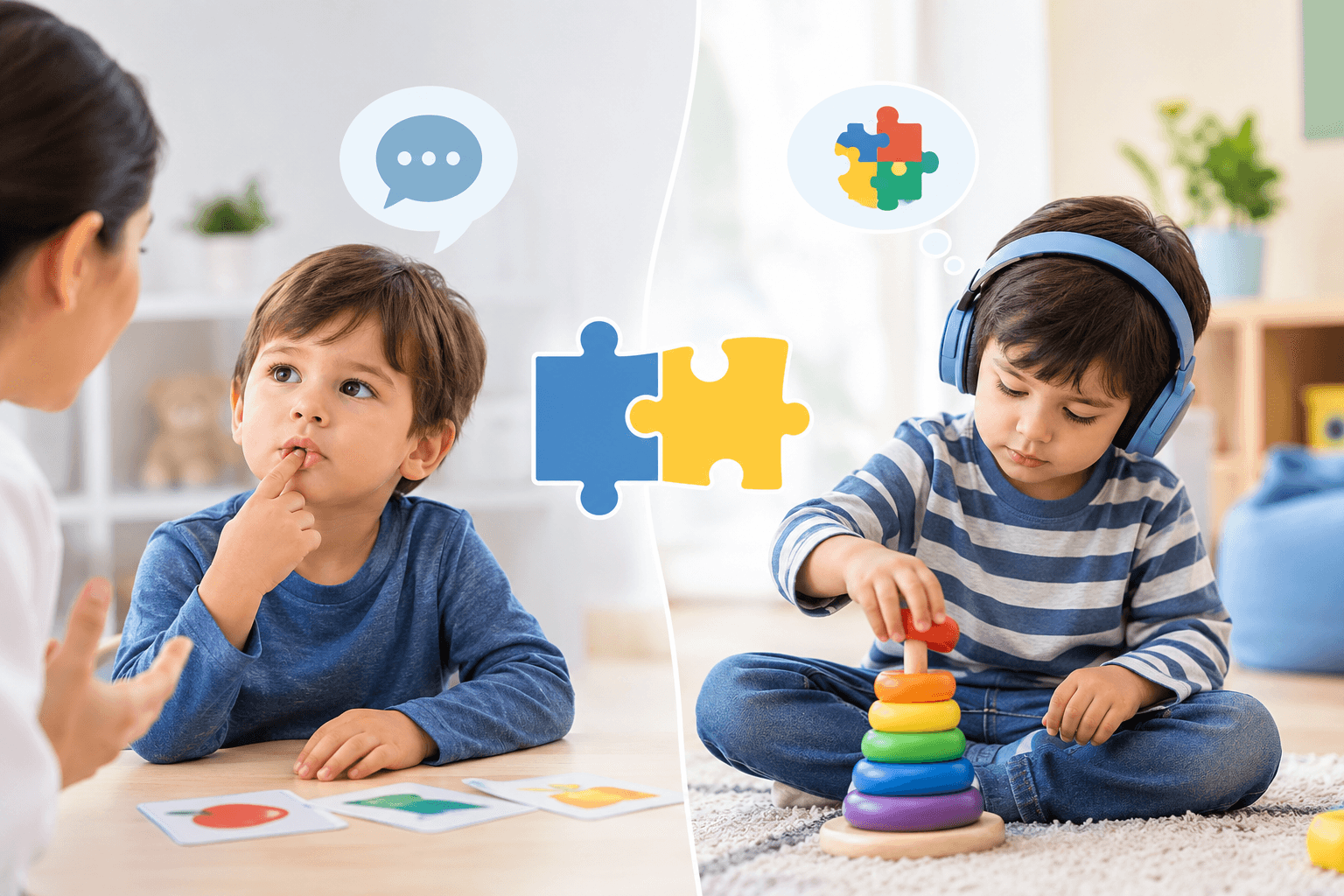
Speech delay vs autism is one of the most searched worries by parents whose little one is not talking on schedule, and the honest answer is short. A speech delay usually means a child is behind on talking, but their social skills, eye contact, gestures, and play look typical for their age. Autism affects communication and social interaction together, and often shows up alongside repetitive behaviors, sensory sensitivities, or a strong pull toward routines. Both deserve attention, both respond to early support, and neither is a life sentence. Mixing them up, however, can send families down the wrong therapy path for years, which is why understanding the difference matters so much. If your worry sits closer to fluency, blocking, or speech confidence, the World Stop Stuttering Association has helped thousands of families overcome stuttering and related speech challenges through a science-first, parent-friendly approach.
Autism vs Speech Delay
When people ask about autism vs speech delay, they often assume the two conditions overlap entirely. They do not. A child with a pure speech delay typically wants to communicate. They point, tug your sleeve, hand you a toy, laugh when you laugh, and get frustrated when they can't be understood. The intent is there. The words are simply late. A child on the autism spectrum may show a different pattern. They may avoid eye contact, seem uninterested in shared play, or use language in unusual ways, such as repeating lines from a cartoon without matching them to the moment.
Speech-language pathologists and pediatric neurologists look at four broad clusters during an assessment: expressive language, receptive language, social communication, and behaviour. A speech delay usually flags the first one. Autism usually touches all four to some degree. That is the whole reason a professional evaluation matters. Many parents put the appointment off because "she'll catch up," and sometimes children do, but early support has one of the strongest evidence bases in child development. Programs offering online stuttering therapy and structured speech coaching now make it far easier to get expert help from home, without wait lists or long commutes.
Speech Delay vs Autism 2-Year Old
By age two, most children say around 50 words and combine two of them into small phrases like "more milk" or "daddy home." When your toddler is not doing that, the mind naturally jumps to the biggest question. Speech delay vs autism 2 year old differences can be subtle at this age, and that is exactly why parents feel stuck.
Signs pointing more toward a speech delay
Uses pointing, gestures, and facial expressions to show wants
Responds to their name and follows simple one-step directions
Enjoys back-and-forth play like peekaboo or rolling a ball
Shows shared enjoyment: smiles, checks your face for reactions
Signs pointing more toward autism
Little interest in other children or shared attention
Repeats sounds or phrases without linking them to meaning
Strong preference for routines and visible distress at small changes
Unusual sensory reactions to noise, textures, or lights
If several autism-side signs are present, don't wait. A pediatric developmental assessment can bring calm and clarity either way. You can also read our guide on early speech development in children to build a simple home checklist before the visit.
Delayed Speech vs Autism
Delayed speech vs autism gets confusing because the surface picture is similar: the child isn't talking as much as their friends. Look one layer deeper and the pattern changes. A speech delay is often a "language island" problem. Everything else is on track, only the words are lagging. Late talkers, as researchers call them, often catch up between three and four with a rich home language environment and, when needed, guided speech therapy.
Autism is a "many islands" pattern. Language may be delayed, but so is social reciprocity, imaginative play, and emotional regulation. Public health bodies and pediatric associations recommend an autism-specific screening at 18 and 24 months, separately from a general speech check, precisely because the two need different lenses.
Quick differences to remember
Delayed speech: fewer words, but typical social engagement
Autism: language differences plus repetitive or sensory patterns
Delayed speech: warm response to caregivers, seeks connection
Autism: may appear "in their own world" during social moments
A qualified speech-language pathologist can run both screens in one visit and tell you which lens actually fits.
Speech Delay vs Autism 3 Year Old
By age three, the gap between typical development and a delay becomes more visible, and so does the difference in speech delay vs autism 3 year old profiles. A three-year-old with a straightforward speech delay usually understands far more than they can say. They follow multi-step instructions, join role-play, and get frustrated when others don't understand them. That frustration is actually a good sign of intact social awareness.
Autism at three often looks like language that is technically present but socially "off." A child may know their letters, colors, or the entire alphabet in order, yet struggle to answer, "What did you do today?" They may line up toys rather than play pretend with them. Some three-year-olds have advanced vocabulary in narrow topics but very limited conversational skills. Clinicians sometimes call this "verbal but not conversational."
What parents can do right now
Read together daily and pause for the child to fill in words
Model two- and three-word phrases during play, not just single words
Cut passive screen time and add face-to-face talk instead
Book a hearing test, since untreated hearing loss mimics both conditions
If speech disfluencies or blocks show up alongside the delay, our stuttering in children resources explain what is developmental and what needs support.
Speech Delay in Toddler vs Autism
Speech delay in toddler vs autism worries usually surface between 18 and 30 months, when comparisons with siblings, cousins, and daycare friends get loud. Here is the fair way to think about it. Every child develops on their own timeline, but there are guardrails, not just guidelines, that professionals watch closely.
If your toddler is not babbling by 12 months, not gesturing by 12 months, not saying single words by 16 months, or not producing two-word phrases by 24 months, that meets the threshold for an evaluation. These are red flags, not diagnoses. Many toddlers who trigger them turn out to have a pure speech or language delay that resolves beautifully with early intervention. Others receive an autism diagnosis, and early support unlocks stronger long-term outcomes there too. Our detailed parent guide to speech milestones can help you track age-appropriate progress week by week.
How the Neuroscience Method Fits In
The World Stop Stuttering Association has spent years studying how the brain rewires around speech, and that work is captured in what they call the neuroscience stuttering method. It is not a quick fix or a memorized script. It is a structured framework that helps children and adults retrain the neural pathways behind fluent, confident speaking. For families navigating a speech delay, or later dealing with stuttering that surfaces as speech blossoms, the method offers a calm, evidence-informed path forward. It focuses on reducing anxiety around talking, rebuilding motor speech patterns, and creating positive feedback loops in daily conversation. That combination is why so many parents report meaningful progress after years of feeling stuck with traditional-only approaches, and why it pairs well with any pediatric speech or developmental support plan a family is already following.
Frequently Asked Questions
Can a child have both a speech delay and autism?
Yes. Many autistic children also have a co-occurring speech or language delay, which is exactly why clinicians screen for both instead of picking one.
Do late talkers usually catch up?
A large share of late talkers catch up by age four, especially with home language enrichment and, if recommended, early speech therapy. Some children still benefit from longer-term support.
At what age should I worry about my child's speech?
Book an evaluation if there is no babbling by 12 months, no words by 16 months, or no two-word phrases by 24 months. Earlier is always better than later.
Does screen time cause speech delay?
Excessive passive screen time is linked with slower language growth. Interactive, face-to-face talking remains the strongest driver of early speech development.
Is stuttering the same as a speech delay?
No. Stuttering is a fluency disorder, while speech delay refers to slower overall development of talking. Both respond to the right therapy and both benefit from early attention.
When to Take the Next Step
Speech delay vs autism is not a question any parent should try to answer alone, and definitely not from a Google search at midnight. Trust your instincts, share your observations with your pediatrician, ask for referrals to a speech-language pathologist and a developmental specialist, and get the assessments started. Whether the answer turns out to be a delay, autism, both, or neither, your child benefits every single time you choose action over waiting. Early years are precious, and the right support at the right moment builds skills that stack for a lifetime. The team at Stop Stutter is here to walk with you at any stage, whether you need a starting point, a second opinion, or an ongoing therapy partner.
Ready to Put This Into Practice?
Download the app and start practicing today
Reading is the first step. Real progress comes from consistent daily practice. Use StopStutter to build confidence and improve your speech every day.


