


ReviewJuly 3, 2021
Stuttering Became My Biggest Blessing
My name is Lee Lovett. I am not a doctor, but I consider myself an expert on stuttering because I battled it for about 25 years, through my teens, 20s, and 30s. I have read countless books on the subject and wrote a book about the methods I use to control it. In short, stuttering forced me to become a better person. I am a long-retired attorney who co-founded dozens of businesses that are still operating today, and I recently wrote four books. I also created a website for my family and anyone interested, which you can find at leeglovett.com.
For reasons still unknown to me, I began stuttering badly during early puberty, and the problem grew progressively worse. By my mid-20s, I had a wife, two sons, and I was flat broke. I had just graduated from law school. When I tried my first case in court, I could not say my own name, my client’s name, or many other words. The judge had to intervene and finish my sentences. It was a ghastly experience, and I felt like I wanted to die on the spot. I knew that without immediate improvement, my legal career was over. In the 1950s and 60s, there were few books, clinics, or speech therapists, and certainly no internet to help people who stutter. I scraped together enough money to pay for six sessions with a psychiatrist, Dr. Frank S. Caprio, a well-known author. I wanted him to hypnotize me and tell me I did not stutter, hoping that would cure me. He explained that hypnosis might provide temporary relief but would not create a permanent cure. However, he believed I could improve dramatically through self-hypnosis.
He gave me a short paperback, “A Practical Guide to Self-Hypnosis” by Melvin Powers. Its techniques were simple to learn, and I began daily self-hypnosis treatments—before going to sleep, after waking, and during the day. I discovered that simply being deeply relaxed allowed me to visualize and hear myself speaking fluently. The more I maintained these images, the less I stuttered. Self-hypnosis was like fluency visualization on steroids. Self-hypnosis led me to autosuggestion, a simpler form of mind training that could be done in small increments. Popularized by Émile Coué, a late 1800s pharmacist turned psychologist, autosuggestion focuses on relaxation, visualization, and repeating the thoughts you want to have.
During my sessions, I would say things like: I love to speak, calm sweeps through my body when I speak, and I focus on my message and delivery, not the words themselves. I would repeat these statements up to 20 times per session. Over time, my mind became filled with positive fluency memories, and my stuttering gradually declined. Through trial and error, I also discovered crutches—tricks that allowed me to bypass the words I feared. These crutches prevented the formation of new stuttering memories. Combined with daily mind training, the crutches helped me speak with decreasing stuttering until it became undetectable.
Yes, I had stuttering fears for some years, but not every minute like I did before. For decades now, only my wife has caught me in a rare stutter. Stuttering first threatened my life, but ultimately it saved my life and made me a better person.
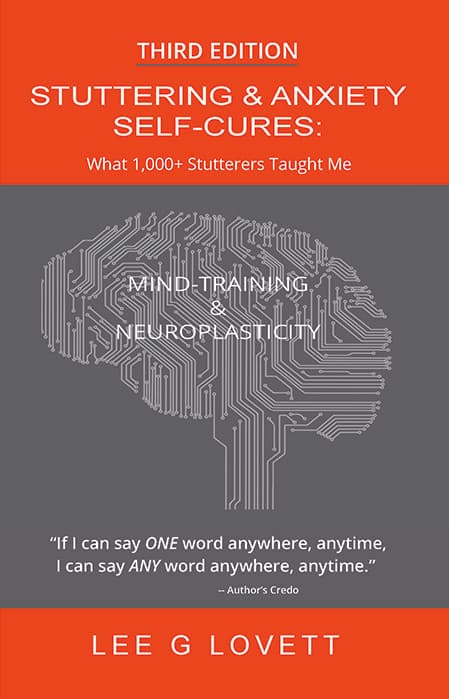
Fighting stuttering forced me to master mind-training methods that helped me control my thoughts, attitudes, words, actions, and overall peace and joy. Every day, I still do mind treatments and occasionally use a crutch, but my life is far better than it was before I began this journey. I am grateful that I had to battle stuttering. I detail my journey in my book, “Stuttering and Anxiety Self-Cures,” which is available on WSSA’s website, along with a 20-video course that complements the book.
Though I am long retired, I continue to Skype with as many readers as I can, having completed over 5,000 coaching sessions in the last five years. Life is good or bad based on how we choose to see it. Stuttering is a challenge, but it can be managed, and it can help us become better people and live happier lives. That is what I want for you.
I’ll leave you with the words of Dr. Frank S. Caprio: “We have free choice to accept or reject our thoughts. Use your mental switch to dictate your thoughts. Believe that you can improve, and you will.”
Ready to Put This Into Practice?
Download the app and start practicing today
Reading is the first step. Real progress comes from consistent daily practice. Use StopStutter to build confidence and improve your speech every day.


