


ReviewJuly 2, 2026
What Causes Stuttering? The Brain Science Behind It
What causes stuttering is a question almost everyone who stutters asks at some point. Is it nerves? Something from childhood? Something you're stuck with for life?
The honest answer is that stuttering starts in the brain. Specifically, in the way certain speech regions time their signals with each other. Genes play a part. So does everything that builds on top over the years. But at the root, it is neurological. Knowing that changes what you can actually do about it, because if the cause is in the brain's wiring, you can go after it there instead of chasing symptoms. That is the whole idea behind how to stop stuttering with the right kind of practice.
A few quick facts about the causes of stuttering:
Rooted in how the brain coordinates the timing between speech regions, not in intelligence, effort, or personality
Affects roughly 3 million Americans and 70 million people worldwide (NIDCD)
About 5 to 10 percent of children stutter at some point, and about 1 percent carry it into adulthood (NIDCD)
Runs in families in around 60 percent of cases, pointing to a genetic link
Can also appear later in life after stroke, brain injury, or severe emotional trauma
What Is Stuttering, Exactly?
Stuttering, also called stammering, is a fluency disorder. It shows up as interruptions in the flow of normal speech. These interruptions take three main forms: repetitions ("I-I-I want..."), prolongations ("Ssssay that again"), and blocks, where no sound comes out even when the person is trying to speak.
What sets stuttering apart from other speech-related issues is its cause. Stuttering is not caused by weak muscles, a small vocabulary, or a lack of intelligence. It lives in how the brain produces and processes speech.
"Stuttering is not a speech deficit but a brain pattern and brain patterns can be altered."
What Causes Stuttering? The Brain Science
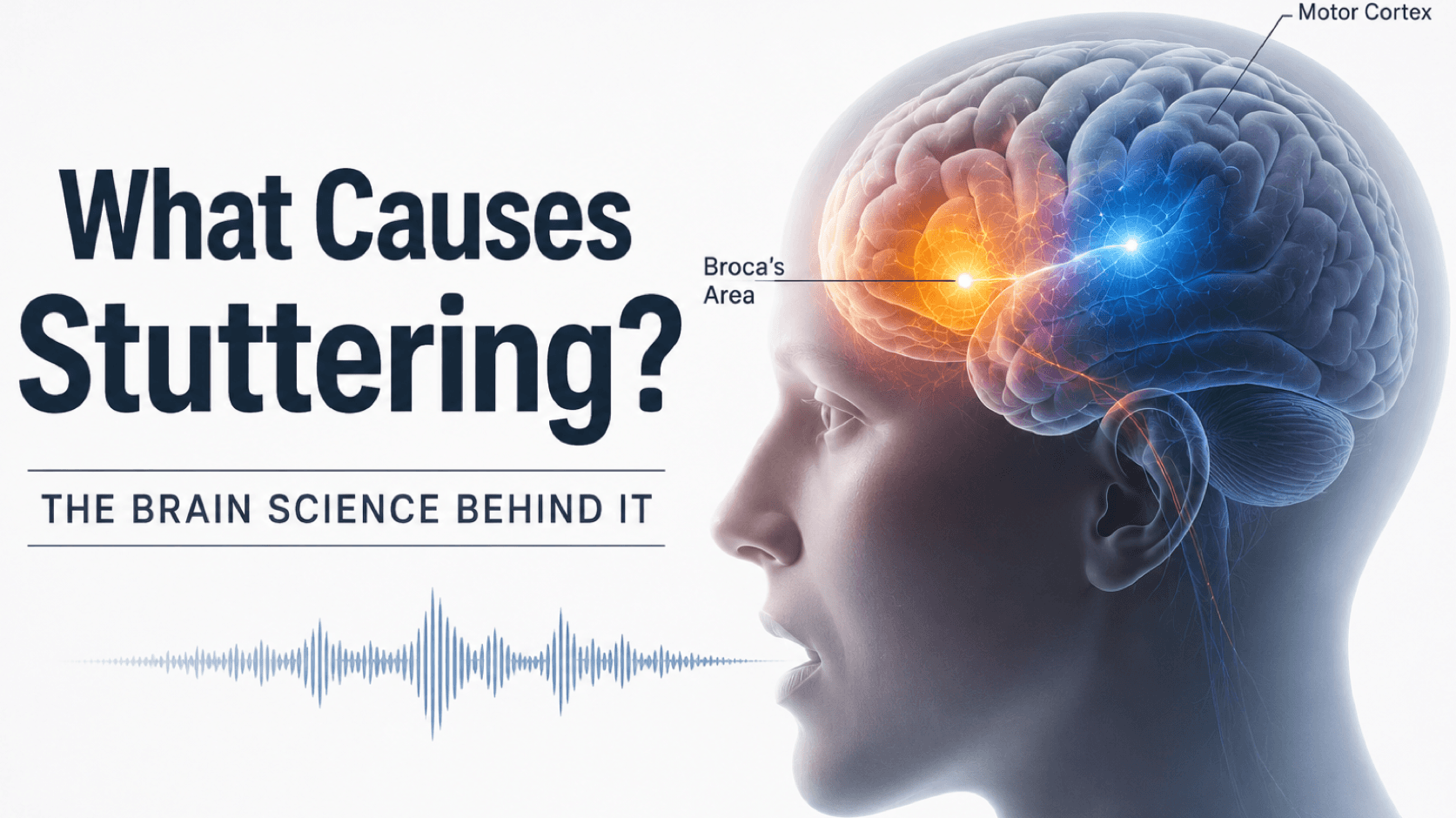
The brain systems that coordinate speech production look and behave differently in people who stutter. Neuroimaging studies consistently show differences in the timing and connection between two key regions: Broca's area, which handles speech production, and the motor cortex, which controls the muscles that turn thought into sound.
In people who stutter, the coordination between these regions is out of sync. The brain knows exactly what it wants to say. The signal to produce those sounds simply does not arrive smoothly. That mismatch is where stuttering happens.
What Causes Stuttering in the Brain?
Brain imaging studies show a clear pattern. When people who stutter are speaking, the right hemisphere is often overactive while the left hemisphere, which usually handles most of the speech work, is underactive. That imbalance is at the heart of the coordination problem.
The good news is that the brain is not fixed. Through neuroplasticity, the brain's ability to rewire itself through repeated practice, these patterns can be reshaped. This is the principle that underlies the StopStutter program.
What Causes Stuttering in Adults?
The main cause of stuttering in adults is connected to their childhood experience. Developmental stuttering arises between ages 2–6 when speech and language acquisition happens rapidly. For unknown reasons, some kids start to stutter at that age and cannot overcome it automatically.
In adults, stuttering becomes a deeply established neural pathway, something that was formed through years of experience of stuttering, avoidance, and anxiety. In adults, stuttering was initiated from childhood but was made stronger with the time.
Why Do People Stutter? The Short Answer
People stutter because the brain regions that produce and time speech are not fully in sync. It is not about intelligence, personality, or how hard someone is trying. It is a wiring pattern that develops early in most cases, and it can be reshaped with the right approach.
Three main factors shape whether stuttering appears and whether it lasts:
Genetics. Around 60 percent of people who stutter have a family member who also stutters, and researchers have identified specific genes linked to the condition.
Brain wiring. Small differences in the timing between speech-planning and speech-motor regions of the brain create the disruption we hear as stuttering.
Environment and emotion. Anxiety, avoidance, and stress do not cause stuttering, but they can make it stronger and harder to move through.
What Causes Sudden Stuttering in Adults?
Some adults begin stuttering without ever having stuttered as a child. This is called acquired stuttering, and it comes in two forms: neurogenic and psychogenic. Common causes include:
Neurological events: damage to the speech regions of the brain from a stroke, head injury, or brain tumour
Neurological conditions: Parkinson's disease, multiple sclerosis, or other progressive conditions
Medication side effects: certain drugs that act on the central nervous system
Severe emotional trauma: psychogenic stuttering, which is rare and often follows a highly distressing event
If stuttering has appeared suddenly in adulthood without any earlier history, see a doctor. The underlying cause matters, and some are treatable at the source.
What Causes Stuttering to Get Worse?
One of the most consistent findings in stuttering research is that anxiety and avoidance can make it worse. When someone who stutters knows a hard speaking situation is coming, the body's stress response kicks in, which makes fluent speech even harder to reach. That builds a loop that is hard to break out of on its own:
A person stutters in a specific situation
They start to fear that situation
They avoid it whenever possible
When avoidance is not an option, anxiety spikes
The higher anxiety makes stuttering more intense
The next similar situation feels even harder
"Stuttering is not merely a speech disorder. The anxiety associated with it is also part of the problem."
That is why approaches, which focus only on the technical aspects of the speech, prove to be insufficient. Because mind training exercises—work on one's anxiety, self-talk and avoidance—are equally crucial to speech work.
Is Stuttering Genetic?
Yes, genetics plays a real role. Research shows that if a person has family members who stutter, the odds of them stuttering too are noticeably higher. Scientists have identified several genes linked to stuttering, most of them tied to how cells process and recycle proteins.
But genetics is not destiny. Plenty of people with a family history of stuttering never develop it themselves. And many people who do stutter go on to speak with real ease through consistent, brain-based practice. Genes may set the stage, but they do not write the whole script.
What Causes Stuttering in the Elderly?
In older adults, stuttering that begins later in life is almost always neurological. Conditions like Parkinson's disease, dementia, and stroke can affect the parts of the brain responsible for coordinating speech, and stuttering can be one of the first signs. If a stutter appears suddenly in an older adult, it deserves a proper medical review.
Can the Cause of Stuttering Be Treated?
Yes. Stuttering is a neurological condition, and the brain is fully trainable. Thousands of people have used the StopStutter program to reshape their speech patterns for good.
The method works at the root of stuttering, not just the surface:
Speech techniques that retrain the mechanics of how sounds are formed
Daily practice to build new neural pathways through consistent repetition
Mind work to loosen the anxiety and avoidance loop that keeps stuttering alive
Hypnotherapy to shift the subconscious patterns that reinforce the stutter
None of this is about "just relax" or "just slow down." Every person who stutters has heard both, and knows neither works on its own. Real change comes from a daily practice that meets stuttering on both the neurological and the behavioural level.
"Asking why stuttering happens is not just a theoretical question; it changes the whole way you treat it."
What This Means for You
If you stutter, here is what the research really means for you:
Your stutter is real, and it has a neurological origin. It is not a character flaw, and it is not something you caused
The pattern lives in the brain's speech wiring, not in your personality
Brain patterns are not permanent. They can be reshaped through the right kind of practice
Anxiety and avoidance are part of the picture too, and they are just as workable as the speech itself
Any stutter that appears suddenly in adulthood deserves a proper medical check to rule out a neurological cause.
Ready to Do Something About It?
StopStutter is the program developed by EX-stutterers, the people who know the cause of stuttering from firsthand experience. The StopStutter method includes the combination of daily speech techniques, mind practices and hypnosis to affect the brain patterns causing the stutter.
→ Get to know more about our online stuttering therapy
→ Schedule free consultation with a specialist
Frequently Asked Questions
What causes stuttering?
Stuttering is caused by differences in how the brain coordinates speech. Specifically, the timing between Broca's area, which plans speech, and the motor cortex, which produces it, is out of sync. Repetitions, prolongations, and blocks are the result. Genetics, brain wiring, and anxiety-avoidance loops all shape how strongly it shows up.
What causes stuttering in adults?
Most adult stuttering carries forward from childhood. What begins between ages 2 and 6 becomes a deeply grooved neural pattern by adulthood, reinforced by years of speech experience and quiet anxiety. Adults can also develop stuttering suddenly after a stroke, brain injury, or severe emotional trauma. This is called acquired stuttering.
What part of the brain causes stuttering?
Two regions are most involved: Broca's area, which plans speech, and the motor cortex, which turns those plans into muscle movement. Brain imaging shows people who stutter have overactivity in the right hemisphere and underactivity in the left, which throws off the timing between planning and producing speech.
Is stuttering a brain problem?
Yes, stuttering is a neurological condition, not a psychological or intellectual one. It stems from small differences in how the brain's speech regions communicate. That said, "problem" is a strong word. The brain pattern behind stuttering can be reshaped through consistent, brain-based practice, so it is better thought of as a wiring difference than a permanent problem.
How do you fix a stutter?
There is no single quick fix, but stuttering can be worked with and often eased a great deal. Effective approaches combine speech techniques that retrain the mechanics of sound production, daily practice that builds new neural pathways, and mind work that loosens the anxiety and avoidance loop. A small, steady daily practice matters more than any one method.
Ready to Put This Into Practice?
Download the app and start practicing today
Reading is the first step. Real progress comes from consistent daily practice. Use StopStutter to build confidence and improve your speech every day.


