


ReviewSeptember 28, 2026
ABA Speech Therapy
ABA and speech therapy are two of the most commonly mentioned options when people start looking for help with speech difficulties, including stuttering. ABA stands for Applied Behavior Analysis. It is a structured, behavior-focused method that breaks goals down into small steps and uses consistent reinforcement to build new patterns. Speech therapy, by contrast, is led by a licensed speech-language pathologist and works directly on the mechanics of language, pronunciation, and communication. Both get recommended often, but they come from very different starting points and work on very different things. For anyone dealing specifically with stuttering, understanding what each one actually does is an important first step. If you are also curious about what a more targeted approach looks like, you can explore how to stop stuttering the full picture over at Stop Stuttering.
A quick note on who's writing this. StopStutter was founded by Lee Lovett, a former stutterer who has personally given more than 10,000 hours of stuttering therapy, all free of charge. Our Certified Stuttering Specialists are ex-stutterers too, and some of the people who join our online stuttering therapy came to us after trying other programs first. That background shapes how we see ABA: with real respect for what it does well, and honesty about where a different kind of help fits better.
What Is ABA and Speech Therapy?
Applied Behavior Analysis is a science of learning and behavior. In practice, a therapist sets a clear goal, prompts the child, and reinforces the right response with something the child enjoys, like praise, a toy, or a favorite snack. Over time, the prompts fade and the skill becomes the child's own.
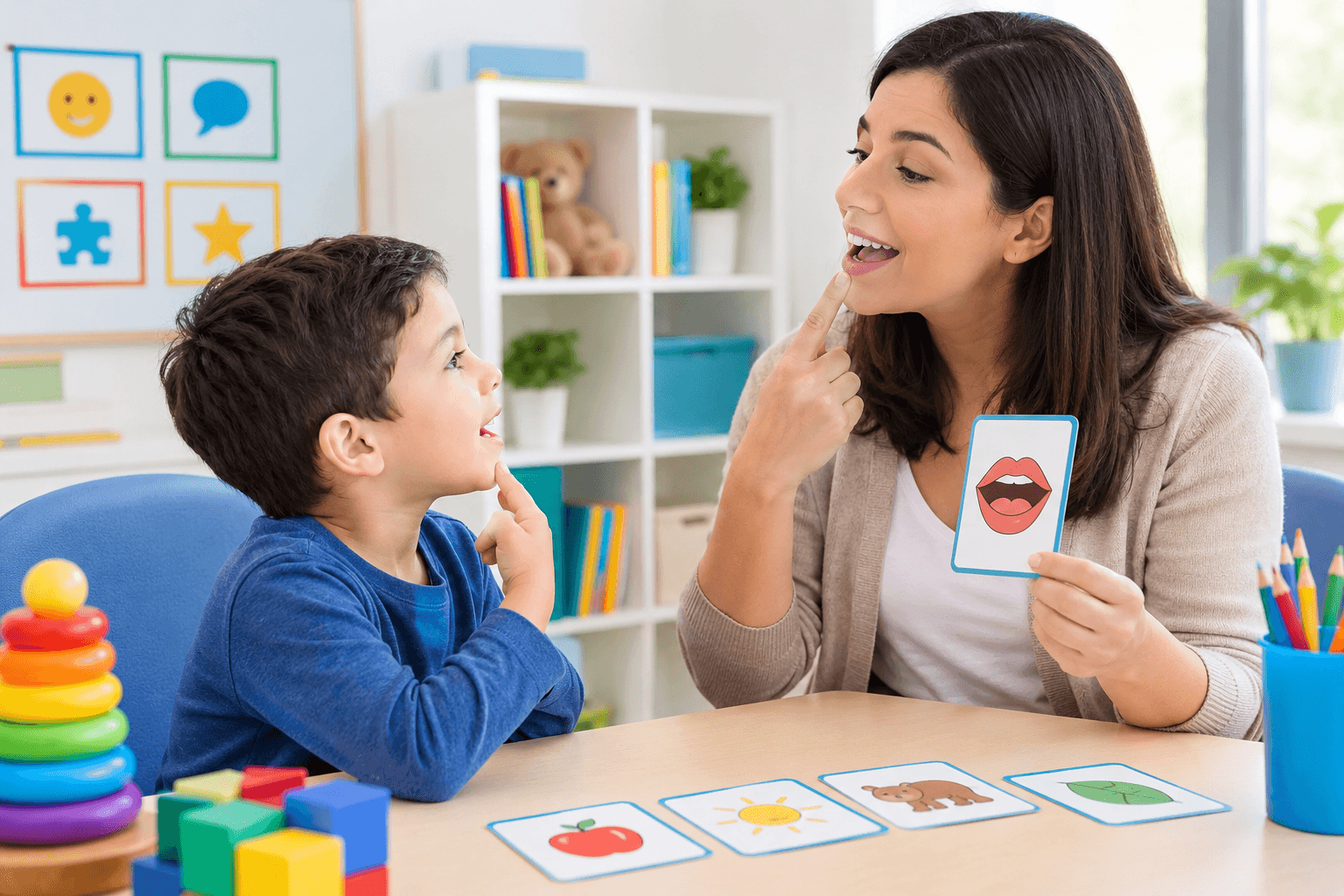
Speech therapy, on the other hand, is led by a speech-language pathologist who looks at the whole picture of communication: sounds, language, voice, social talk, and fluency. When people search for ABA therapy speech therapy, they're usually trying to figure out how the two fit together. The honest answer is that they overlap, but they aren't the same thing.
What an ABA Speech Therapist Does
Strictly speaking, there's no single license called "ABA speech therapist." The phrase usually describes a behavior analyst or behavior technician who focuses on communication goals, or an SLP who borrows ABA-style teaching. In sessions, they might work on requesting items, naming objects, following directions, or answering simple questions.
The ABA SLP Partnership
The strongest programs treat the ABA SLP relationship as a true team. The SLP evaluates and sets communication targets, and the ABA team practices those targets many times a week. That steady back and forth is what people usually mean by the ABA speech connection.
Does ABA Therapy Help With Speech?
For many children, yes. Studies on early, intensive ABA for autistic kids have reported gains in language and communication, though results vary from child to child. ABA is good at building the "I want to talk" side of speech, because it ties words to real rewards. It's less focused on how sounds are physically formed, which is where an SLP shines.
ABA for Speech Delay
ABA for speech delay is common when a delay comes alongside autism or other developmental differences. A late-talking toddler without those concerns may simply need a speech evaluation and some patient modeling at home. And if your little one talks plenty but repeats sounds or gets stuck on words, that's a different story altogether. Our article on 2 year old stuttering explains what's typical at that age and when to look closer.
Speech ABA Techniques in Everyday Sessions
Manding (requesting): The child learns that saying "ball," signing, or pointing to a picture gets them the ball. This is often the first target because it gives kids an immediate, practical reason to communicate, and it tends to ease frustration quickly.
Tacting (labeling): The therapist holds up objects or pictures and the child names them. It sounds simple, but it grows vocabulary and teaches the child that words describe the world, not just get them things.
Natural environment teaching: Instead of drilling at a table, practice happens during play, snack time, or a walk. New words show up in real moments, so they carry over to home and school more easily.
Prompt fading: The therapist starts with full help, like saying the word first, then slowly steps back until the child can do it alone. Done well, this keeps kids from leaning on cues forever.
ABA Therapy vs Speech Therapy: Key Differences
The easiest way to think about ABA therapy vs speech therapy is focus. ABA targets behavior, including communication behavior, through repetition and reinforcement, often for many hours a week. Speech therapy targets the mechanics and meaning of communication, usually in shorter, less frequent sessions. ABA teams are overseen by behavior analysts, while speech therapy is delivered by licensed SLPs with their own training.
Does ABA Therapy Include Speech Therapy?
Not automatically. Some centers keep SLPs on staff, while others coordinate with outside providers, so it's always worth asking. It also helps to know that neither approach was designed specifically for stuttering. Methods like the ones in our guide to fluency shaping techniques exist because fluency is its own area that deserves focused attention.
ABA Therapy With Speech Therapy: Why Teams Work Together
Pairing ABA therapy with speech therapy tends to give kids the best of both worlds. The SLP brings precision, the ABA team brings consistency, and parents get one shared plan instead of two competing ones.
Looking for ABA Speech Therapy Near Me? Questions Worth Asking
Who writes the communication goals? Ideally an SLP is involved, even if ABA staff deliver most of the practice. If no one on the team has speech training, ask how they decide what to work on.
How do you keep sessions positive? Good providers follow the child's interests and watch closely for stress. You want your kid excited to show up, not bracing for it.
How will you teach us to practice at home? Children learn fastest when parents use the same words and routines between sessions, so a provider who coaches you is a big plus.
What happens if my child also stutters? This one tells you a lot. A thoughtful provider will admit fluency isn't their specialty and point you toward stuttering-specific support.
Where ABA Speech Therapy Ends and Stuttering Support Begins
ABA speech therapy is great for building language, but stuttering isn't a shortage of words. A child who stutters usually knows exactly what they want to say. The words just get stuck on the way out, and rewarding "correct" speech can sometimes add pressure if the fluency issue itself isn't addressed. That's why proven stuttering therapy techniques target the problem directly.
Signs the Challenge Is Stuttering
Repeating sounds or syllables, like "b-b-b-ball"
Stretching sounds out or getting silently stuck
Blinking, tensing, or looking away while talking
Avoiding certain words or going quiet in groups
Stuttering can also show up later in life, as we cover in our piece on adult onset stuttering, so these signs matter at any age.
The Neuroscience Method: A Fluency Path Built by Ex-Stutterers
At StopStutter, we use the neuroscience method, developed by Lee Lovett and grounded in neuroplasticity, the brain's lifelong ability to rewire itself. Instead of just managing blocks, it helps people retrain the brain to hear and think in fluency, replacing the old stuttering habit with a new fluency habit. It rests on three daily pillars: speech tools, reading aloud, and mind training. The results speak plainly: more than 300 stopped stuttering stories, and 95% of our therapy clients showing measurable improvement on their OASES scores, the standard clinical assessment used by speech-language pathologists.
Frequently Asked Questions
Does ABA help with speech?
It can. ABA helps many children, especially autistic kids, build requesting, labeling, and conversation skills through repetition and positive reinforcement. Results tend to be strongest when an SLP helps set the goals.
Is an ABA therapist the same as a speech therapist?
No. ABA providers are trained in behavior analysis, while speech therapists are licensed speech-language pathologists. Many families use both, with each one covering a different part of communication.
Can ABA speech therapy treat stuttering?
ABA isn't designed for stuttering. Stuttering affects how speech flows, not how many words a child knows, so it responds best to fluency-focused work like the Neuroscience Method.
When should I get my child's speech checked?
If your toddler isn't using a handful of words by around 18 months, or stuttering lasts longer than six months or comes with visible tension, it's worth getting an evaluation. Trust your instincts as a parent.
Giving Every Child's Voice the Right Kind of Support
ABA speech therapy can open real doors for children who are still building language, and when it works hand in hand with an SLP, the progress can be wonderful to watch. But if stuttering is part of the picture, your child deserves help designed for exactly that, from people who have lived it. Book a free consultation with one of our Certified Stuttering Specialists, and let's figure out the next step together.
Ready to Put This Into Practice?
Download the app and start practicing today
Reading is the first step. Real progress comes from consistent daily practice. Use StopStutter to build confidence and improve your speech every day.


