


ReviewJuly 28, 2026
Can stuttering be caused by trauma
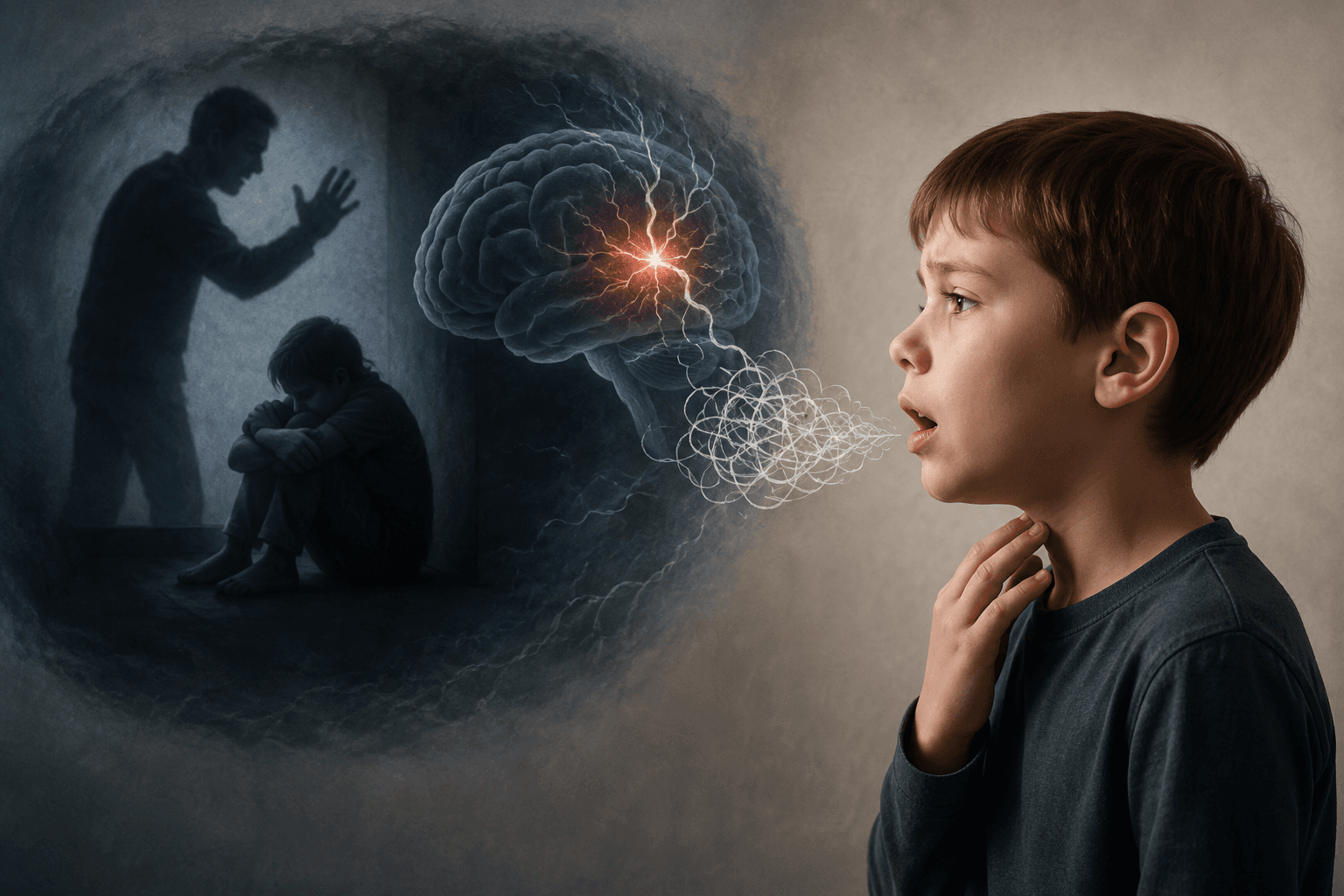
If you stutter, or your child does, it's natural to go looking for a reason. Something must have set it off, right? A frightening fall, a harsh moment at school, a rough stretch at home. So the question comes up again and again: can stuttering be caused by trauma?
Here's the honest answer. For most people, no. Most stuttering begins in early childhood and is rooted in how the brain times and coordinates speech, and it often runs in families. But there are real exceptions, and trauma can absolutely make a stutter louder. Let's walk through all of it.
If you're mainly here for solutions, our guide on How to stop stuttering is a good place to begin. It covers the practical side, while this article focuses on the "why."
And if you'd rather work with someone directly, online stuttering therapy lets you practice from home, at your own pace, with a trained guide beside you.
Can Trauma Cause Stuttering? The Short Answer
Usually not. Stuttering is typically neurodevelopmental, which means it comes from how a person's brain develops and how its speech networks work together. Genetics play a big part. That's why you'll often find a grandparent, an uncle or a cousin who stuttered too.
So, can trauma cause stuttering? In a small number of situations, yes. We'll cover those below. But a stressful event is rarely the root cause of the stutter itself. More often, it's the thing that makes an existing stutter harder to manage.
Quick version: trauma can be involved in stuttering in four ways.
A head injury or stroke can cause neurogenic stuttering.
A severe emotional shock can, rarely, cause psychogenic stuttering.
Ongoing stress and fear can make an existing stutter worse.
Years of difficult experiences caused by stuttering can leave their own emotional mark.
Can Childhood Trauma Cause Stuttering?
Parents often tell us the stutter started right after something upsetting. A move, a divorce, a scary fall, a new sibling. It makes complete sense to connect the two, and if that's you, please hear this first: you did not cause your child's stutter.
Researchers haven't found good evidence that childhood trauma, on its own, creates a stutter. What it can do is raise tension in a child's body and mind. For a child who already has a tendency to stutter, that extra tension can make speaking feel harder, and the stutter becomes more noticeable.
Is It Really Trauma, or Just Timing?
Childhood stuttering usually begins between ages 2 and 5. That's a period when kids are changing fast. Their vocabulary is exploding, their sentences are getting longer, and their brains are working hard to keep up.
It's also a time when big life events happen. So a hard event and the first stutter can land close together purely by chance. When people ask whether it can be caused by trauma, the timing often explains more than the event does.
None of this means a scary experience should be brushed aside. If your child has been through something frightening, support from a pediatrician or a child therapist is worth having, whether or not their speech changed.
Can Head Trauma Cause Stuttering?
Yes, and this is the clearest case. Stuttering that starts after a head injury, a stroke, or a neurological condition is called neurogenic stuttering. The injury disrupts the parts of the brain that coordinate speech, and the result can look a little different from childhood stuttering. Repetitions or blocks may show up on any word, not just the first sound, and often without the worry or tension people expect.
Neurogenic stuttering can also come with other changes, like trouble finding words, slurred speech or weakness on one side of the body. That's why timing matters here. If speech changes suddenly after a blow to the head, or alongside confusion, weakness or a drooping face, get medical care right away. Don't wait to see if it passes.
Once you've been medically cleared, a speech-language pathologist can help you work on speech. Many people improve with the right support, though the path depends on the injury and the person.
Can Trauma Cause a Stutter in Adults?
Rarely, and usually in a form called psychogenic stuttering. It tends to appear suddenly after an intense emotional shock, often in someone who has never stuttered before. It's uncommon, and it doesn't look the same for everyone.
Because several different causes can produce a sudden stutter in adulthood, the order of steps matters. A doctor should rule out neurological causes first. After that, a team approach often works best, with a mental health professional supporting the emotional side while speech therapy supports the speaking side.
If you're wondering whether trauma can cause a stutter in your own case, a proper evaluation is the only reliable way to know which type you're dealing with. Guessing, or Googling at 2 a.m., usually just adds worry.
Not sure where to start? You can book a free stuttering consultation and talk through your history with someone who understands. No pressure, no jargon, just a clear conversation about what you've noticed and what might help.
When Stuttering Itself Feels Traumatic
This is the part that rarely gets talked about. For many people, the trauma isn't what caused the stutter. The stutter is what caused the trauma.
Think about what it can be like to live with it. Being cut off mid-sentence. Being mimicked or laughed at. Planning your order at a restaurant three sentences ahead because certain words feel risky. Dreading a phone call for hours. Over years, those moments add up.
A 2026 qualitative study in the American Journal of Speech-Language Pathology looked at adults who stutter through the lens of complex trauma. Many participants described trauma-like symptoms that grew out of repeated, overwhelming experiences with stuttering. The researchers noted that the evidence base here is still limited, so this is an area where we're still learning. But the lived experience is real.
If that sounds familiar, you're not being dramatic or oversensitive. The emotional weight of stuttering is a legitimate thing to address, and it can be addressed alongside your speech.
So What Actually Causes Stuttering?
The strongest evidence points to a few things working together:
Genetics. Stuttering often runs in families.
Brain differences. People who stutter tend to show differences in how speech timing and coordination are handled across brain networks.
The demands of the moment. Speaking is one of the most complex things we do, and pressure, speed and emotion can tip the balance.
That third piece explains something many people notice. You might be completely fluent talking to your dog, then get stuck in a meeting. Nothing about your brain changed between those two moments. What changed was the pressure on it.
Emotions don't start the stutter, but they can turn the volume up. This is also why a stutter can feel unpredictable. A good day and a hard day can look completely different, even though the underlying wiring is the same.
How Stress and Fear Make a Stutter Louder
When you're anxious, your body tightens. Your breathing gets shallow, your jaw and throat tense up, and your attention floods with thoughts like "Don't stutter on this word." That tension and self-monitoring make smooth speech harder, which leads to more stuttering, which leads to more fear. It becomes a loop.
Trauma can feed that loop, especially if a past event left you feeling unsafe, watched or judged when you speak. This is why we say trauma can make stuttering worse even in cases where it didn't cause it. The good news is that loops can be interrupted. Calmer speaking patterns, less pressure and better support all weaken the cycle over time.
What Helps If Trauma Is Part of Your Story
You don't need to figure out the "why" before you start working on the "how." A few things tend to help:
Speech work that builds control and ease. Practice with a trained professional helps you speak with less struggle, whatever the original cause.
Counseling when emotions are heavy. If trauma is in the picture, a therapist can help you process it, and this can happen alongside speech therapy.
A safe place to practice. Many people find they speak more freely in a low-pressure setting where nobody is rushing them.
A medical check when speech changes suddenly. Always rule out injury or neurological causes first.
One caution. Be wary of anyone who promises that working through a past event alone will make a developmental stutter disappear. The evidence doesn't back that up, and it can leave people feeling like they failed when it doesn't work. Good support looks at the whole person, the speech and the feelings together.
The Bottom Line
So, can stuttering be caused by trauma? Mostly no, with a few important exceptions. Head injuries can cause neurogenic stuttering. A severe emotional shock can, rarely, trigger a sudden stutter in adults. Everyday stress and fear can make any stutter louder. And living with stuttering can itself leave emotional scars that deserve care.
What matters most is that you stop blaming yourself or anyone else. Whatever started it, a stutter can be worked with, and you don't have to do it alone.
If you want to understand what's really happening under the hood, our breakdown of neuroscience stuttering is a great next read.
Ready to Put This Into Practice?
Download the app and start practicing today
Reading is the first step. Real progress comes from consistent daily practice. Use StopStutter to build confidence and improve your speech every day.


