


ReviewSeptember 21, 2026
Delayed Auditory Feedback
You've probably typed "delayed auditory feedback" into a search bar at some point, maybe late at night, wondering if a small trick with your own voice could finally make speaking feel easier. It's a fair question. Delayed auditory feedback, or DAF, has been around for decades, and it does something surprising the first time you try it. Before we get into how it works, it helps to know that stuttering is not a confidence problem or a lack of practice. If you're looking for How to stop stuttering, the answer starts with understanding what's happening in the brain, not with willpower.
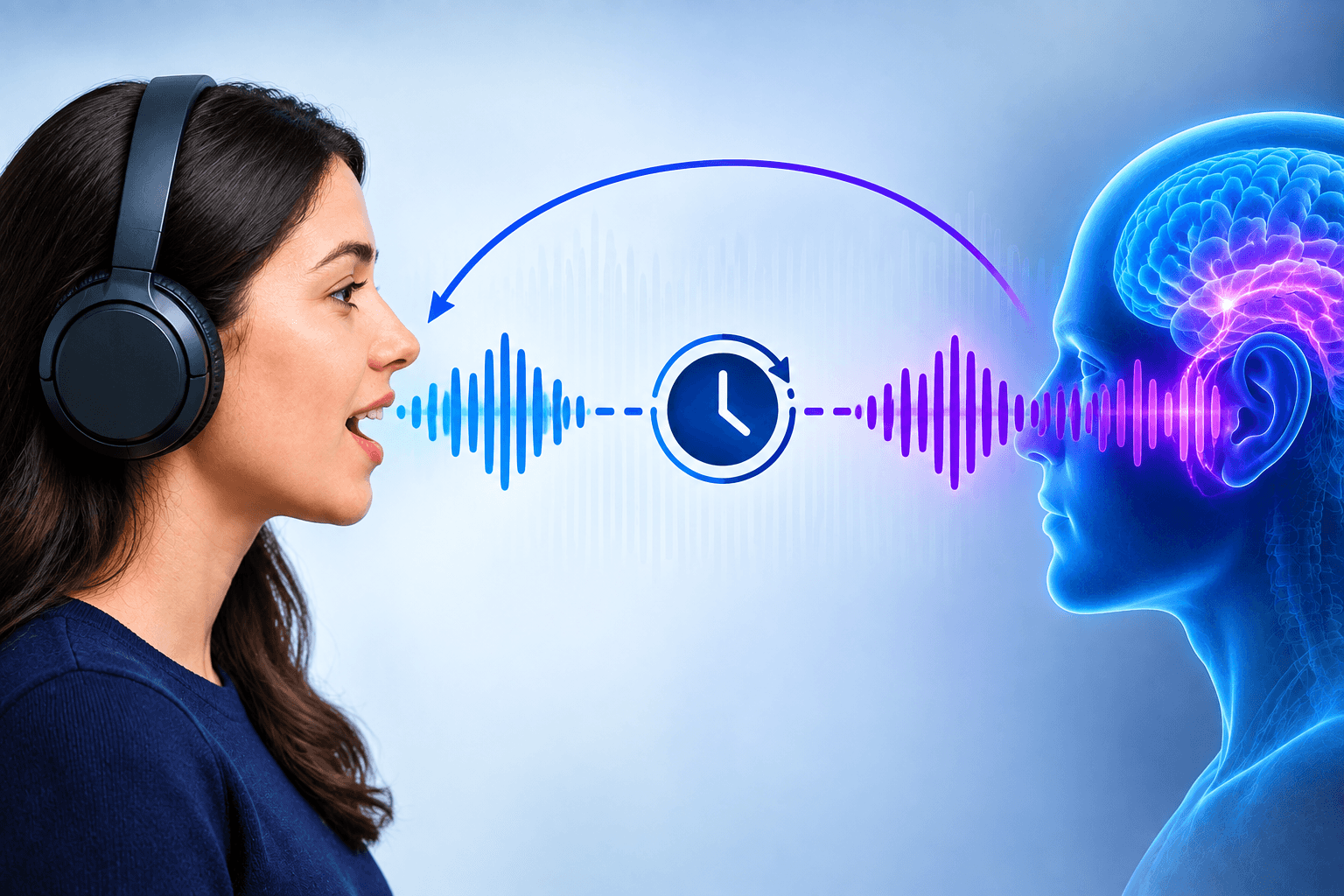
So what is delayed auditory feedback? You speak into a microphone, and your voice is played back to you through headphones a fraction of a second late, usually somewhere between 50 and 200 milliseconds. That tiny gap is enough to change how you speak. For many people who stutter, speech becomes slower, smoother and more deliberate almost immediately.
The odd part is where the discovery came from. In the 1950s, researchers found that when fluent speakers heard their own voices delayed, they started stumbling, repeating sounds and losing their rhythm. Later, people noticed the opposite effect in many people who stutter. The same delay that disrupted fluent speech seemed to steady disfluent speech. That contradiction is exactly why DAF is so interesting to neuroscientists, and why it shows up so often in online stuttering therapy conversations today.
How does delayed auditory feedback work in the brain?
Every time you speak, your brain runs a quiet loop. Motor areas plan the movement, send commands to your mouth, tongue and breath, and at the same time predict what the result should sound like. Then your auditory system listens to what actually came out and compares it with the prediction. If they match, speech flows. If they don't, the brain corrects.
Research on stuttering suggests this loop, the timing between speech planning, movement and hearing, may not sync up as smoothly in some people. Brain imaging studies have pointed to differences in how auditory regions and motor regions communicate, along with the basal ganglia circuits that help time and sequence movements.
Delayed auditory feedback interferes with that loop on purpose. When your own voice arrives late, your brain can't lean on its usual rapid-fire monitoring. Many speakers respond by slowing down and stretching their syllables a little, which gives the motor system more time to line up each movement. In other words, DAF doesn't "fix" the loop. It changes the conditions the loop runs under, and for many people that makes speech easier in the moment.
DAF and stuttering: what the research says (and doesn't)
This is the part that often gets glossed over online, so let's be honest about it. Delayed auditory feedback and stuttering have been studied for a long time, and results are genuinely mixed. Some people get a large, immediate drop in disfluency. Others get a modest change. Some notice almost nothing. A number of people also find the effect fades over time, because the brain adapts to the delay, and speaking with DAF can sound slow or a bit unnatural.
That doesn't make DAF useless. It makes it a tool with clear limits. It's best thought of as a support, something that can show you what easier speech feels like, rather than a permanent fix on its own.
DAF apps, devices, headphones and software: what to know
The search results for this topic are crowded, and it's easy to get lost. Here's a quick lay of the land:
Delayed auditory feedback apps and websites: Many phone apps and browser-based tools let you speak into your mic and hear yourself with an adjustable delay. Some are free, and plenty of people start with a free delayed auditory feedback app or an online free tool just to test the effect. Latency on phones and Bluetooth headphones can be inconsistent, so results may vary from what a proper setup gives you.
DAF devices and machines: Dedicated wearable devices exist, built to keep the delay stable and portable. They tend to cost more, and they're worth trying before buying.
Headphones and software: Wired headphones usually give you a more predictable delay than wireless ones. If you go looking for delayed auditory feedback software or a download, check that you can control the delay time precisely.
Whichever route you pick, treat it as an experiment. Try a few delay settings, pay attention to how your speech and your body feel, and note when it helps and when it doesn't.
Where DAF fits into speech therapy
In delayed auditory feedback speech therapy, DAF is rarely the whole plan. A good program uses it alongside work on breathing, pacing, tension and how you think about speaking, because stuttering isn't only about the sound of your voice. It also involves anticipation, tension and the habits your brain builds around difficult moments.
If you'd like a clearer picture of where a tool like DAF might sit in your own situation, you can talk it through with someone who works on this every day. You can book a free stuttering consultation and ask questions without any pressure to commit to anything.
Getting real, lasting change
The reason people keep searching for the next app or device is understandable: when speech feels hard, a quick fix sounds wonderful. But the brain changes through repeated, well-directed practice. The same auditory-motor loop that DAF temporarily nudges can be retrained, with the right approach, to work more smoothly on its own, without relying on a delay in your ears.
That's the idea behind a neuroscience-based approach: work with the way your brain plans, times and monitors speech, rather than trying to force fluency through sheer effort. DAF can be a helpful window into that process, showing you that your speech system can move differently. The goal is to build that ability so it holds up in real conversations, phone calls and presentations.
If you want to understand the science behind this in more depth, explore the neuroscience stuttering method and see how it approaches lasting change.
Ready to Put This Into Practice?
Download the app and start practicing today
Reading is the first step. Real progress comes from consistent daily practice. Use StopStutter to build confidence and improve your speech every day.


