


ReviewOctober 2, 2026
Different Forms of Stuttering
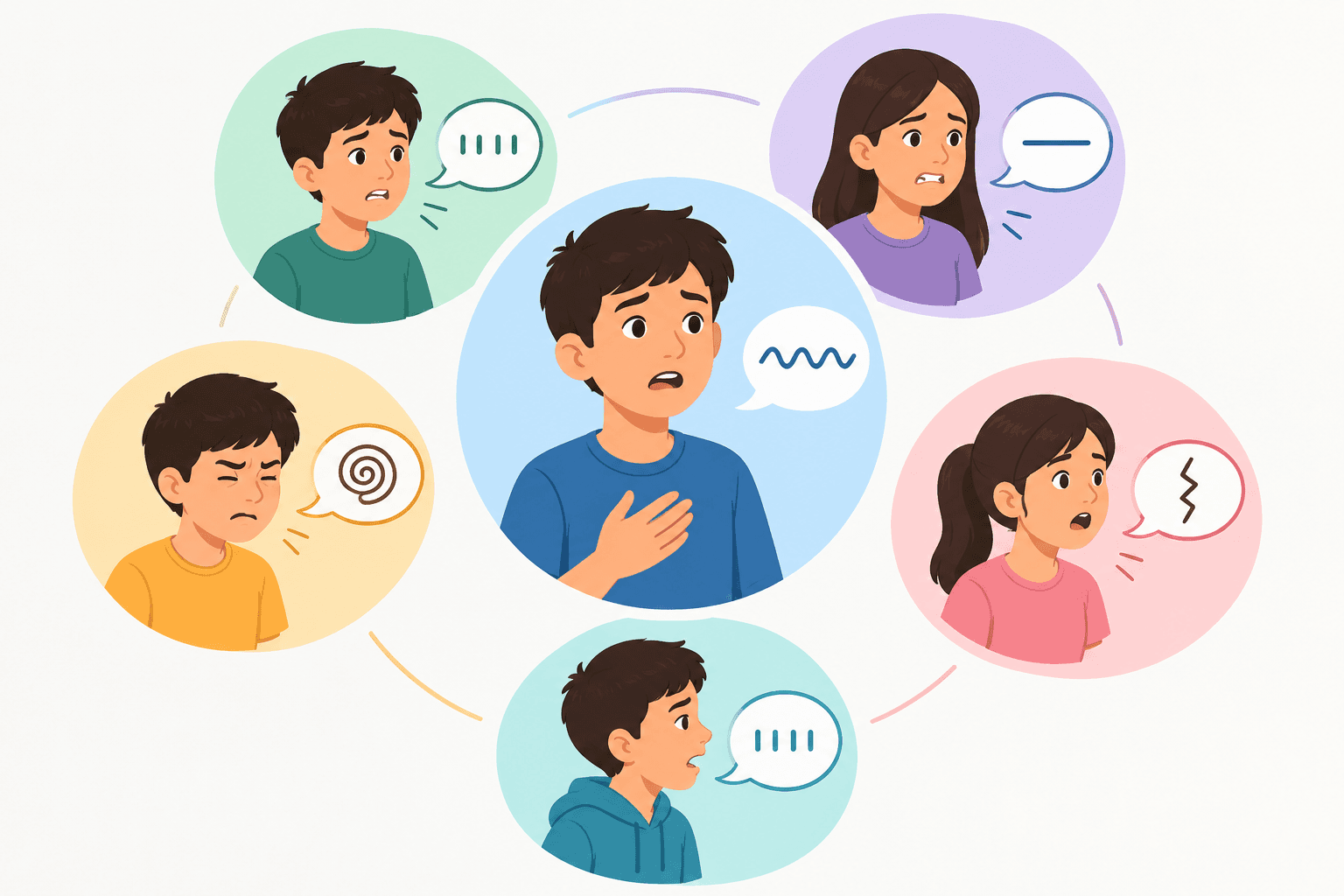
Stuttering isn't a single, uniform condition. It shows up differently from one person to the next, and the way it begins, develops, and responds to support can vary just as much. For millions of people around the world, speech disruptions are a daily reality that affects confidence, careers, and relationships. Yet many still don't realise that there are several different forms of stuttering, each with its own cause and character.
Understanding these differences matters more than most people think. The approach that helps one person may do very little for another, which is why personalised care sits at the heart of modern speech support. If you've been searching for guidance on how to stop stuttering, one of the most useful first steps is identifying which type of stuttering you or your loved one is actually dealing with. Without that clarity, progress can feel slow and frustrating.
In this blog, we'll walk through the main forms of stuttering, look at what causes each one, and explore why neuroscience-based methods are reshaping the way therapists and researchers understand speech. Whether you're exploring online stuttering therapy for the first time or looking to switch to a more targeted approach, this breakdown will help you make sense of a condition that's often misunderstood.
The good news is that stuttering, in any form, is far more treatable than people once assumed. New research into how the brain controls speech has opened up methods that didn't exist a generation ago, and those methods are showing results across a wide range of ages and severity levels.
What Exactly Is Stuttering?
At its most basic, stuttering is a disruption in the normal flow of speech. It can show up as repeated sounds (like "b-b-b-ball"), prolonged sounds ("ssssssun"), or complete blocks where no sound comes out at all for a few seconds. Many people also experience physical tension in the face, neck, or shoulders when they stutter, along with secondary behaviours like avoiding certain words or substituting easier ones.
While stuttering is often lumped together as one condition, researchers now recognise multiple forms, each with distinct origins. Some begin in early childhood. Others appear suddenly after an injury or emotional event. The common thread is a breakdown in the brain's ability to coordinate the complex muscle movements and timing that fluent speech requires.
The Main Different Forms of Stuttering
Let's look at the primary categories specialists use when assessing a person's speech patterns.
1. Developmental Stuttering
This is by far the most common form. It typically begins between the ages of two and six, during the period when children are rapidly expanding their vocabulary and sentence complexity. For many children, these early disruptions fade on their own within a year or two. For others, roughly one in four, the stuttering persists into adolescence and adulthood.
Developmental stuttering has a strong genetic link. Studies have found that children with a family history of stuttering are significantly more likely to develop it themselves. Brain imaging research has also shown differences in how speech-related neural networks are wired in people who stutter, which brings us closer to understanding why this form is so persistent for some.
2. Neurogenic Stuttering
Neurogenic stuttering is caused by damage or disruption to the brain or nervous system. It often appears after a stroke, head injury, Parkinson's disease, or other neurological conditions. Unlike developmental stuttering, which usually starts in childhood, neurogenic stuttering can appear at any age, often very suddenly.
The speech patterns here tend to look slightly different. People may stutter on any word or syllable without the typical pattern seen in developmental cases. There's also usually less anticipation or avoidance involved, because the condition is tied directly to how the brain is now processing speech signals rather than to learned emotional responses built up over years.
3. Psychogenic Stuttering
This is the rarest form. Psychogenic stuttering is linked to psychological trauma, severe stress, or significant emotional upheaval. It can begin suddenly in adults who have never previously stuttered. The speech disruptions often don't follow the typical developmental patterns and may improve dramatically with counselling or when the underlying emotional cause is addressed.
Because this form is uncommon, it's often misdiagnosed. A thorough evaluation by a specialist is essential to rule out other causes before concluding that stuttering is primarily psychological in origin.
4. Cluttering
Technically a separate fluency disorder, cluttering is often grouped alongside stuttering because the two conditions can overlap and sometimes occur together. People who clutter speak rapidly and may slur or merge sounds, making their speech difficult to follow. Unlike classic stuttering, cluttering doesn't usually involve blocks or sound repetitions. Instead, the issue is rhythm, pace, and clarity.
5. Situational and Mixed Variations
Many people who stutter don't fit neatly into one box. Some stutter only in high-pressure settings like job interviews or phone calls. Others combine features of multiple forms, especially when developmental stuttering has been shaped by years of emotional response, avoidance, and compensation. For these individuals, understanding which elements are driving the stuttering at any given moment becomes a key part of effective treatment.
Why the Neuroscience Angle Changes Everything
For decades, stuttering was treated mainly as a behavioural issue, something to be managed through breathing techniques, slow speech, or willpower. These methods helped some people cope, but they rarely addressed the root cause.
Modern research has shifted the conversation entirely. We now know that stuttering is deeply connected to how the brain processes language, motor planning, and timing. Brain scans show measurable differences in the regions responsible for coordinating speech. This is where the neuroscience stuttering approach comes in.
Instead of treating the surface symptoms, neuroscience-based methods work with the brain's natural ability to rewire itself, a process known as neuroplasticity. The goal is to retrain the neural pathways involved in speech production so that fluent speech becomes the brain's default pattern rather than something to constantly fight for. This approach doesn't ignore the emotional and behavioural side of stuttering. It simply builds those elements on top of a stronger neurological foundation.
What makes this method especially promising is that it works across the different forms of stuttering we described earlier. Whether someone has developmental stuttering that started in childhood or neurogenic stuttering following a brain injury, targeting the underlying neural systems can produce real, lasting change. The brain is remarkably adaptive at every age, and that adaptability is what makes long-term fluency possible.
How to Know Which Form You're Dealing With
If you're reading this and wondering which form applies to you or your child, the honest answer is that only a trained specialist can give you a reliable diagnosis. That said, a few observations can point you in the right direction.
Think about when the stuttering started. Was it in early childhood, after a specific event, or following an illness or injury? Consider whether anyone else in the family has similar speech patterns. Pay attention to whether the stuttering feels tied to specific situations, people, or emotions, or whether it's present fairly consistently across contexts.
These notes won't give you a definitive answer, but they're incredibly useful when you talk to a specialist. The more detail you can share, the faster a therapist can build a plan that actually fits your situation.
Why a Tailored Approach Matters
Generic programmes that treat every person who stutters the same way often disappoint, and understandably so. Someone whose stuttering stems from a stroke needs a very different plan from a nine-year-old whose speech began breaking up during preschool. A university student dealing with sudden onset stuttering after a traumatic event has yet another set of needs.
Recognising the different forms of stuttering is the first step toward matching the right method with the right person. From there, consistent practice, the right support team, and a willingness to work with the brain rather than against it make all the difference.
The Path Forward
Living with any form of stuttering can be exhausting, especially when the world around you doesn't fully understand it. The good news is that research continues to advance, and today's best programmes are more effective, more personalised, and more accessible than ever before.
If you're ready to take the next step, consider booking a free stuttering consultation with a qualified specialist. A proper assessment is the fastest way to understand your specific form of stuttering and identify an approach that will work for you. It costs nothing to start the conversation, and the insights you gain can genuinely change the trajectory of your speech journey.
Stuttering doesn't have to define your voice. With the right understanding and the right support, lasting fluency is well within reach, no matter which form you're facing.
Ready to Put This Into Practice?
Download the app and start practicing today
Reading is the first step. Real progress comes from consistent daily practice. Use StopStutter to build confidence and improve your speech every day.


