


ReviewNovember 2, 2026
Does Cocomelon Cause Speech Delay? What Neuroscience Actually Says
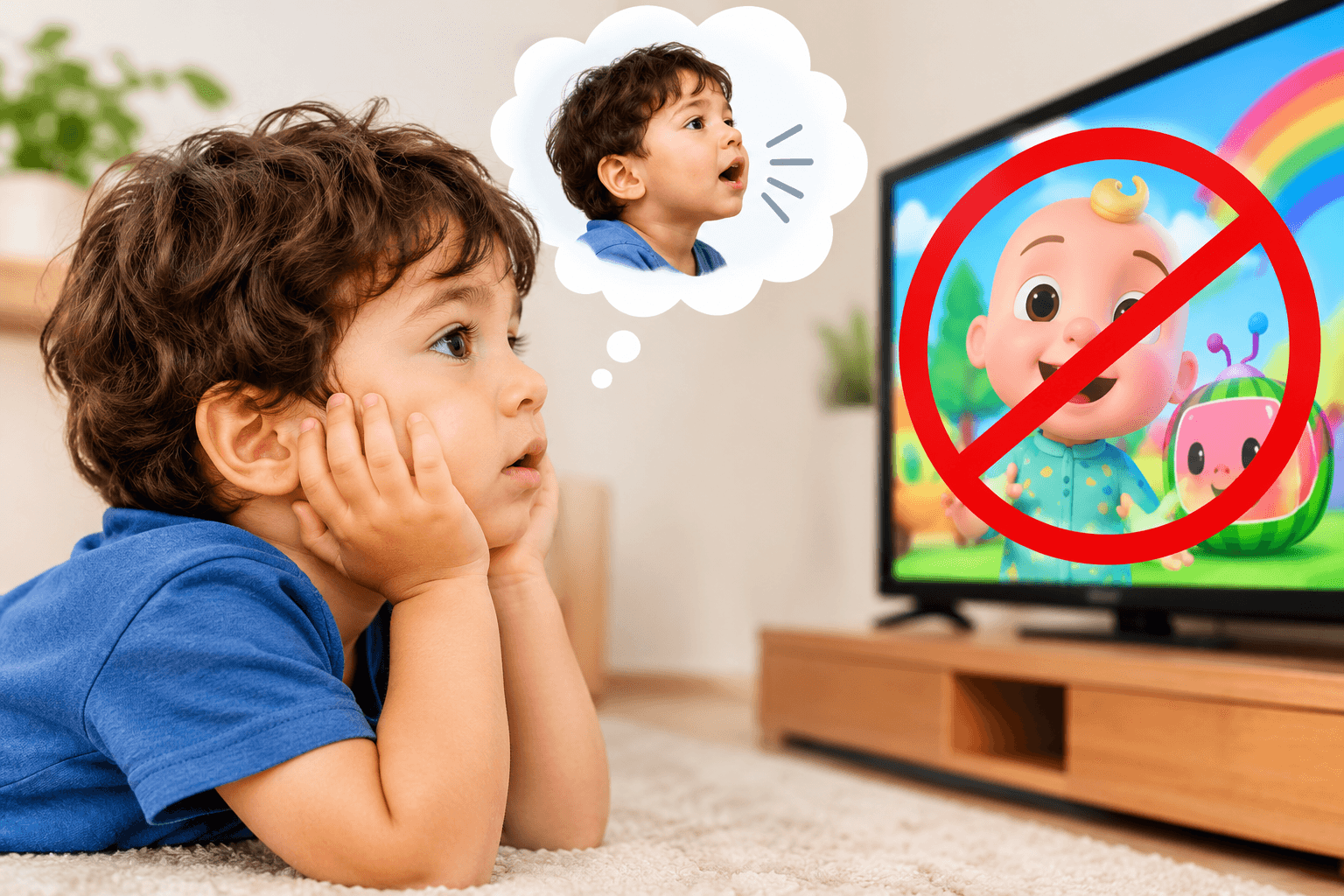
It’s 6 p.m., dinner isn’t ready, and your toddler is happily glued to a bright screen, singing along to a yellow school bus. Then a small voice in your head asks the question millions of parents type into Google: does Cocomelon cause speech delay?
Here’s the honest answer up front. No study has shown that Cocomelon, on its own, causes a speech delay. But that doesn’t make it harmless either. The real story is about what’s happening inside your child’s brain while the video plays, and what the video is quietly pushing out of the day.
At StopStutter, we help people overcome stuttering by working with the brain instead of fighting it. So we look at every speech question through a neuroscience lens, and we’ll do the same here. No guilt, no scare tactics, just what’s known and what you can do with it.
Why does Cocomelon get blamed for speech delay so often? Mostly because of a pattern parents notice. A child who watches a lot of screen time talks less, and the show is the easiest thing to point at. That’s correlation, not proof. Researchers have found links between heavy early screen use and later language difficulties, but the show itself usually isn’t the cause. What matters is what the show replaces. And if your worry is about stuttering rather than delay, our online stuttering therapy is built around exactly that brain-first approach.
What does research say about screens and speech delay?
Most of the useful evidence isn’t about Cocomelon specifically. It’s about early screen time in general.
Large studies that followed young children over time have found that more screen time at ages one and two is associated with weaker communication skills a few years later. The key word is associated. These studies can’t prove the screen did it. Families with a lot of screen time may also be talking, reading and playing less together, and that’s a strong suspect.
The American Academy of Pediatrics suggests avoiding screens for children under 18 months, apart from video chatting with family. For toddlers 18 to 24 months, it recommends high-quality programming watched together with a parent. For ages two to five, it suggests about an hour a day. Cocomelon isn’t banned anywhere in those guidelines. The point is how much, and with whom.
Why does Cocomelon cause speech delay worries? The format problem
Cocomelon is built to hold attention. Scene changes come every few seconds, the colors are saturated, and the songs are catchy and repetitive. Toddlers love it, which is exactly why it works as a babysitter and exactly why parents worry.
There’s some research behind the unease. In one well-known experiment, four-year-olds who watched nine minutes of a very fast-paced cartoon did worse on attention and self-control tasks than kids who drew or watched a slower show. It wasn’t Cocomelon, and the effect was short-term. Still, it suggests rapid-fire visuals can leave a young brain a bit scattered right afterward.
The bigger issue is that the show talks at your child. It never pauses to wait for a reply. It never notices a half-formed word, and it never responds to what your toddler actually pointed at. Language doesn’t grow in a one-way stream. It grows in back-and-forth.
What happens in a toddler’s brain while they watch
This is where neuroscience gets interesting.
A young child’s brain is wiring itself for language at a staggering pace. The auditory areas learn to tune into the sounds of their home language. The networks that link hearing to speech movement, including the regions around Broca’s area and the motor system, strengthen through practice. And the timing circuits that coordinate all this, the same ones that matter so much in stuttering, are still being built.
What switches these systems on isn’t just sound. It’s social sound.
One classic study played Mandarin to nine-month-old American babies. Babies who heard a live person speaking learned to distinguish the new sounds. Babies who got the exact same content through a video didn’t. Same words, same sounds, no learning. The brain seems to treat a responsive human face as a signal that says “pay attention, this matters.”
Developmental researchers call the everyday version of this “serve and return.” Your child babbles, points or says a word, and you answer. That volley builds the neural connections for language. Passive viewing gives the brain plenty of input and almost no volley.
So when parents ask why Cocomelon causes speech delay, the more accurate version is this: heavy passive screen time can crowd out the serve and return the brain depends on. The show isn’t toxic. The missing conversation is the problem.
Not sure whether your child’s speech is on track or you’re just a tired parent catching every little thing? You don’t have to guess. You can book a free stuttering consultation and talk it through with someone who looks at speech from the brain’s point of view.
Does watching Cocomelon cause speech delay? It depends on three things
If you want a clearer answer to whether watching Cocomelon causes speech delay, it comes down to three questions.
How much? An episode while you cook dinner is very different from three hours a day. Dose matters more than the show’s name.
Who’s there? A parent sitting beside the child, pointing at the bus, asking “Where’s the doggy?” and singing along turns passive viewing into interaction. A child alone with a tablet gets the pure one-way stream.
What’s being replaced? If screen time takes the place of meals together, bedtime books, playground chatter and messy play, that’s where the cost shows up. If it’s added on top of a talkative, language-rich day, the risk looks much smaller.
Then there’s the child. Some toddlers are simply late talkers who catch up on their own. Others have an underlying language or hearing issue that was there before any screen time began. For those kids, Cocomelon didn’t cause anything. It just happened to be on in the background while the parents started noticing.
Signs it might be more than screen time
Screens can be a convenient scapegoat, so it helps to know the real red flags. Talk to your pediatrician or a speech-language pathologist if your child:
isn’t babbling or using gestures by around 12 months
has very few words by 18 months
isn’t putting two words together by around 24 months
doesn’t seem to respond to their name or to sounds
has lost words or skills they used to have
seems frustrated or stuck when trying to say something, or repeats sounds and gets visibly tense
Also ask for a hearing check. Mild hearing loss from repeated ear infections is a common and very fixable reason for delayed speech, and it gets missed all the time.
Early evaluation is nearly always worth it. Brain plasticity is highest in the toddler years, which means support given early tends to go further than support given late.
How to keep Cocomelon without hurting speech
You don’t have to throw out the TV. A few small habits shift the brain’s experience from passive to active:
Watch together when you can. Narrate what you see. “Look, the baby is clapping! Can you clap?”
Pause and wait. When a song comes on, stop it and let your child fill in the next word. That silent beat is where the brain does its work.
Repeat and expand. If your child says “bus,” you say “Yes, a big yellow bus!”
Turn off background TV. Even when no one’s watching, constant noise cuts down on the words adults and children say to each other.
Protect meals and bedtime. These are your best natural talking windows, so keep them screen-free.
Take the songs offline. Singing the same nursery rhymes yourself, slowly and with your face visible, gives your child something the screen can’t: timing, eye contact and a reply.
Read daily. Books invite questions, pointing and pauses. Few things build language faster.
None of this needs to be perfect. A few more conversations a day makes a measurable difference.
Where stuttering fits into the picture
Parents sometimes wonder whether screens or fast cartoons can cause stuttering too. There’s no good evidence for that. Stuttering is rooted in how the brain’s speech timing and motor networks coordinate, and genetics play a big role. It isn’t caused by parenting or by what a child watches.
That’s actually a relief for many families. It also explains why the most effective approaches don’t just tell a child to slow down or try harder. They work on the brain’s wiring for fluent speech. If you want to understand how, this explanation of neuroscience stuttering is a good place to start.
The bottom line
So, does Cocomelon cause speech delay? Not directly, and not by itself. But heavy, unsupervised screen time can replace the conversation, play and responsive interaction a young brain needs to build language. Cut the time, add the talking, and watch together when you can.
If you’re still worried, trust that instinct. Get your child’s hearing and speech checked, and don’t wait for them to “grow out of it.” Early support is almost always kinder than late regret.
Ready to Put This Into Practice?
Download the app and start practicing today
Reading is the first step. Real progress comes from consistent daily practice. Use StopStutter to build confidence and improve your speech every day.


