


ReviewSeptember 21, 2026
Frequency Altered Feedback: What Happens in Your Brain When You Hear Your Own Voice Differently
If you stutter, you've probably tried a few tricks. Slowing down, taking a breath, swapping a hard word for an easier one. And maybe, somewhere in your search for answers, you came across frequency altered feedback and wondered whether a device that changes how you hear your own voice could really make a difference.
It's a fair question, and the honest answer is: sometimes, yes, and the reason why is far more interesting than the gadget itself. Frequency altered feedback (often shortened to FAF) is a peek into how your brain builds speech in the first place. And if you're still figuring out how to stop stuttering, understanding that process is a great place to begin.
So, what is frequency altered feedback?
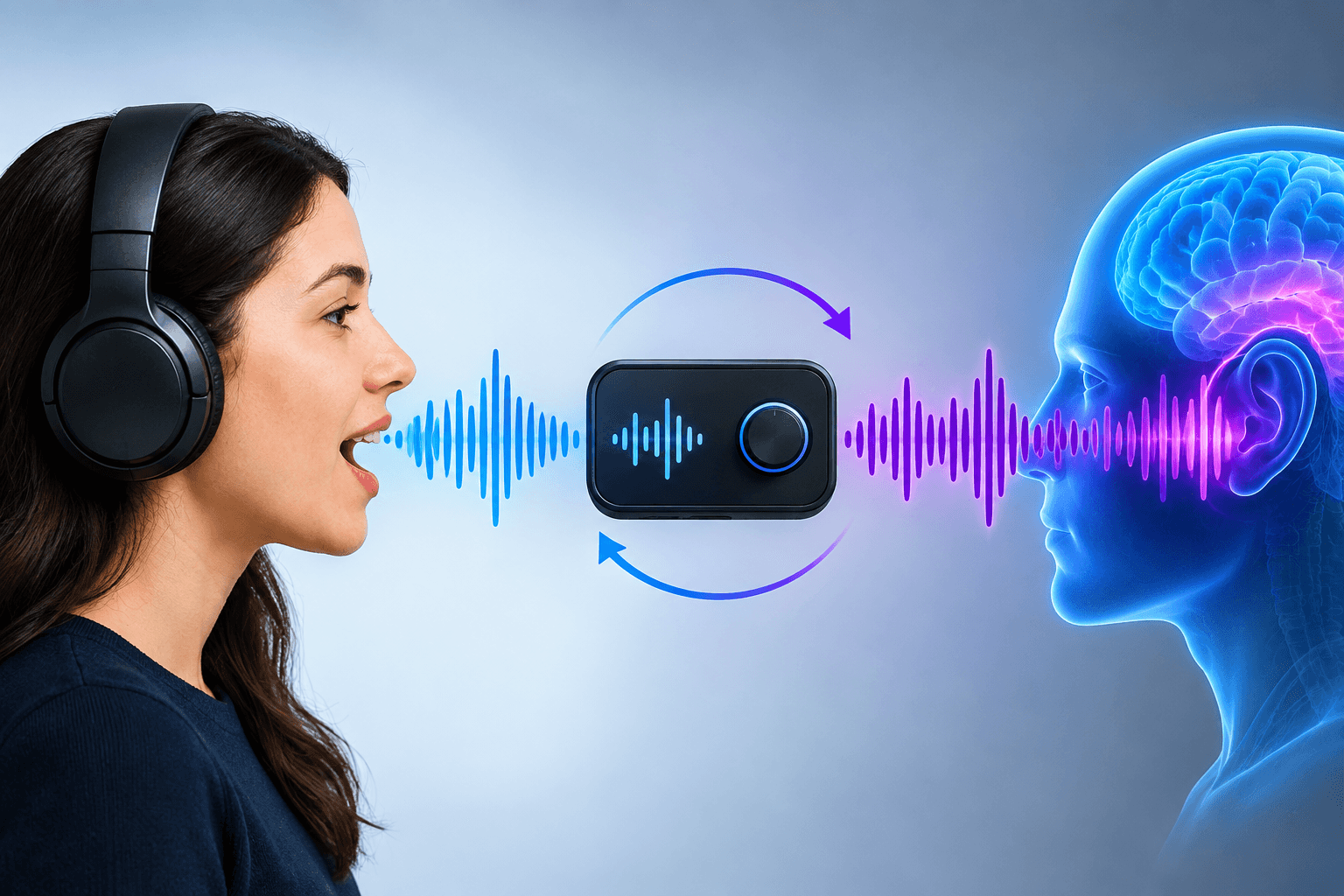
Every time you speak, you hear yourself. It feels instant and automatic, but your brain is quietly using that sound as a live check on what your mouth just did. With frequency altered feedback, the pitch of your voice is shifted slightly, usually up or down, and played back to you through headphones in real time. Your own voice, just a little "off."
Many people who stutter notice that their speech gets smoother almost immediately when they hear this altered version of themselves. Some describe it as talking along with someone else, which is not far from the truth, as we'll get to in a moment.
Why would changing your voice change your fluency?
This is where the neuroscience gets good. Speaking isn't just a mouth thing. It's a conversation between several brain regions: the areas that plan speech, the areas that time and sequence movements, and the auditory areas that listen to the result. In many people who stutter, that back-and-forth doesn't run as smoothly as it does in fluent speakers. The timing between "plan," "move," and "listen" can get out of sync.
Frequency altered feedback seems to work by giving the auditory side of that loop something different to react to. Instead of monitoring your usual voice, your brain gets a new signal, and the loop can settle into a steadier rhythm. It's closely related to something called the choral speech effect, the well-known fact that many people who stutter speak far more fluently when they talk in unison with another person. Hearing a "second voice" that isn't quite yours appears to help the system lock into a more stable pattern.
Researchers are still working out the exact mechanisms, and results vary from person to person. Some people notice a big change, some a modest one, and some none at all. That variability is worth remembering.
Where frequency altered feedback falls short
Here's the part that most product pages skip. For a lot of people, the effect of altered feedback is strongest in a quiet room, in a lab, or in the first few days of use. Out in real life, with noise, stress, phone calls and presentations, the benefit can fade. The brain is very good at adapting, and it can get used to the altered signal and stop responding to it the way it did at first.
That doesn't make FAF useless. It makes it a tool, not a treatment plan. A device can change what you hear, but it can't teach your brain new speech habits, and it can't touch the fear and tension that build up around difficult words. Lasting change usually comes from training the brain and body to speak differently, with someone guiding you. That's exactly what online stuttering therapy is built to do, and doing it from home means you practise in the situations where you actually speak.
A practical way to think about it
If you're curious about frequency altered feedback, treat it as an experiment rather than a promise:
Try it and pay attention. Notice when your speech feels easier and when it doesn't. That information is valuable.
Test it in real conditions. Try it on a call, at a table with background noise, and when you're a bit nervous, not just alone at your desk.
Watch for the fade. If the effect shrinks over a couple of weeks, that's normal, and it's a sign you'll need more than the device.
Don't blame yourself. If it doesn't work for you, that says something about how your brain handles speech feedback. It says nothing about your effort or your potential.
The bigger picture: training the brain, not just the ear
The most useful thing frequency altered feedback teaches us is that stuttering is not a character flaw or a nervous habit. It's tied to how the brain coordinates speech, and that coordination can be trained. Neuroplasticity, the brain's ability to rewire through repetition and practice, is the reason structured therapy can produce changes that a device alone rarely holds on to.
If you'd like to talk through what a personalised approach could look like for you, you can book a free stuttering consultation. There's no pressure and no commitment. It's just a conversation about where you are, what you've tried, and what might actually move the needle.
Final thoughts
Frequency altered feedback is a fascinating window into the way your brain hears, plans and produces speech. It can give some people a taste of easier, smoother talking, and that taste alone can be encouraging. But real, lasting fluency comes from working with the brain rather than around it.
If you want to understand the science behind that, the neuroscience stuttering approach explains how retraining the speech networks in your brain can help you speak with more ease, confidence and control, in the moments that matter most to you.
Ready to Put This Into Practice?
Download the app and start practicing today
Reading is the first step. Real progress comes from consistent daily practice. Use StopStutter to build confidence and improve your speech every day.


