ReviewOctober 9, 2026
Gestalt Language Processing
If your child repeats whole phrases from a cartoon, or you’ve noticed yourself speaking in ready-made chunks, you may have come across the term gestalt language processing. It’s one of the most searched topics in speech therapy right now, and also one of the most misunderstood. Some people use it as a diagnosis. Others dismiss it as a trend. The truth sits somewhere in the middle, and the brain science behind it is more interesting than either camp admits.
Here is a plain-language walkthrough of what it is, how the stages work, where autism fits in, and what current research does and doesn’t support.
What Is Gestalt Language Processing?
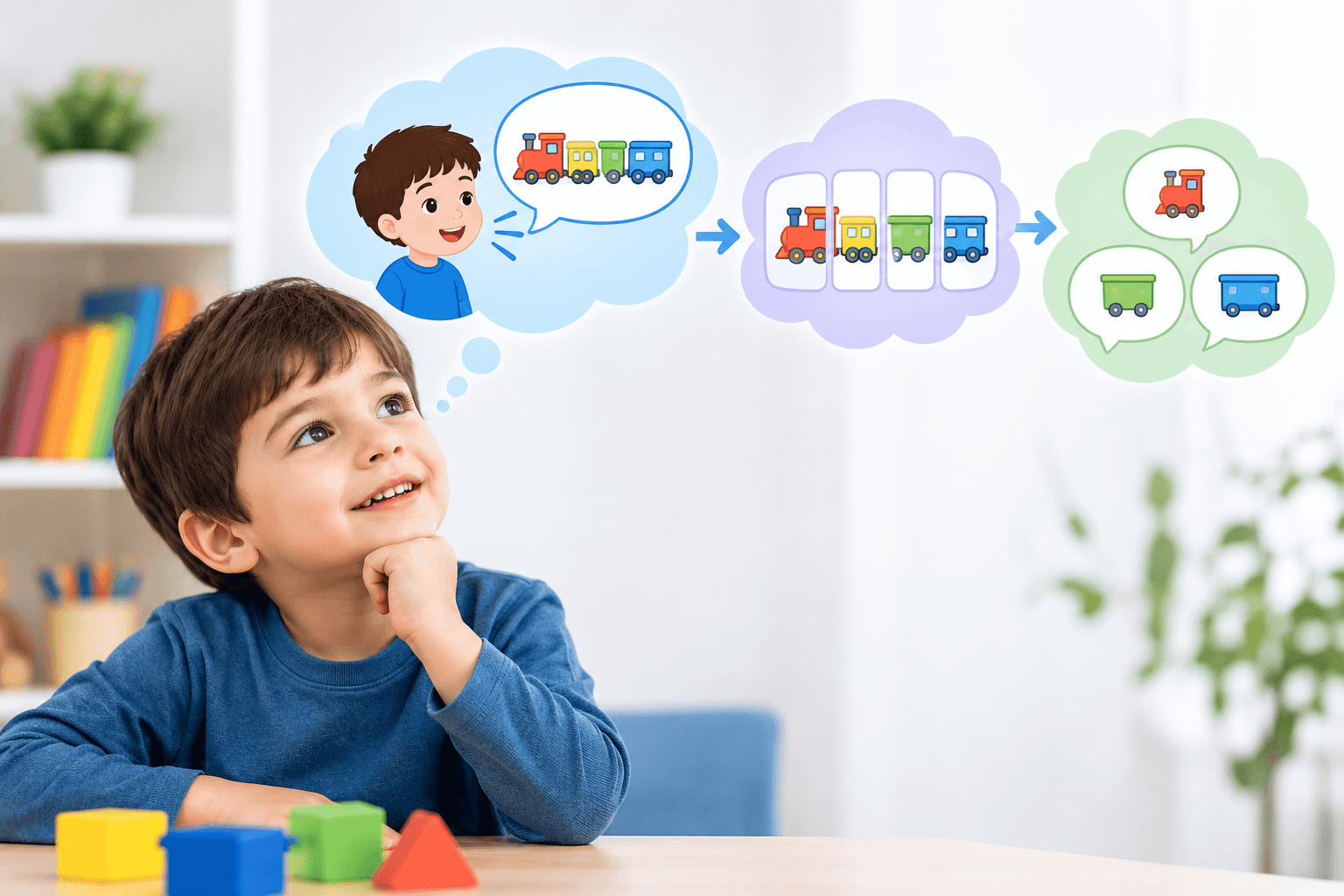
If you’re asking “what is gestalt language processing?”, the short answer is this: it is a way of learning language in which a person starts with whole chunks of speech, called “gestalts,” instead of single words. A gestalt might be a line from a movie, a song lyric, or something a parent says every day, like “Time to get your shoes on!” The child says it as one unit, with the same melody and rhythm.
The other route is analytic language processing, which is the one most of us were taught to expect. A child says “ball,” then “big ball,” then “I want the big ball.” Words come first and grammar is built up piece by piece.
The idea was developed by speech-language pathologist Marge Blanc, who called her framework Natural Language Acquisition. The core belief is that gestalt processors learn language by breaking those chunks down into smaller parts over time, rather than by stacking words together.
Both routes are normal. Neither is better. They are simply different ways of getting to the same place.
Many people who struggle with fluency also have a complicated relationship with how their brain packages speech, and that’s part of why this topic matters on a stuttering website. If you want the bigger picture of how speech and the brain connect, you can start with our guide on how to stop stuttering and see where your own patterns fit.
Why Echolalia Looks Different Through This Lens
Echolalia means repeating what you’ve heard. For a long time it was treated as meaningless parroting, and families were often told to discourage it.
The gestalt framework flips that. When a child says “Do you want some juice?” as a way of asking for juice, that echoed phrase carries real meaning for them. It’s their way of communicating with the language they have access to. This is called delayed echolalia, and it’s often the most visible sign of gestalt language processing.
That doesn’t mean every echolalic child is a gestalt processor, and it doesn’t mean every echolalic phrase is functional. A good clinician looks at context, intent, and development over time, not just the repetition itself.
Signs of Gestalt Language Processing
Parents often describe a pattern like this:
Long, fluent phrases with natural intonation, but very few single words
Scripts from shows, videos, or songs used in new situations
A phrase that sounds odd out of context but makes sense once you know its origin
Pronouns that seem “mixed up,” such as a child saying “Do you want a snack?” when they mean “I want a snack”
Strong rhythm and melody in speech, with clear “tunes” behind the words
Some children show only a few of these, and some show all of them. A formal evaluation with a speech-language pathologist is the only reliable way to know.
Gestalt Language Processing Stages
You’ll often see people searching for “gestalt language processing stages,” so here are the six stages as described in the Natural Language Acquisition model:
Stage 1: Gestalts. The child uses whole chunks, usually delayed echolalia. Words may not be separated yet.
Stage 2: Mix and match. The child starts combining parts of different gestalts. “Time to get your shoes” and “Let’s go to the park” might become “Time to go to the park.”
Stage 3: Single words and original combinations. Single words appear, and the child begins making their own two- and three-word phrases that were never heard before.
Stage 4: Early grammar. Simple sentence structures emerge, though forming new sentences may still be unpredictable.
Stage 5: Advanced grammar. More complex structures develop, such as questions, negatives, and different tenses.
Stage 6: Refined grammar. Sentences become flexible and varied, including more complex clauses.
A few things worth knowing: stages aren’t a race, children can move back and forth, and these descriptions are a clinical model rather than a medical test. If you search for “stage 2 gestalt language processing” or “stage 3 gestalt language processing,” most of what you’ll find describes exactly this idea, that language is being gradually “unpacked” from larger chunks.
Gestalt Language Processing and Autism
This is the question families ask most. Is gestalt language processing the same as autism?
No. Gestalt language processing is a style of language development, not a diagnosis. Many autistic children are gestalt language processors, and that overlap is real and well noticed in clinics. But plenty of gestalt language processors aren’t autistic, which is why “gestalt language processing not autism” is a search people make so often. Children with other developmental profiles, or no diagnosis at all, can also learn language this way.
The reverse is also true. Not every autistic child is a gestalt processor. So the safest way to say it is: the two can overlap, but one does not define the other.
Is Gestalt Language Processing Evidence Based?
Here’s where honesty matters, because “is gestalt language processing evidence based?” is a fair question, and the answer isn’t a clean yes.
What’s solid: echolalia is well documented, and many children do use memorized chunks as part of language development. The observation that some children begin with phrases rather than words has support in the broader language-acquisition literature.
What’s still limited: the specific staged model and the therapy approach built around it have a smaller research base. Professional bodies such as ASHA have pointed out that the evidence for the Natural Language Acquisition framework and its treatment protocol is still developing. In other words, it’s a reasonable clinical framework that many families and therapists find helpful, but it isn’t yet backed by large controlled trials.
So a balanced stance is to take the observations seriously, stay curious about the research, and be cautious about anyone selling it as a guaranteed cure or the only valid approach.
Gestalt Language Processing Treatment and Goals
If you’re searching for “gestalt language processing treatment,” “gestalt language processing goals,” or “gestalt language processing examples,” here’s what the approach generally looks like in practice:
Model gestalts first. Instead of drilling single words, adults offer natural, meaningful phrases the child can pick up, like “Let’s go!” or “I want that one.”
Follow the child’s stage. Therapy targets the next step, not where a child “should” be by age. In stage 1, the focus is on supplying useful gestalts. In stage 2, on modeling mix-and-match combinations.
Keep it natural and emotional. Real situations, shared attention, and warm intonation tend to matter more than flashcards.
Accept echolalia as communication. Responding to the meaning behind a phrase builds connection.
Support with AAC when it helps. Augmentative and alternative communication can work alongside gestalt-based approaches, offering phrases or words a child can use while spoken language grows.
Example goals might sound like: “The child will use a mixed gestalt in a new context with a familiar partner,” or “The child will produce two-word combinations drawn from known phrases.” Goals should always be individualized, and a goal bank is a starting point, not a script.
What Does the Brain Have to Do With It?
This is where a neuroscience lens gets interesting, and where it connects back to fluency.
Researchers who study “formulaic language,” meaning idioms, greetings, song lines, and other stored phrases, have found that these chunks are handled differently from freshly built sentences. Evidence points to a stronger involvement of right-hemisphere networks and deeper brain structures such as the basal ganglia, which help with timing, rhythm, and automatic sequences. Novel sentences, by contrast, lean more heavily on left-hemisphere language networks that assemble grammar word by word.
Put simply: a memorized phrase often runs on an “autopilot” circuit, while a brand-new sentence needs the brain to plan, select, and sequence in real time.
That distinction is useful for thinking about gestalt processors. A child who starts with chunks may be relying on the brain’s stored-phrase pathways first, then slowly building the flexible left-hemisphere machinery as the chunks get taken apart. It’s a hypothesis worth exploring rather than settled fact, but it fits what many clinicians see.
It also lines up with something stuttering researchers have talked about for years. People who stutter often speak far more fluently when singing, reciting something memorized, or talking in rhythm with another voice. Those situations lean on timing and automatic circuits rather than moment-to-moment planning. The basal ganglia and their connections have been a major focus in research on why timing breaks down in stuttering.
If you’re curious how that kind of brain-based thinking can be applied to speech, you can read about online stuttering therapy built around how the brain actually learns to plan and time speech, instead of just telling people to slow down or relax.
A Quick Note for Parents
If you’re reading this because you’re worried about your child, here’s the grounded version:
Don’t panic and don’t suppress echolalia. Repeated phrases are often a child’s bridge to language.
Get a proper evaluation. A speech-language pathologist can look at the whole picture, including understanding, play, social connection, hearing, and development.
Ask questions about the approach. Good clinicians will explain their reasoning, acknowledge what the research does and doesn’t show, and adapt to your child.
Stay connected. Fancy techniques matter less than responsive, warm interaction every day.
And if you’re an adult who recognizes yourself in this description, perhaps you grew up quoting lines, or you notice you speak best in phrases you’ve said a hundred times, that’s valid too. Adults can be gestalt language processors, and the topic is gaining attention among adults who’ve never had a name for their pattern.
Where Stuttering and Language Style Meet
Some people who process language in chunks also stutter. For them, fluency is not just about “fixing” the stutter. It’s about understanding how their brain stores, retrieves, and times speech. A person who flows through a rehearsed greeting but blocks on an unexpected question is showing exactly the planning-versus-automatic contrast described above.
Whether you’re a parent, an adult, or a clinician, one of the most useful steps is to talk with someone who understands both the language side and the brain side of speech. If you’d like to talk through your own situation, you can book a free stuttering consultation and get honest, practical guidance on where to start.
The Takeaway
Gestalt language processing is a real and common way of learning language. It’s marked by starting with chunks, passing through recognizable stages, and gradually breaking those chunks into flexible, original sentences. It overlaps with autism but isn’t the same thing, and the research behind the staged therapy model is still growing.
What we can say confidently is that language lives in the brain’s networks, and different people build those networks along different routes. Understanding that route, rather than forcing everyone down the same one, is what makes support effective.
If you’d like to go deeper into how brain science can shape speech and fluency work, explore the neuroscience stuttering method and see how a brain-first approach can help you or your child communicate with more confidence.
Ready to Put This Into Practice?
Download the app and start practicing today
Reading is the first step. Real progress comes from consistent daily practice. Use StopStutter to build confidence and improve your speech every day.