ReviewOctober 13, 2026
Hearing Test for Toddler Speech Delay
Your toddler is almost two. He points, he grunts, he drags you by the hand to the snack cupboard, but actual words? Maybe five or six, and half of them only you can decode. A relative tells you "Einstein didn't talk until he was four," you smile politely, and your stomach tightens anyway. If this sounds familiar, you're not alone, and there is one practical step worth taking before anything else: a hearing test for your toddler.
When it comes to a hearing test for toddler speech delay concerns, the logic is simple. Speech doesn't appear out of thin air. A child learns to talk by soaking up thousands of hours of spoken language, and if that sound arrives muffled, patchy or incomplete, the brain is learning from a blurry draft. Checking hearing first tells you whether the problem sits at the doorway (the ears) or in the processing room (the brain), and that changes everything about what happens next.
At Stop Stutter, we spend our days looking at how the brain and the voice work together. Whether someone is asking How to stop stuttering or a parent is wondering why their two-year-old isn't talking yet, the foundation is the same: sound goes in, the brain makes sense of it, and speech comes out. If any link in that chain is weak, the earlier we notice, the better.
That's also why our approach to online stuttering therapy always starts with listening: how a person hears, monitors and times their own voice. The same listening-first thinking applies to little ones who are slow to talk.
In this guide, we'll walk through why hearing matters so much for early speech, what a toddler hearing test actually involves, the sneaky ear problem many parents miss, and what to do if the results come back normal but the words still aren't coming.
Why Hearing Matters So Much for Early Speech
Here's the neuroscience in plain language. A baby is born with a brain that is hungry for patterns. The auditory cortex, the part of the brain that handles sound, builds detailed maps of the sounds it hears most often. By around the first birthday, babies have already started tuning in to the sounds of their home language and tuning out the ones they rarely hear.
This early period is called a sensitive window. The brain is unusually flexible, wiring and rewiring quickly based on what comes in through the senses. If the signal is clear, those sound maps become sharp. If hearing is reduced, even a little, the maps can end up fuzzy, and fuzzy maps make it harder to learn words, copy sounds and put sentences together.
There's a second piece that parents rarely hear about: the feedback loop. When your toddler babbles or says "ba," he hears himself, compares it with what he heard from you, and adjusts. That loop connects the auditory areas of the brain with the motor areas that move the lips, tongue and jaw. Weaken the hearing side and the whole loop struggles to calibrate.
Signs It's Time to Book a Toddler Hearing Test
Some children with hearing loss are spotted at birth through newborn screening, but screening isn't a lifetime guarantee. Hearing can change later because of infections, fluid, genetics or other causes. Consider a hearing test if your toddler:
Doesn't consistently turn toward your voice or respond to their name
Has fewer than about 50 words, or isn't starting to combine two words, around age two
Leaves off the ends of words or seems to miss soft consonant sounds like s, f and t
Needs the TV turned up louder than everyone else does
Has had repeated ear infections or colds that linger
Has a family history of childhood hearing loss
Seems to hear some days and not others
That last one trips parents up. "But he hears me when I whisper the word cookie!" Of course he does. Children with mild or partial hearing loss often react to loud, familiar or emotionally meaningful sounds while missing the quieter, high-pitched sounds that make up much of speech. Responding to some sounds doesn't prove hearing is typical.
What a Hearing Test for a Toddler Actually Looks Like
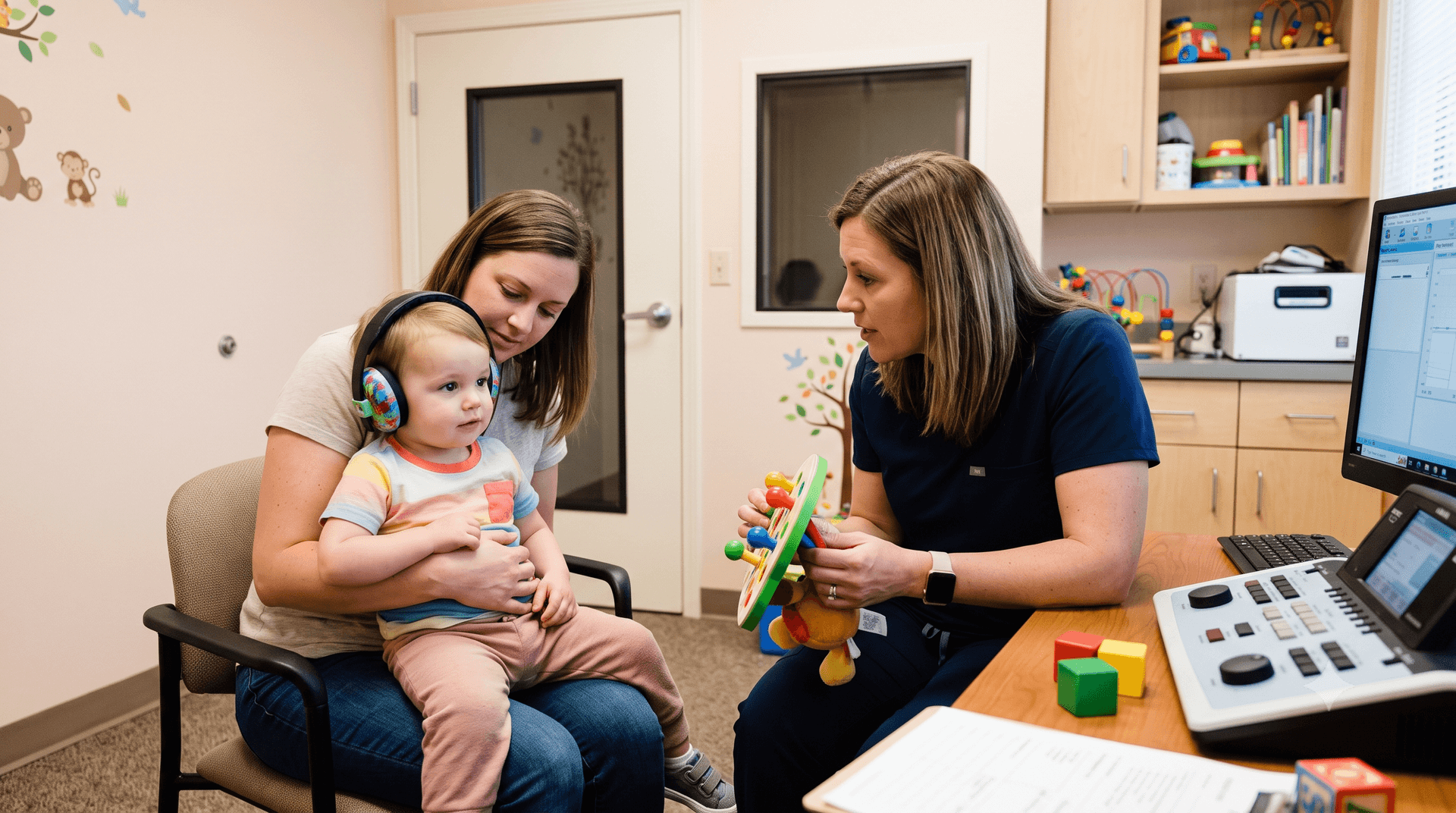
Many parents imagine a scary booth and a screaming child. In reality, a pediatric audiologist makes it feel like a game. Depending on your child's age and mood, the appointment may include:
Otoacoustic emissions (OAE): A tiny soft probe sits at the ear opening. It plays gentle sounds and records the echo the inner ear sends back. It takes minutes and doesn't hurt.
Tympanometry: This checks how well the eardrum moves, which helps show whether there's fluid behind it.
Visual reinforcement audiometry: Sounds come from speakers, and when your child turns toward a sound, a toy lights up or dances as a reward. This works well from roughly six months to two and a half years.
Conditioned play audiometry: Your child learns to drop a block in a bucket every time they hear a beep. It's popular with older toddlers and preschoolers.
Auditory brainstem response (ABR): Small sensors on the head measure how the hearing nerve and brainstem respond to sound, often while the child sleeps. It's used when play-based tests aren't possible.
You don't need to prepare your toddler with big speeches. Keep it light, bring a favorite snack and toy, and let the audiologist do the rest.
If you're unsure what you're seeing in your child's speech, whether it looks like a delay, early stuttering or something else, you can book a free stuttering consultation and talk it through with our team. It's a calm, no-pressure place to ask questions while you sort out next steps.
The Sneaky Culprit: Fluid Behind the Eardrum
One of the most common reasons for temporary hearing loss in young children is fluid sitting behind the eardrum, often after a cold or ear infection. The tricky part is that it can be painless. No fever, no tugging at the ear, no crying. Your child just seems a little "off," distracted or stubborn about listening.
What's happening is that sound gets dulled, a bit like listening to a conversation with your fingers in your ears or while underwater. Fluid can come and go over weeks or months. During a period when your toddler's brain is building its sound maps, those muffled stretches can matter.
The good news is that this is something an audiologist and pediatrician can find and monitor. If fluid hangs around, they may suggest follow-up, a visit to an ear, nose and throat specialist, or other treatment. The point is to catch it rather than guess.
What If the Hearing Test Is Normal but Speech Is Still Delayed?
First, take a breath. A normal result is genuinely helpful because it narrows the search. Your toddler's ears are getting the message through, so now we look at what the brain does with it.
Hearing a sound and turning it into speech are two different jobs. Speaking needs the brain to plan a sequence of tiny movements and fire them in exact order and with exact timing. That takes teamwork between auditory regions, motor planning areas, and timing networks that include the basal ganglia and cerebellum. When that teamwork is slower to develop, children may talk late even though their hearing is fine.
Common explanations an evaluation might explore include:
An expressive language delay, where understanding is ahead of speaking
Difficulty planning the movements of speech
Challenges with processing and organizing language
Limited chances to interact and take turns in conversation
Being raised with two languages is not on that list. Bilingual children may mix languages or have smaller vocabulary in each language at first, but that is not the same as a disorder.
The next step is an evaluation with a speech-language pathologist, who can look at understanding, speaking, sound production and play skills together. Bring the audiology report along. It saves time and gives everyone the full picture.
How to Prepare for the Appointment
A little prep goes a long way:
Book with a pediatric audiologist if you can, since they're experienced with small, wiggly patients.
Choose a good time. Avoid nap time and hunger. A rested toddler cooperates far better.
Write down your observations. Note when you first worried, how many words you hear, and any ear infections.
Ask for a written report that shows results for each ear.
Share the results with your pediatrician and any speech-language pathologist.
What You Can Do at Home While You Wait
Waiting for an appointment can feel endless, but your everyday routines are powerful. Try these:
Talk face to face, at your child's eye level, so they can see your mouth
Narrate what you're doing: "Mommy is stirring the soup. Stir, stir, stir!"
Read the same short books again and again. Repetition is gold for the brain
Turn off background TV and music during play to give speech a clean signal
Ask a question, then wait a full five seconds before filling the silence
Sing simple songs with actions
And please skip the pressure. Asking "Say ball! Say ball!" over and over tends to make toddlers shut down. Model the word and move on.
Hearing, Timing and Stuttering: The Connection Parents Don't Hear About
Here's something we see often. The age window for speech delays, roughly eighteen months to three years, overlaps with the age when stuttering commonly begins. A parent may notice repeated sounds or long pauses and wonder whether it's a delay, a hearing problem or stuttering.
Stuttering isn't caused by hearing loss, but it is closely tied to how the brain times speech and monitors its own voice. That's why a hearing check is a smart part of any early evaluation: it clears one possibility and lets everyone focus on the real picture.
Final Thoughts
A hearing test for toddler speech delay isn't a sign you're overreacting. It's a calm, quick, evidence-based first step that tells you whether your child's brain is receiving the full message. Whatever the result, you walk away knowing more than you did before, and you can act on it.
If you'd like to understand how the brain's listening, timing and speech networks shape fluency, we explain it in detail on our page about neuroscience stuttering. Early answers are kinder than long worry, so trust your instincts, book that appointment, and keep talking to your little one. They're listening more than you think.
Ready to Put This Into Practice?
Download the app and start practicing today
Reading is the first step. Real progress comes from consistent daily practice. Use StopStutter to build confidence and improve your speech every day.