ReviewOctober 16, 2026
How to Help a Nonverbal Autistic Child
If your child isn’t speaking yet, you have probably heard well-meaning advice from every direction. Wait and see. Try this app. Push harder. Back off. When you’re searching for how to help a nonverbal autistic child, what you actually want is a calm, clear place to start, and that is what this guide is for.
I’ll say something upfront that I wish more parents heard early: nonverbal does not mean your child has nothing to say. It does not mean they don’t understand you, and it does not mean they won’t ever speak. It means spoken words aren’t the main channel yet. Our job is to find the channels that work and build bridges from there.
You may be wondering why a site known for helping people learn how to stop stuttering is writing about autism. Stuttering and nonverbal autism are different things, and we won’t pretend otherwise. But both sit in the same territory: how the brain plans, sequences and delivers communication. Years of working with speech and the brain taught us that the way you support communication matters as much as the therapy label on it.
That perspective shapes everything on our site, including our approach to online stuttering therapy. That service is built for people who stutter and is not an autism treatment. Still, the thinking behind it carries over: lower the pressure, work with how the brain actually learns, and celebrate small wins. Below you’ll find ideas rooted in that thinking, plus what the evidence says about supporting a nonverbal child.
First, understand what “nonverbal” really means
The term covers a wide range of children. Some have no spoken words at all. Others have a handful of words that come and go, or only speak in certain places, like home. Some echo phrases they’ve heard without using them to communicate. Others understand a lot and struggle to get words out.
Underneath, there are usually a few different things going on, and they can overlap:
Language processing: Understanding and organizing language can work differently in autistic brains.
Motor planning for speech: Speaking takes fast, precise coordination of the lips, tongue, jaw and breath. Some children, including some autistic children, have difficulty planning those movements.
Sensory and emotional load: A busy environment, a loud room or a stressful moment can shut down communication that was available five minutes ago.
Social motivation and connection: Some children simply haven’t discovered that communicating gets them something they care about.
Knowing which of these is driving your child’s silence changes what helps. That is why a full evaluation from a speech-language pathologist who works with autistic children is worth pursuing early. Get a hearing test too, since you want to rule out a hearing problem layered on top of everything else.
Why the brain’s wiring matters
Here’s the encouraging part. The brain is remarkably adaptable, especially in early childhood. Neuroplasticity means the brain builds and strengthens connections through repeated, meaningful experience. Every time your child successfully gets a message across, whether by a gesture, a picture or a sound, you’re strengthening the pathways that communication relies on.
This is why early, consistent support makes such a difference. It is also why pressure backfires. When a child feels demands, anxiety rises, and a stressed brain is a poor learner. A calm, connected child is far more able to try something new. Keep that in mind, because almost every strategy below comes back to it.
Start with connection, not words
Before language comes the desire to communicate. Many families skip this step because they’re understandably focused on words, but this is the foundation.
Get on their level, literally. Sit on the floor and join what your child is already doing. If they line up cars, line up cars beside them. Don’t redirect yet. You are showing them that being with you is safe and interesting.
Imitate them. If they tap a block, tap one too. If they make a sound, make it back. Children often light up when they realize someone is tuned in to them. This kind of back-and-forth is the beginning of conversation, even without a single word.
Follow their lead and wait. Offer a pause. Raise your eyebrows expectantly and give them a few full seconds. That silence can feel awkward to adults, but it gives your child’s brain room to respond.
Give your child a way to communicate right now
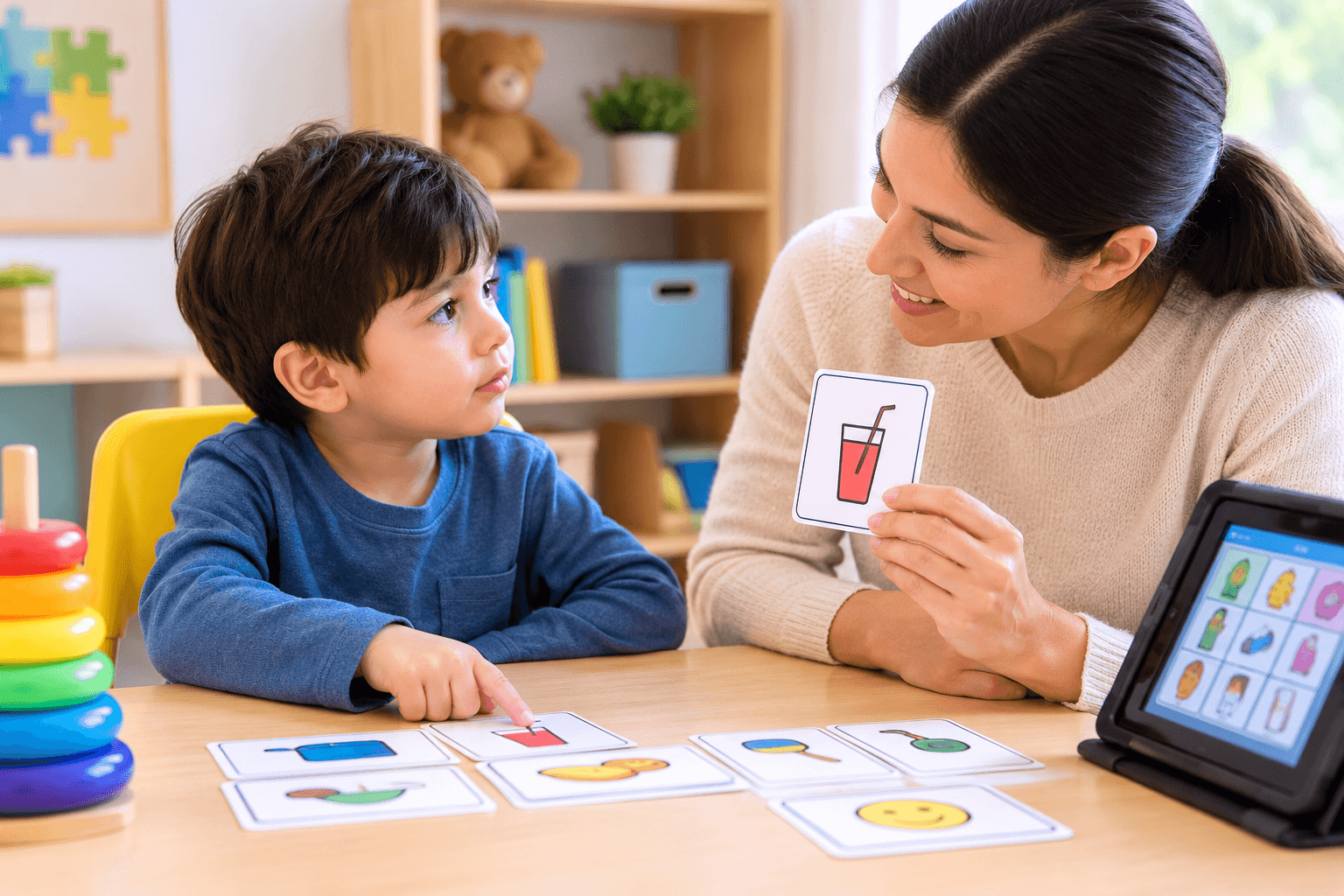
One of the most common fears parents have is that using pictures, signs or devices will stop their child from speaking. The research doesn’t support that fear. Augmentative and alternative communication, usually shortened to AAC, tends to reduce frustration and often supports spoken language rather than replacing it. A child who can finally say “more” or “stop” in any form is a calmer, more connected child.
Options include:
Picture exchange systems, where a child hands over a picture to make a request.
Simple signs or gestures, such as “more,” “eat,” “help” and “all done.”
Speech-generating devices or tablet apps, where touching a symbol produces a spoken word.
Core word boards, which focus on small, flexible words like “go,” “want,” “stop” and “more.”
A speech-language pathologist can help you choose a system that fits your child’s motor skills and interests. Don’t wait for “readiness.” Communication access is a right, not a reward.
Make everyday routines your classroom
You don’t need an hour of drills. The most powerful learning happens inside moments your child already cares about.
Build in reasons to communicate. Hold a snack just out of reach, or give them only part of what they need so they have to signal for the rest. A little “sabotage” creates genuine motivation. Keep it playful, and respond right away when they try.
Narrate simply. Use short phrases at their level. “Open.” “Big splash.” “Your turn.” Fewer words, said clearly, are easier for a young brain to absorb than long explanations.
Repeat routines. Songs, bath time, getting dressed and the same game each day give your child predictable patterns. Predictability lowers anxiety and lets the brain focus on the language inside the routine.
Celebrate every attempt. A look, a reach, a sound, a point. All of it counts as communication. Respond warmly and show that it worked.
Take care of the sensory side
Many nonverbal autistic children are working hard just to cope with their surroundings. If a room is too bright, too noisy or too crowded, there is very little brain bandwidth left for communication.
Watch for patterns. Does your child communicate more in a quiet corner? After movement or deep pressure activities? With a favorite object nearby? These clues are gold. Adjust the environment first, then build skills inside the calmer setting. An occupational therapist can be a great partner here, especially for sensory regulation and motor planning.
If speech-motor difficulty is part of the picture
For some children, the challenge isn’t understanding or wanting to talk. It’s the physical planning of speech. If your child makes lots of sounds but can’t seem to shape them into words, or their attempts are inconsistent and effortful, ask your speech-language pathologist specifically about motor speech difficulties such as childhood apraxia of speech. This is a separate evaluation question, and the right therapy approach is quite different from general language therapy. Don’t be shy about asking.
What not to do
A few things that tend to slow progress or add stress:
Don’t force eye contact or demand words. “Say it!” turns communication into a test.
Don’t withhold essentials until they speak. Motivation helps, but needs like food, comfort and safety should always be met.
Don’t compare timelines. Autistic children develop language along very different paths, and some speak for the first time at ages that surprise everyone.
Don’t carry the whole load alone. Isolation is the fastest route to burnout.
You deserve support too
Parenting a nonverbal child is deeply loving work, and it can also be exhausting, lonely and full of second-guessing. You don’t have to figure it out on your own, and asking questions early is a strength, not a sign you’ve failed.
If you’re also wondering about your own communication, a family member’s speech, or whether a speech-fluency concern is part of the picture, you can book a free stuttering consultation with our team. We’ll listen, answer honestly, and tell you plainly if what you need is outside what we offer, and if so we’ll point you toward the right kind of specialist.
Build a team around your child
The best outcomes tend to come from a team that talks to each other. Consider including:
A speech-language pathologist experienced with autism and AAC
An occupational therapist for sensory and motor needs
Your pediatrician for the medical picture and referrals
Your child’s teachers, so strategies stay consistent between home and school
Share the same core vocabulary, the same visuals and the same expectations across settings. Consistency helps the brain learn faster because the pattern keeps showing up.
A realistic way to start this week
If this all feels like a lot, shrink it down. Pick three things:
One routine (like snack time) where you’ll pause and wait for any attempt to communicate.
One communication tool (a few signs or pictures) to introduce with a professional’s guidance.
One calm daily window of play where you simply follow your child’s lead and imitate them.
That’s enough. Small, steady, joyful practice beats an overloaded schedule every time.
Final thoughts
Helping a nonverbal autistic child isn’t about forcing speech out of them. It’s about opening every door communication can walk through, reducing the pressure around it, and trusting that a supported brain keeps learning. Progress may be slow, and it may arrive in ways you don’t expect, but it is real.
The same principle drives our work on speech and the brain. When we understand how neural pathways form, strengthen and adapt, we can support communication in a way that is kinder and more effective. If you’re curious how that thinking works in practice, you can explore the neuroscience stuttering method we use, and see why a brain-first approach changes what’s possible.
Your child is communicating already. Your job, and your gift, is learning to listen in the language they’re speaking right now.
Ready to Put This Into Practice?
Download the app and start practicing today
Reading is the first step. Real progress comes from consistent daily practice. Use StopStutter to build confidence and improve your speech every day.