


ReviewSeptember 24, 2026
Language Disorder DSM 5
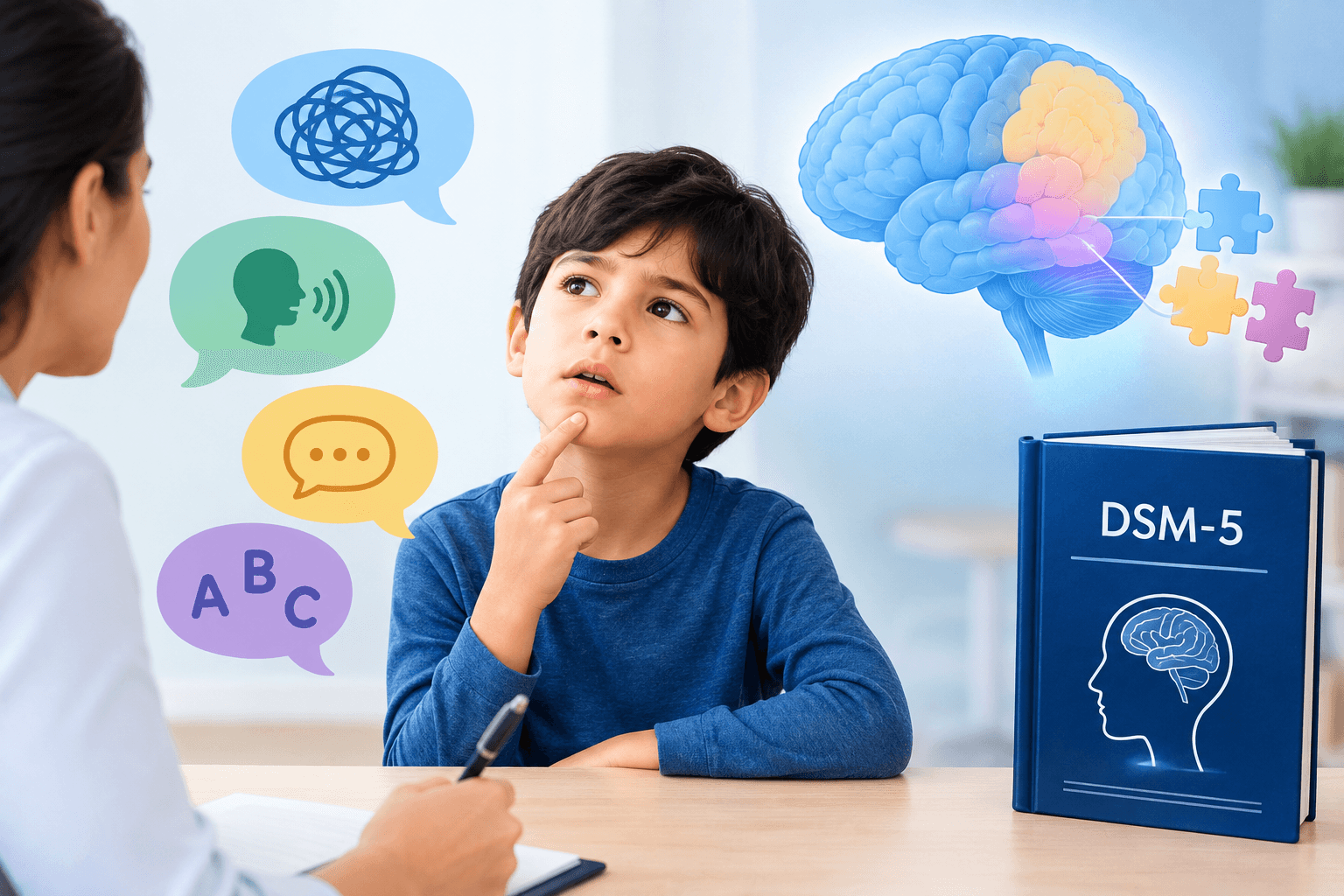
If you searched “language disorder DSM 5,” there’s probably a document in front of you. It might be an evaluation report, a school email, or a page of textbook notes. Here’s the short version. In the DSM 5, a language disorder is a lasting difficulty learning and using language. It starts in early childhood, it sits clearly below what’s expected for a person’s age, and hearing loss or another condition doesn’t explain it. In the DSM-5-TR, it carries the code F80.2.
That’s the quick answer. The rest of this guide walks through the four criteria in plain English, the full list of communication disorders, and where stuttering sits. That last part matters more than most people expect, because language disorder and stuttering can look alike from the outside and are completely different diagnoses.
Plenty of readers land here while actually dealing with stuttering. If that’s you, you probably care less about the manual and more about How to stop stuttering. Fair enough, we’ll get there. But the DSM 5 is worth five minutes of your time, because it shows why a language problem and a fluency problem need different kinds of help.
Knowing exactly which condition you’re dealing with also helps you ask better questions, whether you’re weighing in-person support or online stuttering therapy. One note before we start: this guide is for education and doesn’t replace an evaluation by a qualified clinician.
What Is a DSM 5 Language Disorder?
The DSM 5 is the Diagnostic and Statistical Manual of Mental Disorders, published by the American Psychiatric Association. The current version is the DSM-5-TR, a 2022 text revision, and the language disorder criteria are essentially the same in both. Clinicians across the US use it to classify developmental and mental health conditions, and language disorder is one of them.
Language is about much more than talking. It covers the words you know, how you put them into sentences, and how you connect ideas so another person can follow you. Speech is the physical side: producing sounds and keeping them flowing. A child can have trouble with one and be perfectly fine with the other. That difference is the whole reason the manual keeps these conditions apart.
DSM 5 Communication Disorders: The Full List
The DSM 5 groups communication disorders under neurodevelopmental disorders. There are five:
Language disorder: trouble with vocabulary, grammar, and putting ideas together
Speech sound disorder: trouble producing sounds clearly enough to be understood
Childhood-onset fluency disorder: the DSM 5 term for stuttering
Social (pragmatic) communication disorder: trouble using language in social situations
Unspecified communication disorder: clear symptoms that don’t fully fit one of the above
Think of them as five separate doors. A person can walk through more than one. A child might have a language disorder and a speech sound disorder together, or a language disorder and a stutter. Each one gets its own evaluation and its own plan.
Language Disorder DSM 5 Criteria, Explained Simply
Language disorder in the DSM 5 is a lasting difficulty learning and using language, whether spoken, written or signed, that begins in early childhood. Vocabulary, sentence structure or the ability to connect ideas sits well below what’s expected for age, and another condition doesn’t better explain it.
There are four criteria, and all four must be met.
Criterion A: ongoing trouble with language. This shows up as a small vocabulary, short or simple sentences, or difficulty telling a story or holding a conversation together. A child might know what they want to say and still struggle to build the sentence.
Criterion B: skills well below age level. It isn’t enough to be a late talker or a bit behind. The gap has to be real, and it has to get in the way of everyday life, whether that’s school, friendships or simply being understood at home.
Criterion C: early onset. The symptoms begin in the early developmental period. Sometimes they only become obvious later, when language demands go up at school, but they trace back to early childhood.
Criterion D: not explained by something else. Hearing loss, other sensory or motor problems, a medical or neurological condition, intellectual disability and global developmental delay all have to be ruled out first. This is why a hearing test is usually part of any proper evaluation.
Language Disorder DSM-5 Code (and Why It Matters in the US)
In the DSM-5-TR, language disorder is coded F80.2. That code comes from ICD-10-CM, the system US clinics, schools and insurers use for records and billing. If you have an older copy of the DSM 5, you might see a different number, because the codes were updated after the book first came out.
The code matters because it’s what shows up on paperwork: the claim your insurer processes, the diagnosis line on a report. If the number on a document doesn’t match what you were told in the appointment, ask the clinician to explain it.
One more thing for US families. A DSM 5 diagnosis and school eligibility aren’t the same process. Under IDEA, a school team decides whether a child qualifies for services as having a speech or language impairment, and it doesn’t need a DSM diagnosis to do that. Many families end up with both a school evaluation and a private one. That’s normal.
Stuttering DSM 5: Childhood-Onset Fluency Disorder
Stuttering sits in a different part of the same chapter. The formal name is childhood-onset fluency disorder, coded F80.81. To meet it, a person has to show frequent, marked disruptions in the normal flow and timing of speech that don’t fit their age. The manual describes patterns like these:
Repeating sounds or syllables
Stretching out consonants or vowels
Broken words, with a pause in the middle of a word
Silent or audible blocks
Swapping in other words to avoid a hard one
Speaking with visible physical tension
Repeating whole one-syllable words
The disruption also has to cause anxiety about speaking, or get in the way of communication, school, work or social life. It has to start in early development. And it can’t be better explained by a speech-motor problem, a sensory deficit, a neurological injury or another medical condition. If stuttering first appears in adulthood, the DSM 5 doesn’t call it childhood-onset. It’s labeled adult-onset fluency disorder, and clinicians often look into whether a neurological event, a medication or something else played a part.
If stuttering is what brought you here, you don’t have to figure this out alone. You can book a free stuttering consultation and talk through what’s going on with someone who understands the brain-based approach. No pressure, just a clear conversation.
Language Disorder vs Stuttering: Side by Side
Language Disorder
DSM-5 name: Language disorder
Code (DSM-5-TR): F80.2
What’s affected: Words, grammar, and connecting ideas
What it can look like: Short sentences and difficulty finding words
Stuttering
DSM-5 name: Childhood-onset fluency disorder
Code (DSM-5-TR): F80.81
What’s affected: Flow and timing of speech
What it can look like: Repetitions, stretched sounds, and speech blocks
Pragmatic (Social) Communication Disorder
DSM-5 name: Social (pragmatic) communication disorder
Code (DSM-5-TR): F80.89
What’s affected: Using language appropriately in social settings
What it can look like: Difficulty with turn-taking and understanding sarcasm
So a child can have a language disorder and not stutter. A child can stutter with completely typical language. And some children have both. That’s exactly why a proper evaluation matters. Treating a fluency issue as a language issue, or the other way around, can mean months of effort aimed at the wrong target.
When to Get an Evaluation (and Who to See in the US)
In the US, the usual starting point is a speech-language pathologist (SLP). Your pediatrician can refer you, and so can your child’s school. A full evaluation typically includes a hearing screening, standardized language testing, and a conversation about development. Ask about the hearing test early, because hearing loss is one of the things the DSM 5 requires clinicians to rule out.
It’s worth booking an evaluation if you notice any of these in yourself or your child:
Understanding or using words and sentences lags behind peers
Ongoing difficulty with the social side of conversation
Repeated sounds, stretched sounds or blocks that don’t fade over time
Avoiding speaking, certain words or social situations because of how speech feels
Frustration, worry or embarrassment around talking
An SLP can tell you whether the pattern points toward a language disorder, a social communication disorder, a fluency disorder, or a combination.
Why the Labels Matter Less Than the Brain Behind Them
Diagnostic categories are useful. They help clinicians communicate, help schools plan support, and help insurance systems function. What they don’t do is explain how speech works inside the brain, or how it can change.
Speaking is a fast, coordinated process. It involves planning, timing, movement, hearing yourself and constantly predicting what comes next. When that system gets caught in a pattern of anticipation and fear, the brain can start bracing for trouble before a word even begins. That bracing is often what turns a small hesitation into a full block.
The encouraging part is neuroplasticity. The brain keeps rewiring itself based on what we repeatedly do and feel. In practice, the work is usually simple and personal. You notice the words, calls or situations you’ve been avoiding. You learn to ease the physical tension that builds before speaking. Then you practice in real life, so your nervous system slowly learns that speaking is safe.
Progress shows up in small moments first. A phone call that feels a little lighter. Ordering the food you actually wanted. Saying your own name without bracing for it. Each one is the brain learning something new.
Moving Forward With Clarity
The DSM 5 tells you what category a difficulty belongs in. A label is a starting point, not a verdict. If you or someone you love stutters, the next step is working with the brain rather than against it, and the research behind neuroscience stuttering is a good place to start.
Ready to Put This Into Practice?
Download the app and start practicing today
Reading is the first step. Real progress comes from consistent daily practice. Use StopStutter to build confidence and improve your speech every day.


