ReviewOctober 13, 2026
Lisp in Speech: What It Is, Why It Happens, and How to Fix It
You’ve probably heard someone say “thith” when they meant “this,” or “shoop” when they meant “soup.” That’s a lisp in speech: the “s” and “z” sounds come out distorted instead of crisp. It’s one of the most recognizable speech sound differences, and one of the most misunderstood.
Most people write it off as a quirk, or a habit you either grow out of or you don’t. Neither is quite right. A lisp is a motor pattern, and motor patterns live in the brain. Once you look at it that way, the question shifts from “why can’t I say this properly?” to “how do I teach my brain a new movement?”
Stop stuttering is the heart of what we do at StopStutter, but the brain science behind fluency overlaps with other speech patterns, lisps included. Both depend on timing, coordination, and feedback between your ears, your mouth, and your motor system.
In this guide you’ll get a plain-English definition, the four types of lisp, the common causes, and what actually works for kids and adults. We’ll also look at how online stuttering therapy applies the same brain-training principles to sound production in general.
What Is a Lisp in Speech? (Lisp Meaning in Plain English)
A lisp in speech is a speech sound difference where the “s” and “z” sounds come out distorted, usually because the tongue sits too far forward, too far back, or lets air escape over the sides. In speech-language pathology, it’s classed as an articulation difference.
So if you want the lisp meaning in one line: it has nothing to do with intelligence, effort, or what you want to say. It’s about where your tongue sits and how air moves when you make certain sounds.
The sounds hit hardest are called sibilants: “s,” “z,” “sh,” “zh,” “ch,” and “j.” A clean “s” needs your tongue close to the roof of your mouth, a narrow groove down the center, and air pushed through at just the right speed. Miss on any of those and you hear a lisp. It’s a tiny, fast movement, and your brain has to get it right hundreds of times a day.
Speaking With a Lisp: What It Sounds and Feels Like
Speaking with a lisp doesn’t only change how a word sounds. It changes how talking feels. Many people describe lisp talking as hearing a slightly “off” version of themselves. “Street” comes out soft, “sister” turns into something close to “thithter,” and it gets more obvious when you speak fast.
Some people notice it most on the phone or in meetings. Others only hear it on recordings. And plenty quietly start steering around words they know will trip them up, saying “yes” instead of “sure,” or “okay” instead of “sounds good.” That small habit of avoiding words matters, and we’ll come back to it.
Lisp Mouth: What Your Tongue, Teeth, and Jaw Are Doing
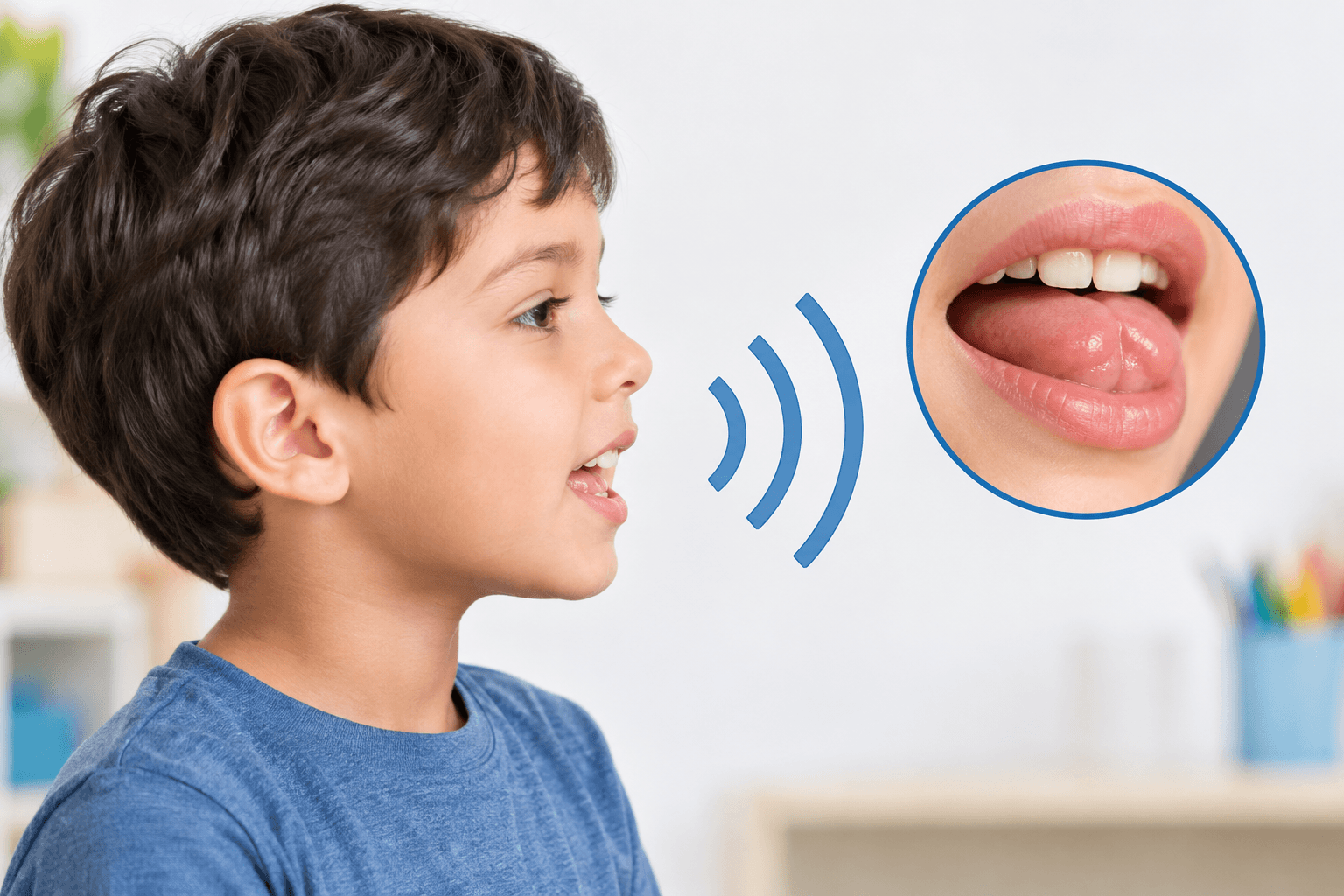
Inside the mouth, three things have to work together. The tongue sits close to the roof of the mouth with a narrow groove down the middle. The teeth are close enough to give the air a small channel to hit. And the jaw stays steady instead of drifting open or pushing forward.
When the tongue slips forward between the teeth, you get an interdental lisp. When air spills over the sides, you get a lateral one. A gap in the front teeth, an open bite, or a tight tongue-tie can nudge the airflow too, though plenty of people with those features have perfectly clear “s” sounds. A lisp mouth is never just about shape. It’s about what the tongue does inside it.
Types of Lisp in Speaking: Interdental, Dentalized, Lateral, and Palatal
Not every lisp sounds the same, and the type shapes what practice will help. Here are the four main types of lisp in speaking:
Interdental lisp. The tongue pokes out between the front teeth, so “sun” sounds like “thun.” This is the one most people picture.
Dentalized lisp. The tongue pushes against the back of the front teeth. The sound is muffled and a bit “wet” instead of crisp.
Lateral lisp. Air escapes over the sides of the tongue instead of down the middle. It sounds slushy, as if there’s water in the mouth, and it’s often the most noticeable and stubborn.
Palatal lisp. The tongue touches too far back on the roof of the mouth, giving the “s” a heavy, “sh”-like quality.
Why Do People Talk With a Lisp? Common Causes
There’s rarely one single cause. These are the usual suspects:
Tongue thrust patterns. The tongue pushes forward when swallowing or speaking, and the habit carries into “s” sounds.
Dental or jaw structure. Gaps, an open bite, or losing baby teeth can change airflow. Many kids develop a temporary lisp when their front teeth fall out, and it fades once the new ones arrive.
Tongue-tie. A short or tight band under the tongue can limit movement, though it isn’t always the cause even when present.
Learned motor habit. Sometimes there’s no structural reason at all. The tongue simply learned a slightly off placement early on, and it stuck.
Hearing differences. If you can’t clearly hear the difference between “s” and “th,” it’s hard to correct yourself.
That last one matters more than most people realize, and it leads straight to the brain.
Is a Lisp a Speech Impediment?
Yes. “Speech impediment” is an everyday term for any difference in how speech sounds are made, and a lisp fits it. Clinically, a lisp is usually called an articulation difference or a speech sound disorder. It’s one of the more common speech differences in children, and it often responds well to therapy.
A speech impediment lisp isn’t the same as a stutter, though. A lisp affects how a sound is formed. Stuttering affects the flow and timing of speech. If you’re curious how the two are classified, we break down whether a stutter counts as a speech impediment too in a separate guide.
Lisp and Stutter: Can You Have Both?
Yes, a lisp and a stutter can show up in the same person. They’re two separate things. Someone can have a clear “s” and still stutter, or speak smoothly and have a lisp, or deal with both.
Where they overlap is the experience. Avoiding certain words, swapping them out, bracing before you speak, tightening up when the phone rings. That tension can make either pattern harder to change, and calming it helps with both.
If you can’t tell which one is showing up in your speech, a free stuttering consultation is a low-pressure way to talk it through with someone who knows the difference.
What’s Actually Happening in the Brain?
Speech isn’t just muscles. It’s a loop. Your brain plans a movement, sends it to your tongue, lips, and jaw, then listens to the result through your ears and the feeling in your mouth. If the result doesn’t match the plan, it adjusts the next attempt. That feedback loop is the engine behind every spoken word, and it’s the same system we unpack in our post on what happens in the brain when you stutter.
With a lisp, that loop has settled into a stable but inaccurate pattern. Your brain built a motor program for “s” that places the tongue slightly wrong, and every repetition strengthens it. That’s neuroplasticity working against you.
The encouraging part is that it works in both directions. The same mechanism that locked in the pattern can build a new one. This isn’t about trying harder or speaking slower. It’s about giving the brain better information and enough well-structured repetition to update the map.
Can Adults Fix a Lisp in Speech?
Yes, and this surprises a lot of people. Adults often assume a lisp they’ve had for decades is permanent. It isn’t. The brain stays plastic throughout life. It may take more deliberate practice than it would for a child, because the old pattern is deeply grooved, but the capacity to change is there.
Adults who come looking for help usually share a few things: they’ve worked around the sound for years, they avoid certain words, and they feel self-conscious in meetings, interviews, or on calls. That avoidance cycle is exactly what many people who stutter describe too.
How to Fix a Lisp: A Neuroscience-Led Approach
Traditional articulation therapy has helped many people and remains a solid foundation. A brain-based approach builds on it by paying attention to how the brain learns a movement, not just which movement to make.
Start with awareness. Before you can change a sound, you need to hear and feel the difference between your current “s” and the target one. Many people genuinely can’t tell until it’s pointed out.
Isolate the movement. Practice tongue placement away from words. Notice where the tip sits, how the groove forms, and how the air feels on the roof of your mouth.
Build up gradually. Move from the sound alone to syllables, then short words, phrases, sentences, and finally conversation. Rushing this ladder is the most common reason progress stalls.
Use feedback. A mirror, a recording, or a therapist giving real-time cues all strengthen the loop.
Practice little and often. Five focused minutes a day beats an hour on Sunday, because motor learning consolidates during rest and sleep.
Lower the tension. A tight jaw, tongue, and throat make precise movements harder. Calm practice gives the brain the best conditions to learn.
A few mistakes to avoid: over-articulating, repeating the lisp thousands of times while “trying” to fix it, skipping the ear training, expecting overnight change, and avoiding “s” words altogether. Avoidance protects you in the moment but leaves the old pattern unchallenged.
When to See a Speech-Language Pathologist
For children, a lisp is common enough in early development that a speech-language pathologist usually won’t worry before around age 5 or 6, though it’s always fine to ask sooner. For teens and adults, there’s no waiting period. If the lisp bothers you or limits what you’re willing to say, that’s reason enough. And if you notice pain, trouble swallowing, or a sudden change in your speech, get it checked by a professional, since those can point to something beyond a habit.
Lisp in Speech FAQs
What is a lisp in speech?
A lisp in speech is a speech sound difference where “s” and “z” come out distorted. The tongue sits too far forward or back, or air slips over the sides, so you hear a “th” or slushy sound instead of a crisp hiss.
What does speaking with a lisp mean?
It means your “s” and “z” sounds don’t come out as a clean hiss. You might say “thun” for “sun.” It’s about how sounds are made, not intelligence or effort.
Is a lisp a speech impediment?
Yes. It’s an everyday term for a difference in how sounds are made, and clinically a lisp is usually called an articulation difference. It’s different from stuttering, which affects speech flow.
Can you have a lisp and a stutter at the same time?
Yes. They’re separate patterns, so one person can have both. A speech-language pathologist can help you tell which is which.
Should I worry if my child has a lisp?
Usually not early on. Many kids have a temporary lisp while front teeth change. If it’s still there around age 5 or 6, or it bothers your child, ask a speech-language pathologist.
Final Thoughts: Speaking With a Lisp Can Change
A lisp in speech is a distorted “s” or “z” caused by tongue placement, airflow, structure, or learned habit, and it can be changed at any age. Speaking with a lisp says nothing about your intelligence or effort. It says your tongue learned one pattern, and it can learn another.
The path forward is awareness, gradual practice, good feedback, and a calm nervous system. Those are the same foundations behind everything we do with fluency. If you want to see how this kind of retraining works in more depth, start with our neuroscience method, where we explain how the brain builds, reinforces, and rewires speech patterns.
Ready to Put This Into Practice?
Download the app and start practicing today
Reading is the first step. Real progress comes from consistent daily practice. Use StopStutter to build confidence and improve your speech every day.