ReviewOctober 14, 2026
Oral Motor Therapy and Exercises for Speech: A Simple Guide for Kids and Adults
Oral motor therapy is a set of simple lip, tongue, jaw and cheek exercises that help the mouth move with more strength and control, so speech feels easier and sounds clearer. It helps most when the muscles feel weak, tired or slow to coordinate. It works best when you mix it with real speech practice instead of doing drills on their own. These oral motor exercises for speech therapy take about five minutes a day at home. And if stuttering is part of your story too, the team at StopStutter can show you how to stop stuttering with calm, practical steps.
At StopStutter, we spend our days around speech, and many of our specialists have lived the struggle themselves. That experience taught us something books rarely say out loud. Speech is never just muscle work. It is a conversation between your brain, your breath and your mouth, and each part needs attention.
So this guide stays honest. You will learn what these exercises can do, where the research is mixed, and how to use them safely at home. If you want guided support on the fluency side stuttering therapy lets you work with a specialist from your own living room.
What Are Oral Motor Exercises and Oral Placement Therapy?
Think of the mouth as a small gym. The tongue, lips, cheeks and jaw are muscles, and like any muscle they respond to regular, gentle training. Oral motor exercises are the reps. They include things like lip pursing, tongue lifts, cheek puffs and slow jaw movements.
Speech therapists use a few related labels, and they overlap quite a bit:
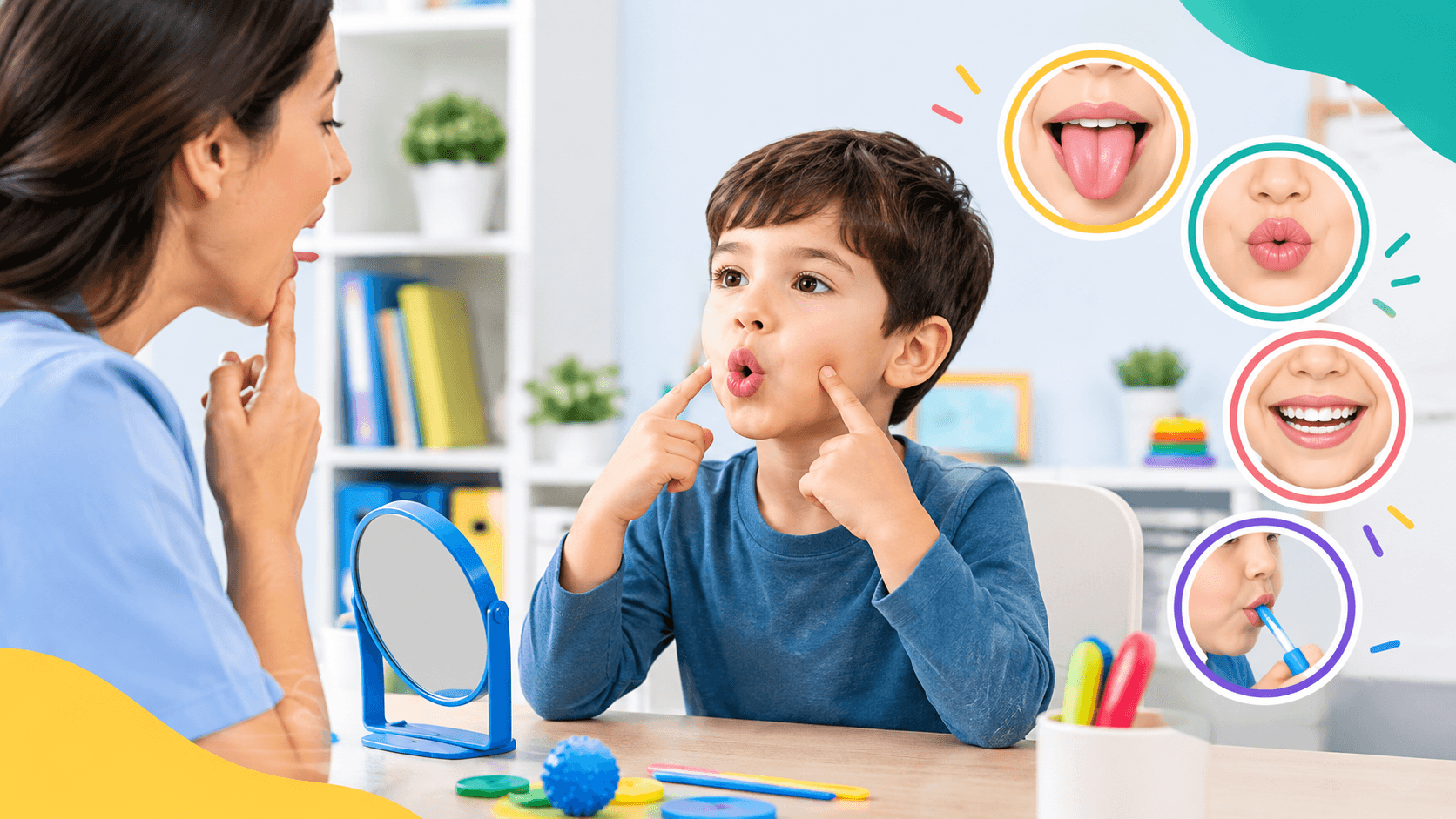
Oral exercises and oral motor activities are the everyday names for mouth movements done on purpose, such as blowing bubbles, licking a lollipop slowly or making funny faces in a mirror.
Speech therapy oral motor work means those movements are chosen by a clinician to match a person’s goals, then folded into a plan that also includes sound practice and conversation.
Oral Placement Therapy Explained
Oral placement therapy is a more hands-on style. A therapist uses small tools or gentle touch cues to show the mouth exactly where a sound should be made. It is often used when a person knows the sound they want but cannot find the right position for it.
Ejercicios Orofaciales for Spanish-Speaking Families
If your family speaks Spanish, you may search for ejercicios orofaciales. The idea is identical. Many bilingual therapists share the same lip, tongue and jaw routines in both languages, which makes practice easier at home.
How Oral Motor Exercises for Speech Therapy Actually Work
Here is the simple version. Clear speech needs strength, range of movement, speed and timing. When one of those is off, sounds can come out blurry or tiring to produce. Oral motor exercises for speech therapy aim to improve the physical side of that chain so the mouth can follow what the brain asks of it.
A good plan usually focuses on a few things:
Strength and stamina, so the lips and tongue do not tire halfway through a long sentence, which matters for children who get frustrated when talking feels like hard work.
Range and control, so the tongue can lift, tuck and spread with accuracy instead of one big clumsy motion, which supports sounds like t, d, l and s.
Awareness, so a person can actually feel where the lips and tongue are, which is the part most people never think about until someone points it out.
Why Practice Alone Is Not Enough
Strong muscles do not automatically become clear words. Speech is a skill, so it has to be practised as speech. That is why the best therapists mix movement drills with sounds, then syllables, then real talking. If you only do the drills, progress tends to stall.
Oral Motor Exercises for Kids and Toddlers
Children rarely want to do “exercises,” and honestly, who can blame them? The trick is to make everything playful. A giggle is worth more than a perfect rep.
Oral Motor Exercises for Toddlers
Toddlers learn through copying, so keep sessions to two or three minutes. Blow bubbles, sip thick smoothies through a straw, blow a feather across the table or make animal sounds together. Our guide to speech therapy activities for toddlers has plenty of ideas that fit into snack time and bath time.
Oral Motor Exercises for Kids
Older children can handle simple games with a clear goal:
Mirror challenges, where you and your child take turns copying silly faces such as a big smile, a kiss, a fish face or tongue to the nose, so they can watch their own mouth and link what they see with what they feel.
Straw and cotton ball races, where they blow a cotton ball across a table, which builds steady breath and lip closure in a way that feels like a contest instead of homework.
One gentle note for parents. If your little one repeats sounds or seems stuck, do not assume mouth weakness is the cause. Our post on 2 year old stuttering explains what is typical and when to ask for help.
Nonspeech Oral Motor Exercises: What the Research Says
Nonspeech oral motor exercises are movements done without making sound, like pushing the tongue against a spoon or puffing the cheeks. They are popular, and plenty of families swear by them. But the evidence is mixed. Many professional bodies note that these drills alone have limited proof for improving clear speech.
So what does that mean for you? It means treat them as a warm-up, not the whole workout. Use them to build awareness, then move quickly to speech sounds. If a program promises that mouth exercises alone will fix everything, be cautious. Good therapy stays flexible and checks progress often.
Oral Motor Training and Mouth Exercises: Where They Fit in Speech and Swallowing Care
Oral motor training just means practising mouth movements in a planned, repeatable way. Some people do it to speak more clearly. Others do it because a swallowing team asked them to. The moves can look alike, but the goal behind them is different, so it helps to know which one you are working on.
Easy Mouth Exercises You Can Start Today
Switch between a wide smile and a kiss shape, ten slow rounds, to wake up the lips.
Lift the tongue tip to the roof of the mouth, hold for three seconds, then relax.
Puff the cheeks and move the air from left to right to build control.
Open and close the jaw slowly in front of a mirror so you can spot any drifting to one side.
Add gentle motor exercises that involve blowing, like a straw or a pinwheel, to link breath with lip movement.
Dysphagia Oral Motor Exercises: Get a Swallow Check First
Dysphagia means trouble swallowing, and the exercises are not the same as a speech routine. A speech-language pathologist usually picks them after a swallow assessment, because the right move depends on which part of the swallow is weak.
Common targets are lip closure, tongue strength and jaw control for chewing.
Stop and call your clinician if you notice coughing, choking, a wet sounding voice or pain.
Never swap a prescribed swallowing plan for a general printable sheet.
Oral Motor Therapy vs Motor Speech Therapy
Oral motor therapy uses nonspeech movements to build strength and awareness.
Motor speech therapy practises the planning and sequencing of real sounds and words. It is often used for childhood apraxia of speech or dysarthria.
Many children need more of the second than the first, so ask your therapist which one the plan leans on.
Both can sit in the same plan, as long as the mouth work leads into actual speech.
Oral Motor Exercises for Low Muscle Tone
Some children and adults have low muscle tone, which can make the lips and tongue feel soft or tired. You might notice drooling, slumped posture, a mouth that rests open, or speech that sounds slushy. A speech therapist can assess this properly, since the cause matters.
For low muscle tone, a few steady habits tend to help:
Short, frequent sessions of two to five minutes, because tired muscles respond better to little and often than to one long push.
Resistance with a purpose, such as pressing the tongue against a spoon or chewing slightly firmer foods, only when a therapist has said it is safe for that person.
Good posture first, since a supported trunk and head make mouth movement easier, which is something families often overlook.
Please skip the guesswork here. Low tone can have medical roots, so a professional plan is the safest path.
Oral Motor Exercises PDF and a Simple Home Routine
Lots of parents search for an oral motor exercises pdf so they can print it and stick it on the fridge. That is a smart move because pictures make routines easier to follow. Just check that the sheet was written or reviewed by a licensed speech-language pathologist and matches your child’s age.
A Five-Minute Routine
Warm up with three slow jaw opens and closes.
Lips next, alternating a wide smile with a gentle kiss shape.
Tongue moves come after, such as lifting to the roof of the mouth, then sweeping side to side.
Blow bubbles or a pinwheel to finish with breath control.
Say three words aloud so the muscle work connects to real speech.
Keep it light and stop before anyone is tired. If speed is a problem for you or your child, our article on rapid speech and stuttering shows how pace and tension are linked. And if you ever notice words suddenly vanishing, read about sudden difficulty finding words when speaking.
Frequently Asked Questions
What is the difference between oral motor therapy and speech therapy?
Speech therapy is the bigger picture. It covers sounds, language, fluency and voice. Oral motor therapy is one possible tool inside it, focused on the strength and control of the lips, tongue and jaw. A therapist may use it as a warm-up, then move quickly to sounds, words and real conversation.
Do oral motor exercises work for speech delay in toddlers?
They can help a little when a toddler has weak or uncoordinated mouth movements, but they rarely fix a speech delay alone. Most progress comes from play, modelling words and practising sounds together every day. If your toddler isn’t using many words by their second birthday, it’s wise to ask for a professional check.
Can oral motor exercises fix a lisp or unclear speech?
Sometimes they help with awareness, but research doesn’t show that mouth exercises alone correct a lisp or unclear sounds. Those usually need targeted sound practice with a therapist. Think of the exercises as a warm-up that makes that practice easier, not as a replacement for it.
What are the best oral motor activities for kids who hate exercises?
Turn them into games. Blow cotton balls across a table, hold a pinwheel contest, make silly faces in the mirror or sip a thick smoothie through a straw. Keep each round under three minutes and let your child lead. A giggle does more good than a perfect repetition.
Building Stronger Speech, One Small Step at a Time
Mouth exercises help the body side of speech, but the brain steers the whole thing. Our neuroscience method shows how retraining the learned layer of speech, including fear, tension and avoidance, can change how talking feels. Pairing that brain-first work with simple mouth practice gives many people a more complete path. You can also explore the top 7 stuttering therapy techniques that actually work for fluency tools you can start using today.
Oral motor exercises for speech therapy work best when they are gentle, playful and connected to real conversation, so start small and stay patient. If worry about speech is weighing on you or someone you love, you do not have to sort it out alone. Book your free consultation and take a calm, pressure-free first step toward clearer, easier speech.
Ready to Put This Into Practice?
Download the app and start practicing today
Reading is the first step. Real progress comes from consistent daily practice. Use StopStutter to build confidence and improve your speech every day.