ReviewOctober 14, 2026
Progressive Muscle Relaxation
Progressive muscle relaxation is a technique where you tense one muscle group for a few seconds, then release it, so your brain learns the difference between tension and rest. For people who stutter, that contrast matters. Tension in the jaw, throat, and chest often shows up right before a block.
Let’s be clear about what this is. Core stuttering has a genetic and neurodevelopmental basis. Relaxation will not erase it. But the layers built on top (anticipatory fear, physical tension loops, avoidance traps) are learned behaviors. Learned behaviors can be retrained. That is the foundation of how to stop stuttering using the neuroscience method: lower the alarm, create prediction errors, and let the brain update.
What Is Progressive Muscle Relaxation?
Dr. Edmund Jacobson developed it in the 1920s. His core idea: you cannot release a muscle you do not notice is tight.
Progressive Muscle Relaxation Definition
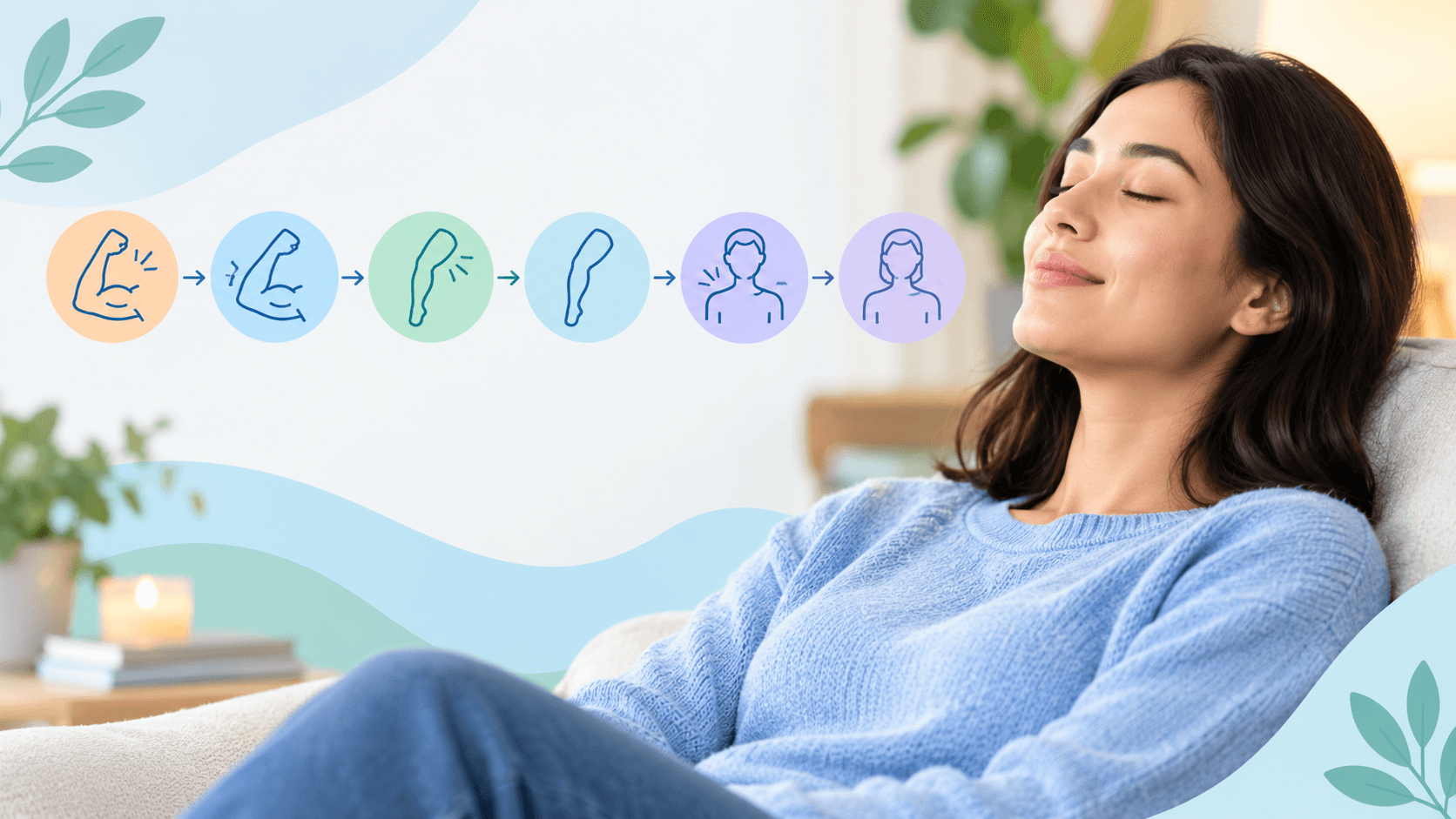
The definition of progressive muscle relaxation is simple. It is a structured exercise that moves through the body, tensing and releasing muscle groups in sequence. Most people shorten it to progressive muscle relaxation PMR, or just PMR.
Clinicians use progressive muscle relaxation therapy for anxiety and sleep problems. Many programs include progressive muscle relaxation training as part of stress management. As a daily progressive muscle relaxation exercise, it takes only minutes.
Why It Matters for Stuttering
When you expect to stutter, your nervous system treats the moment like a threat. Your body braces. The bracing makes a block more likely. Then the block confirms the fear.
PMR interrupts the bracing step. It gives your body a trained way to drop its guard. Pair it with online stuttering therapy and you get a structure for using it in real conversations, not just on your couch.
Benefits of Progressive Muscle Relaxation for Stress and Tension
The benefits of progressive muscle relaxation are well supported for general relaxation outcomes. Here is what people commonly report:
Progressive muscle relaxation for tension: less tightness in the neck, shoulders, and jaw
Progressive muscle relaxation for stress: slower breathing and a calmer heart rate
Progressive muscle relaxation for anger: less reactivity and irritability, which is why it appears in progressive muscle relaxation for anger management plans
Progressive muscle relaxation for athletes: faster recovery and better awareness of overworked muscles
These progressive muscle relaxation benefits fit neatly into any progressive muscle relaxation stress management routine.
The Stuttering Angle
Body awareness is the real prize. Most people who stutter have been tense for so long it feels normal. PMR makes the invisible visible. You cannot retrain what you cannot feel.
Progressive Muscle Relaxation for Anxiety and Panic Attacks
Anxiety and stuttering feed each other. Fear of speaking raises arousal. Higher arousal disrupts speech timing. Disrupted speech raises fear.
How PMR Lowers Alarm
When muscles release, your body sends your brain a “safe” signal. A steady progressive muscle relaxation anxiety routine can quiet the amygdala’s alarm response over time. This is neuroplasticity. Old threat pathways weaken over time, but they can resurface under heavy stress, fatigue, or pressure. That is normal. It is not a failure.
Progressive Muscle Relaxation for Panic Attacks and Racing Thoughts
Short rounds work best. Progressive muscle relaxation for racing thoughts gives your mind a job while your body resets. Practice progressive muscle relaxation for panic attacks when you are calm first. Do not wait for a crisis to try it for the first time.
Some people add progressive muscle relaxation meditation: tense, release, then rest your attention on the feeling of loose muscles.
How to Do Progressive Muscle Relaxation: Steps and Technique
Find a quiet spot. Sit or lie down. Loosen tight clothing.
Progressive Muscle Relaxation Steps
To teach progressive muscle relaxation steps for reducing body tension, keep the sequence simple:
Hands: Make fists for 5 seconds. Release for 15.
Arms: Bend elbows, tense biceps. Release.
Face: Scrunch eyes and forehead. Release.
Jaw: Clench gently, then let teeth part and the tongue rest.
Neck and shoulders: Lift shoulders to ears. Drop them.
Chest and stomach: Tighten, hold, release.
Legs and feet: Press heels down, curl toes. Release.
Stuttering-Specific Tweaks
Spend extra time on the jaw, tongue, throat, and chest.
Tense at about 60% effort, not 100%. Hard tension can mimic a block.
Skip any painful or injured area, and ask your doctor if unsure.
Progressive Muscle Relaxation Technique and Techniques
Every progressive muscle relaxation technique follows one rhythm: tense, hold, release, notice. Other progressive muscle relaxation techniques add breathing counts or imagery. Whichever you pick, treat progressive muscle relaxation exercises as skill practice, not a test.
Timed Progressive Muscle Relaxation Scripts
Progressive muscle relaxation scripts come in many lengths. A progressive muscle relaxation script short enough for a busy day beats a long one you skip.
5 minute progressive muscle relaxation script: hands, face, jaw, shoulders, chest
6 minute progressive muscle relaxation: add legs and feet
7 minute progressive muscle relaxation: add slow breathing between groups
10 minute progressive muscle relaxation: full body, steady pace
15 minute progressive muscle relaxation: longer rests; a 15 minute progressive muscle relaxation script suits evenings
20 minute progressive muscle relaxation script: deep practice for weekends
Progressive Muscle Relaxation Script: A Real-World Stuttering Example
Relaxing on your couch is step one. The brain changes when you test calm in a real moment. Here is what a prediction error looks like at work.
Scenario: Introducing Yourself in a Team Meeting
Before the meeting (2 minutes): Run a mini-release at your desk.
You (internal): “My brain predicts a block on my name.” (Press your feet into the floor. Tense your shoulders for 3 seconds, then drop them.)
Manager: “Let’s go around the room. Alex, you’re up.”
You: “Hi, I’m... (jaw softens, small pause, slow exhale) ...Alex. I handle the design side.” (Unclench your hands under the table.)
What just happened: You expected a hard block. Your body was loose. Even if some disfluency showed up, the catastrophe did not. Your brain logged a prediction error: “I was relaxed, I spoke, nothing terrible happened.”
Stack enough of these and the learned layer of speech blocks loosens its grip.
Progressive Muscle Relaxation for Sleep and Insomnia
Many people who stutter replay conversations at night. They rehearse, cringe, and stay wired. Progressive muscle relaxation sleep routines help the body stand down.
Progressive Muscle Relaxation Technique for Sleep
Practice in bed, lights low
Move from feet upward, slowly
Use gentle tension, not hard squeezing
Pair it with slow breathing: in for 4, out for 6
If your mind drifts, return to the muscle you were on
Use a progressive muscle relaxation script for sleep that moves slowly and ends with the face and jaw. People often search for progressive muscle relaxation insomnia help, and PMR is a common first tool. Progressive muscle relaxation for insomnia does not replace medical care. If poor sleep lasts several weeks, talk to a clinician.
Progressive Muscle Relaxation for Kids and Teens
Children who stutter often feel pressure to “speak right.” Adults may notice tight faces and raised shoulders.
Progressive Muscle Relaxation Script for Kids
Use images: “Squeeze a lemon in each hand, then drop it.”
Keep sessions to 5 minutes
Make it a game, not a task
Never tie it to how they speak
A good progressive muscle relaxation script for kids stays playful. Progressive muscle relaxation for kids is about feeling calm, not fixing speech.
Progressive Muscle Relaxation Script for Teens
Progressive muscle relaxation for teens works best as a short, private tool. A progressive muscle relaxation script for teens can target exams, sports, and social nerves. Do not frame it as a stuttering fix.
Guided Progressive Muscle Relaxation: Audio, Video, PDF, and Apps
Guidance helps you stay on track, especially at first.
Guided progressive muscle relaxation audio: best for sleep and eyes-closed practice. Any progressive muscle relaxation audio works if the pacing is slow.
Progressive muscle relaxation video: useful for learning the sequence
Progressive muscle relaxation PDF and progressive muscle relaxation script PDF: easy to print and keep by your bed
Progressive muscle relaxation handout and worksheet: good for tracking progress and sharing with your therapist
Progressive muscle relaxation app: reminders and timers
Progressive muscle relaxation in Spanish: look for Spanish audio and handouts if that is your first language
A Note on Therapy
Traditional speech therapy is not just “training the mouth.” Modern SLPs use mind-body methods, including CBT and desensitization. PMR fits well inside that work. A therapist can help you apply it to speaking situations, avoidance habits, and fear patterns.
Your 7-Day Progressive Muscle Relaxation Protocol
Daily Practice (10 Minutes)
☐ Pick a consistent time
☐ Run the full-body sequence slowly
☐ Spend 2 extra minutes on jaw, tongue, and throat
☐ Rate your tension before and after (0 to 10)
Transfer to Speech (Days 4 to 7)
☐ Do a 60-second mini-release before one low-stakes conversation
☐ Drop your shoulders and soften your jaw as you start talking
☐ Allow one pause without rushing to fill it
☐ Write down what you predicted vs. what happened
Track the prediction errors. They are the evidence your brain needs.
Frequently Asked Questions
Does progressive muscle relaxation help stuttering?
It can reduce the tension and alarm that make blocks worse. It does not cure stuttering alone. It works best with speech-focused retraining.
How long should a PMR session last?
Anywhere from 5 to 20 minutes. Consistency beats length. Ten minutes daily outperforms one long weekly session.
How often should I practice?
Daily for the first two weeks. After that, a few times a week, plus mini-releases before speaking.
Is PMR safe for everyone?
Most people tolerate it well. Skip tensing in any injured or painful area. Check with a doctor if you have a muscle or circulation condition.
Can PMR replace therapy?
No. It is a support skill. A qualified SLP or structured program addresses fear, avoidance, and speech patterns.
Where to Go From Here
Your body learns what you practice. Tense and release often enough, and you start catching bracing before it hijacks your speech. Pair that awareness with real-world prediction errors, and the learned layer of blocks weakens. Start small today, and let progressive muscle relaxation become one steady tool in your fluency work.
Ready to Put This Into Practice?
Download the app and start practicing today
Reading is the first step. Real progress comes from consistent daily practice. Use StopStutter to build confidence and improve your speech every day.