


ReviewSeptember 30, 2026
Secondary Characteristics of Stuttering
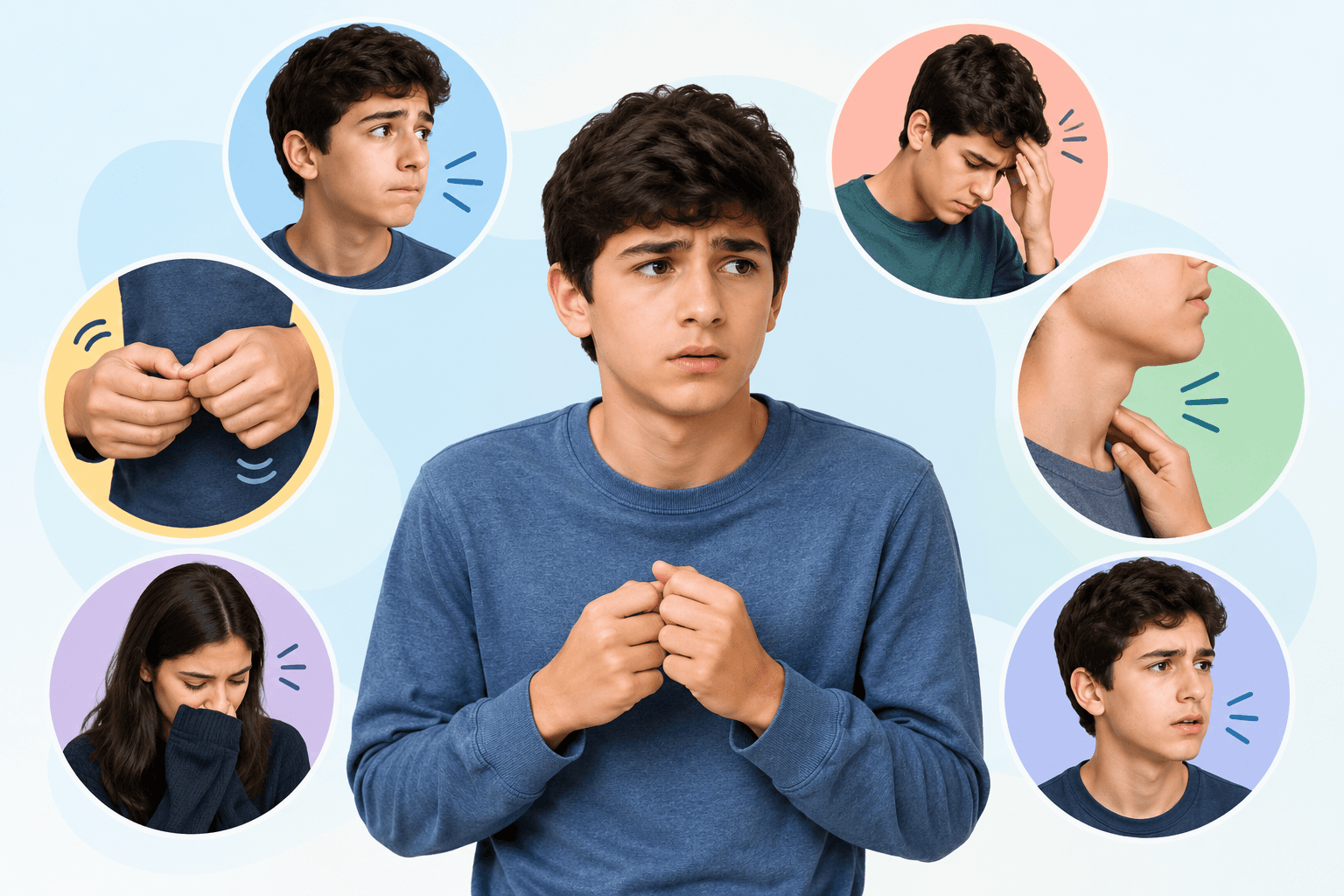
If you have ever watched someone struggle mid-sentence and noticed them blink hard, tap a foot, or turn their head just to push a word out, you have witnessed something most people miss. The block itself is only half the story. Everything that grows around it, the tension, the movements, the avoidance, is what speech researchers call the secondary characteristics of stuttering. These behaviors quietly shape daily life in ways that repeating sounds never quite do on their own.
For a lot of people who stutter, these secondary layers eventually become louder than the stutter itself. A child who once repeated the first sound of a word might, a few years later, avoid the word entirely, substitute another one, or freeze mid-sentence to prepare. That shift is why so many families searching for guidance on How to stop stuttering end up asking a different question altogether: how do you stop the fear, the muscle tension, and the mental gymnastics that come with speaking?
That question matters because it points to something modern research keeps confirming. Stuttering is not just a speech habit. It is a nervous system pattern, and the visible behaviors on the outside are usually reactions to what is happening inside the brain and body. This is one reason so many one-size-fits-all fluency drills seem to help for a while and then quietly stop working. The mouth learns a new trick, but the underlying alarm system keeps firing.
More families are exploring online stuttering therapy for exactly this reason. Working from home, in a familiar setting, without the pressure of a waiting room, makes it easier to notice the small physical and emotional patterns that feed a stutter. And once you can see the pattern clearly, you can start to change it, gently and on your own timeline.
What the Secondary Characteristics Actually Are
To understand the secondary characteristics of stuttering, it helps to first look at the primary ones. The primary characteristics of stuttering are the core disfluencies: repetitions of sounds or syllables, prolongations of a single sound, and silent blocks where the airflow simply stops.
Secondary characteristics are the extras. They are the learned reactions someone develops, often unconsciously, to cope with or hide those primary moments. Over time, the brain wires these responses into the act of speaking itself, so they no longer feel separate from talking at all.
They generally fall into two groups:
Physical or motor behaviors, such as eye blinking, facial grimaces, head jerks, tapping fingers, stomping a foot, jaw tightening, or sudden shifts in breathing.
Verbal or avoidance behaviors, such as swapping a difficult word for an easier one, adding filler sounds like "um" or "you know," pausing before a specific letter, restarting sentences repeatedly, or staying silent when there was actually something to say.
None of these are done on purpose. They start as tiny escape strategies and settle into habit.
How These Patterns Take Hold
Here is where the neuroscience angle becomes important. Stuttering is not a flaw in the mouth or the vocal cords. It involves timing and coordination between several brain regions that manage speech planning, motor control, and self-monitoring. When those regions fall out of sync for a moment, a disfluency happens.
The nervous system, being a fast learner, treats that disfluency as a threat. The next time a similar word comes up, it braces. That bracing shows up in the body as tension, in the face as a grimace, in behavior as avoidance. Over months and years, the person is no longer just stuttering. They are running an entire background program every single time they open their mouth.
This is one reason the wider characteristics of stuttering can look so different from one person to the next. Two people can share the same core disfluency yet carry completely different secondary layers, because their nervous systems learned to protect them in different ways, at different ages, and under different pressures.
Recognizing These Patterns in Everyday Life
Secondary behaviors often hide in plain sight because families adapt to them. A parent may not realize their child has started clearing their throat before every hard word. A partner may not notice the small pause and eye shift before a name that used to come easily. Adults who stutter sometimes describe scanning a sentence three or four words ahead, like a chess player, planning which word to swap before they arrive at it.
You may notice these signs in familiar moments: ordering at a restaurant and switching what you actually wanted, letting a call go to voicemail even though it is important, offering shorter answers in meetings, or feeling drained after a normal conversation for reasons you cannot quite name. That tiredness is not weakness. It is the cost of running the background program mentioned above, all day, in silence.
Why Fluency Drills Alone Rarely Solve This
Many traditional programs focus on the surface: slow the speech down, stretch the vowels, breathe from the diaphragm. These techniques can help someone sound smoother in a controlled setting, but they rarely calm the underlying pattern. The moment stress rises, real conversation returns, or the phone rings, the old wiring kicks back in.
That gap between the practice room and real life is one of the most frustrating parts of the journey. It is also one of the clearest signs that the secondary characteristics of stuttering are being managed rather than resolved. Managing a pattern takes constant effort. Resolving one, at the level where it started, takes far less over time.
The Emotional Weight Nobody Talks About
There is a quieter layer under all this that deserves its own paragraph. Many people who stutter grow up with anticipation, the almost-instant knowing that a hard word is coming a full second before it arrives. Anticipation is itself a nervous system response, and it fuels the physical bracing that becomes visible as secondary behaviors. Working only on the mouth without acknowledging that anticipation is like treating a burn without turning off the stove.
That is why real progress often begins with awareness rather than technique. When someone starts noticing where the tension actually lives, jaw, chest, shoulders, eyes, they gain the first bit of leverage. Awareness by itself does not fix anything. But it makes everything that comes next possible.
A Neuroscience-Based Way Forward
A growing body of work suggests that lasting change comes from teaching the nervous system a new response, not from stacking more control on top of an anxious one. This is the foundation of the neuroscience stuttering approach used by the World Stop Stuttering Association.
Instead of drilling fluency, the method works on the loop itself: the sensory input, the emotional charge, the muscle memory, and the speech output. When the nervous system stops treating certain sounds, words, or situations as threats, the bracing softens. When the bracing softens, the visible secondary behaviors have less reason to fire. Speech starts to feel less like a performance and more like breathing.
This shift is not instant, and it is not a trick. It is a re-training. But because it addresses where the pattern actually lives, the changes tend to hold, even in situations where old drills used to fall apart. Some people notice a shift within a few weeks. Others need more time, and that is normal. The nervous system moves at its own pace.
What Change Can Look Like
People who work through this kind of approach often describe the early wins in small, honest ways. A grocery store interaction that used to require a rehearsed script becomes ordinary. A phone call gets answered instead of ignored. A child stops rubbing their eyes or clenching their fists when a hard word is coming. A teenager raises their hand in class for the first time in years.
The stutter may still appear in some form. That is not failure. The real goal is not silence or perfection but freedom, the ability to speak without the exhausting scaffolding around every sentence. Understanding the secondary characteristics of stuttering is the first honest step toward that freedom, because you cannot release what you have never named.
Small Shifts You Can Notice Today
You do not need a formal program to start observing yourself or a loved one with more compassion. A few things worth watching for:
Where does the body tighten first when a hard word approaches? Jaw, hands, chest, or somewhere else?
Are certain settings, people, or topics louder triggers than others?
Is there a word being avoided so often that it has almost disappeared from daily speech?
Does the exhaustion after speaking match the length of the conversation, or is it disproportionately heavy?
None of these questions have a right answer. They exist only to build the awareness that any lasting work is built on.
Where to Begin
If any of this sounds familiar, whether for yourself or someone you love, the first useful step is a conversation, not a commitment. A free stuttering consultation with the team is a chance to describe what your speech actually looks and feels like day to day, ask questions about the method, and get a sense of whether this direction fits your life.
Stuttering is not a fixed identity, and the patterns wrapped around it are not permanent either. With the right lens on how the nervous system learned them, they can be unlearned too, one gentle layer at a time.
Ready to Put This Into Practice?
Download the app and start practicing today
Reading is the first step. Real progress comes from consistent daily practice. Use StopStutter to build confidence and improve your speech every day.


