


ReviewNovember 18, 2026
Self and Parallel Talk Examples: What They Look Like and What Your Child’s Brain Does With Them
Picture a mum folding laundry while her toddler plays with a toy truck. She says, “Mummy is folding the blue sock. Now I’m putting it in the basket.” Then, without asking a single question, she adds, “You’re pushing the truck. The truck is going fast. Whoosh, it stopped.” That small, ordinary moment contains two of the most useful language tools in early childhood. The best way to understand them is through real self and parallel talk examples, so that is what this guide gives you.
At Stop stuttering, we spend our days thinking about how the brain builds speech. Families often arrive worried about fluency, and we usually find that the everyday way adults talk around a child matters just as much as any technique. Self talk and parallel talk are a big part of that.
You don’t need a clinic to use them, though some children benefit from extra support. If your child is stuck, repeating sounds, or avoiding words, structured online stuttering therapy can work alongside these home habits. Think of today’s strategies as the foundation.
So let’s start with what these two terms actually mean.
What Is Self Talk and Parallel Talk?
If you’ve searched “what is self talk and parallel talk,” here’s the short version.
Self talk means narrating what you are doing, seeing, or feeling, out loud, in simple language. You are the subject. “I’m pouring the milk.” “I’m tired, so I’m going to sit down.”
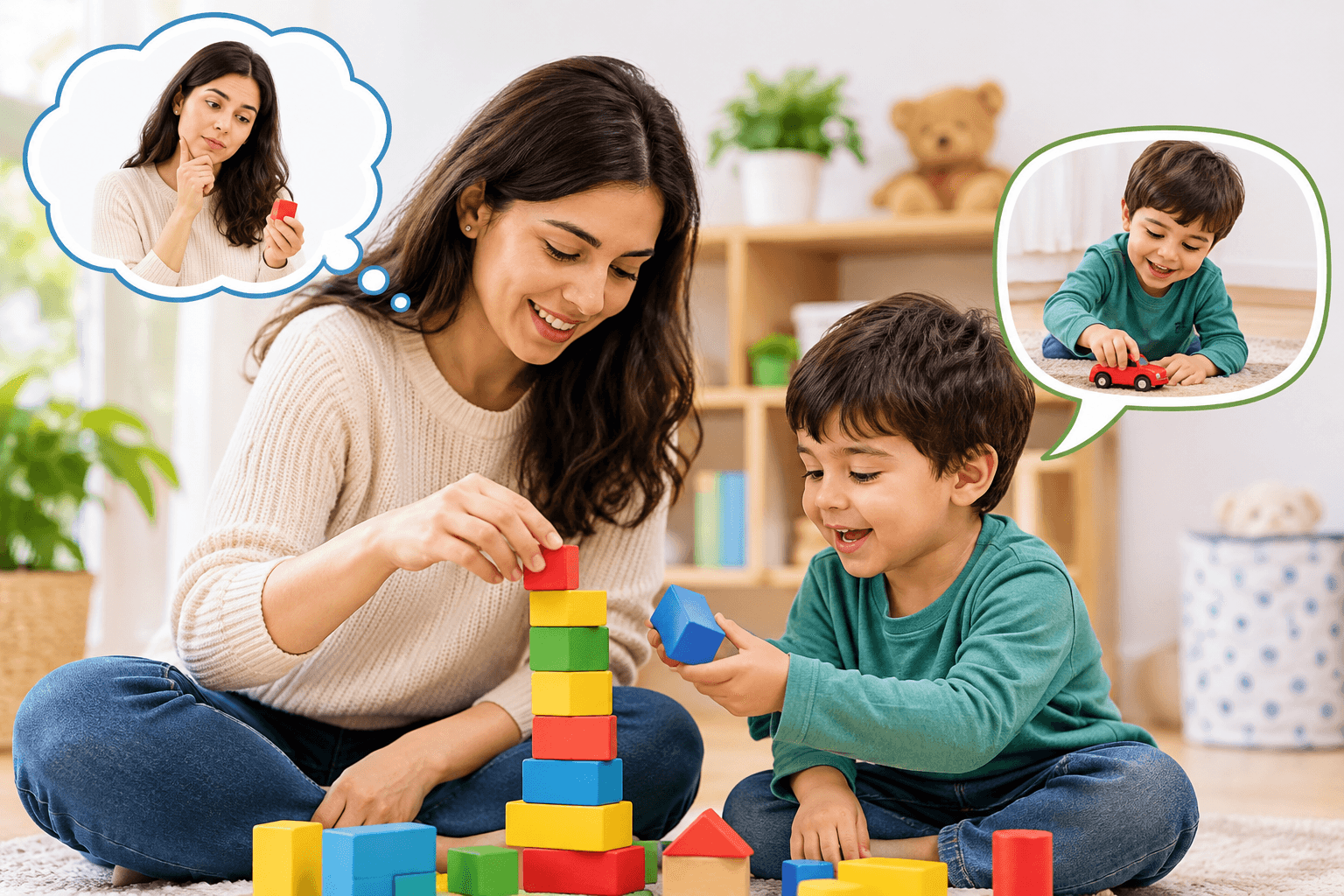
Parallel talk means narrating what the child is doing, as it happens. The child is the subject. “You’re stacking the red block.” “You’re hungry. You’re eating your banana.”
Neither one asks the child to respond. There’s no quiz, no “say ball,” and no pressure. You are simply putting words onto the moment the child is already living in. That is why people use “self and parallel talk” for infants, toddlers, late talkers, and children who are learning to speak with more ease.
Self Talk Examples You Can Use Today
Self talk works best when the sentences are short, the words are concrete, and the topic matches what the child can see.
In the kitchen:
“I’m cutting the apple. Cut, cut, cut.”
“The water is hot. I’m turning it off.”
“I’m opening the fridge. I see the cheese.”
Getting dressed:
“I’m putting on my socks. One sock, two socks.”
“My jacket is zipped. Zip, zip, up.”
Out and about:
“I’m looking for my keys. Where are they? Oh, here they are!”
“The light is red. I’m going to stop.”
Feelings:
“I’m frustrated. The lid is stuck. I’ll try again.”
“I’m happy. We’re going to the park.”
That last pair matters. Modelling calm self talk for frustration also shows a child that it’s normal to pause, think, and try again, which is a useful habit for anyone who struggles with speech.
Parallel Talk Examples for Home
Parallel talk is where you become a sports commentator for your child’s play. Here are some parallel talk and self talk combinations that feel natural.
During play:
“You’re building a tower. It’s getting tall. Uh-oh, it fell!”
“You’re rolling the ball. Roll, roll. It went under the couch.”
At mealtime:
“You’re drinking your milk. You want more? You’re pointing at the bowl.”
“Crunch, crunch. You’re eating the cracker.”
At bath time:
“You’re splashing. Splash, splash. The water is warm.”
“You’re washing your feet. Soap on your toes.”
Notice what’s missing. There are no demands and no corrections. If your child says “wa-wa-water,” you don’t comment on it. You just carry on narrating.
Self and Parallel Talk in Preschool and Classrooms
Teachers and daycare staff can use the same approach with groups. Here are some self and parallel talk in preschool examples.
Circle time:
Self talk: “I’m opening the book. I see a big brown bear.”
Parallel talk: “Maya is turning the page. Leo is pointing to the bear.”
Art table:
“I’m squeezing the glue. Squeeze, squeeze.”
“You’re painting a yellow circle. Now you’re adding blue.”
Outdoor play:
“Jamal is climbing up the slide. He’s holding on tight.”
“I’m putting on my hat because the sun is bright.”
For a child who is quiet, shy, or learning English, these running commentaries give them a steady stream of vocabulary tied to real actions. They get to listen without being put on the spot.
What Happens in the Brain When You Narrate
This is where it gets interesting, and where our neuroscience angle comes in.
A young child’s brain is wiring up language networks at remarkable speed. Areas that handle sound, meaning, and movement of the mouth have to learn to talk to each other. For that to happen, the child needs repeated experiences where a word, an object, and an action line up in the same moment.
Self and parallel talk create exactly that. When you say “truck” while the child is touching the truck, the brain links the sound pattern, the visual image, and the feeling in the hands. Researchers sometimes describe this as contingent language, meaning it responds to what the child is attending to right now. Attention is what makes learning stick, so words delivered in the moment tend to be remembered better than words delivered out of the blue.
There’s a second benefit. Hearing simple, slower, predictable sentences gives the child’s brain a clean model to copy. Speech is one of the most complex motor skills humans learn. It requires split-second timing between breathing, voice, lips, and tongue. A calm adult voice acts like a rhythm guide. The child is free to listen, absorb, and eventually try, without the stress that comes from being asked to perform.
Why This Matters for Children Who Stutter
Let’s be honest about what these strategies can and cannot do. Self talk and parallel talk do not cause stuttering to disappear, and they aren’t a replacement for assessment when a child needs it. What they can do is lower the pressure in everyday conversations.
Many children who stutter become more disfluent when they feel rushed, interrupted, or quizzed. Questions like “What colour is that? Say it again. Tell Grandma what you did” put a lot of demand on the speech system. Narration removes the demand. The adult does the talking, the pace slows down, and the child gets space to join in whenever they feel ready.
Slowing your own pace slightly, pausing between phrases, and using relaxed, simple sentences models an easier way of speaking. Over time, many families notice the whole household settles into a calmer rhythm.
Common Mistakes to Avoid
Even well-meaning adults slip up. Watch for these:
Talking too fast. Narration should feel unhurried. Pauses are part of the technique.
Turning it into a test. If every sentence ends with “Can you say that?” it stops being parallel talk.
Using long, complicated sentences. Aim for short phrases, around one or two words longer than what your child usually says.
Correcting speech. Don’t fix words or point out repeated sounds. Just keep the conversation warm.
Narrating non-stop. Silence is fine. Give your child room to respond, point, or play quietly.
Making It a Daily Habit
You don’t need special equipment or a set time. Try this simple plan:
Choose two routines each day, such as breakfast and bath time.
Spend five minutes narrating, using self talk for your actions and parallel talk for theirs.
Keep sentences short and your pace relaxed.
After a week, notice what changes. Is your child pointing more? Using new words? Seeming calmer when they talk?
Small, repeated moments do more than long, intense sessions. The brain loves repetition in a safe setting.
When to Get Extra Support
Self and parallel talk are fantastic for everyday language growth, but they aren’t a complete answer for every child. It’s worth reaching out for guidance if you notice:
Repeated sounds or syllables, such as “b-b-ball,” that last for several months
Visible tension in the face or neck when speaking
Your child avoiding speaking, or going silent in situations they used to enjoy
Frustration, embarrassment, or fear around talking
A family history of stuttering and growing concern
If any of this sounds familiar, you don’t have to figure it out alone. You can book a free stuttering consultation and talk through what you’re seeing with someone who works with these patterns every day. It’s a relaxed conversation, not a test, and it can give you a clear sense of what to do next.
Quick Reference: Self Talk vs Parallel Talk
Self Talk
Who is the subject? You (the adult).
Example: “I’m stirring the soup.”
Purpose: Models vocabulary and calm speech.
Pressure on child: None.
Parallel Talk
Who is the subject? The child.
Example: “You’re stirring the soup.”
Purpose: Links words to the child’s own experience.
Pressure on child: None.
Bringing It All Together
Self talk and parallel talk are among the simplest ways to support language, and also among the most effective. The examples above, whether in the kitchen, at the art table, or on the playground, come down to the same idea: say what’s happening, keep it short, slow down, and let your child lead.
Behind this simplicity is real brain science. Each narrated moment strengthens the links between sounds, meanings, and movements, and it does so in an environment where the child feels safe. That sense of safety matters enormously for fluent, confident speech.
If you want to understand how these ideas connect to a bigger picture of speech and the brain, take a look at our neuroscience method. It explains how we approach speech from the inside out, working with the way the brain actually builds and controls talking.
Start with five minutes today. Pick a routine, describe what you’re doing, describe what your child is doing, and enjoy it. The words will come.
Ready to Put This Into Practice?
Download the app and start practicing today
Reading is the first step. Real progress comes from consistent daily practice. Use StopStutter to build confidence and improve your speech every day.


