ReviewOctober 14, 2026
Speech Therapy Activities for Toddlers
If your toddler isn’t saying as many words as the kid next door, you’ve probably already typed something into Google at 11 pm. Most parents do. The good news is that you don’t need a fancy clinic setup to help. A few well-chosen speech therapy activities for toddlers, done in short bursts during ordinary life, can make a real difference.
Here is what most guides skip: these activities work because of what they do inside the brain. A toddler’s brain is building language pathways at an astonishing speed, and every sound, gesture and playful exchange strengthens them. Once you understand that, you’ll stop treating “practice” as a chore and start seeing it as brain-building through play.
I’ll say up front that I come at this from a fluency and speech-brain perspective. At Stop Stutter, we work with people who want to know how to stop stuttering, and one thing we’ve learned is that the earlier a child’s speech system gets supportive, low-pressure input, the smoother the road tends to be, whether the concern is late talking, unclear sounds or early stuttering. Many families even start with online stuttering therapy from home because it fits around nap schedules and tantrums far better than a weekly clinic drive.
How the Toddler Brain Actually Learns to Talk
Between roughly 12 and 36 months, a toddler’s brain forms new connections between hearing, motor planning and meaning at a huge rate. Three areas do most of the work. The auditory regions pick out the sounds of your language. The motor regions plan the tiny, fast movements of lips, tongue and jaw. The language networks link sounds to meaning.
Speech needs all three to cooperate, and they strengthen through repetition that feels rewarding. That’s why a toddler who laughs while you blow bubbles together learns “pop!” faster than one who is drilled with flashcards. Emotion and attention release the chemicals that help the brain hold on to new information.
So when we talk about speech therapy activities for toddlers at home, the secret ingredients are always the same: short, playful, repeated and connected to something your child cares about.
10 Speech Therapy Activities for Toddlers at Home
You don’t need special equipment for any of these. Pick two or three, not all ten, and rotate them through the week.
1. Narrate Your Day (Self-Talk and Parallel Talk)
Describe what you’re doing (“I’m stirring the soup, stir, stir, stir”) and what your toddler is doing (“You’re pushing the car, vroom!”). Keep sentences short and a little slower than normal. This feeds the auditory-language network with clean, repeated models of words in context.
2. Sing Songs With Actions
Songs like “Wheels on the Bus” or “Open Shut Them” pair rhythm, movement and words. Rhythm helps timing circuits in the brain, and the predictable pattern lets your toddler fill in the blanks. Pause before a familiar word and let them finish the line.
3. Bubble Play
Bubbles are a speech therapist’s favourite tool. Blowing builds breath control and lip movement, and the natural words (“pop,” “more,” “up,” “bye-bye”) are easy first targets. Hold the bubble wand and wait. That little pause invites your child to ask.
4. Make Animal and Vehicle Sounds
“Moo,” “baa,” “beep beep” and “choo-choo” are simple sound combinations that give the mouth easy practice. They’re a great bridge for children who aren’t yet ready for real words. Celebrate every attempt, even when it’s only the first sound.
5. Give Choices Instead of Yes/No Questions
Hold up two snacks and ask, “Banana or crackers?” Looking at both items and hearing the words repeated helps your toddler connect word and object. Accept a point, a sound or a word. Then repeat the word back and expand it: “Banana! You want the banana.”
6. Read the Same Book Again (and Again)
Yes, it’s boring for you. For your toddler’s brain, repetition is gold. Familiar books let children predict words, which builds memory for language. Let them turn pages, point and make the noises. Ask simple “where is…?” questions.
7. Sabotage a Little (Gently)
Put a favourite toy in a clear container they can’t open, or serve juice in a cup you hold. Wait with an expectant face. This creates a natural reason to ask for help or say “open” and “more.” Keep it light so frustration never takes over.
8. Mirror Play
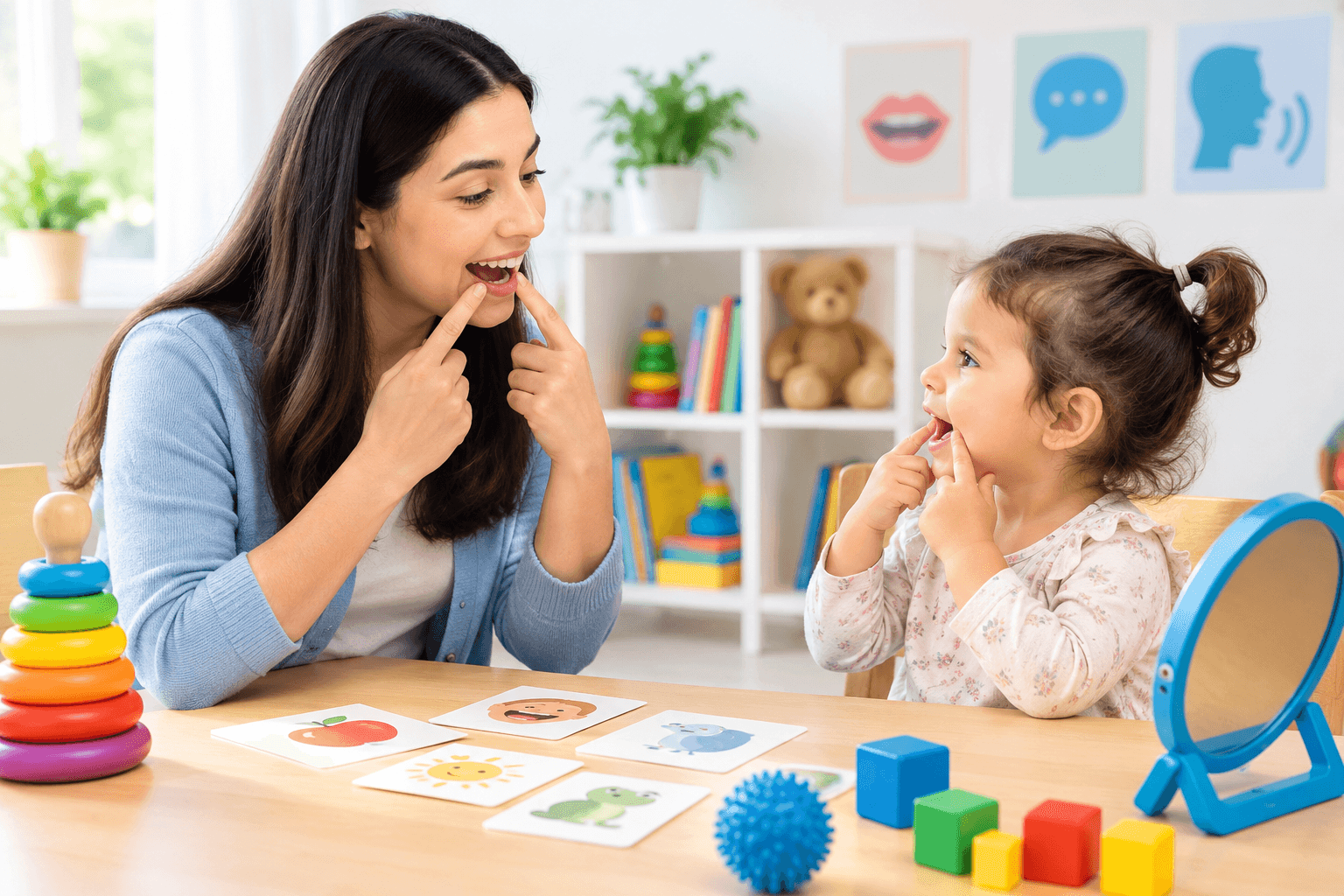
Sit with your toddler in front of a mirror and make silly faces: tongue out, big smile, kiss lips, puffed cheeks. They watch their own mouth move, which supports the motor planning that clear speech depends on.
9. Sound Treasure Hunt
Hide small toys that start with the same sound (a ball, a bear, a banana) and hunt for them together, saying the sound each time. You’re training the ear to notice sound patterns, which is an early building block of later speech clarity and reading.
10. Slow Down and Wait
This one is free and powerful. After you speak or ask something, count silently to five. Many toddlers need that extra processing time to organise a response. Rushing in to fill the silence can accidentally switch off their attempt.
Where to Find Speech Therapy Activities for Toddlers at Home PDF Options
A lot of parents search for a speech therapy activities for toddlers at home pdf because they want something they can print and stick on the fridge. That’s a smart idea. A one-page checklist keeps you consistent when life gets chaotic.
If you want to build your own, here’s a simple layout. Divide a page into three columns: “Sounds,” “Words” and “Play.” Under each, list two or three of the activities above. Tick them off as you go. Keep it to one page, because a long list becomes a guilt list.
When you look for a speech therapy activities pdf free download for toddlers, check that it was written or reviewed by a licensed speech-language pathologist, that the activities match your child’s age, and that it focuses on play, not drills. Be wary of anything promising a fixed timeline for first words. Every toddler’s brain develops at its own pace.
Make Practice Stick: A Simple Routine
Consistency beats intensity. Brains learn best from small, regular doses, so aim for five to ten minutes of focused play, two or three times a day. Tie activities to routines you already have: bath time songs, snack-time choices, bedtime books.
A few ground rules keep things positive:
Follow your child’s lead. If they love trains, use trains.
Model, don’t correct. If your toddler says “wawa,” respond with “Water! You want water.”
Stop before they’re tired. End on a success so the brain links talking with feeling good.
Keep your own stress low. Toddlers read tension fast, and pressure to “say it right” can make speech harder, especially if your child has any early disfluency.
When Home Activities Aren’t Enough
Home play is a wonderful foundation, but it isn’t a replacement for professional support when something seems off. It’s worth seeking an evaluation if your toddler:
Has no words by around 16 months, or fewer than about 50 words by 24 months
Isn’t combining two words by around 2 to 2.5 years
Seems to lose words they once had
Doesn’t respond consistently to their name or to simple instructions
Repeats sounds or gets visibly stuck or tense when trying to speak
Is very hard for family members to understand after age 3
These are general guideposts, not a diagnosis, and a hearing check is usually a good first step. Early help works best because a young brain is still so adaptable. Waiting rarely helps and acting early rarely hurts.
If you’re not sure whether what you’re seeing is typical, you don’t have to figure it out alone. You can book a free stuttering consultation with our team to talk through your toddler’s speech, ask questions and get a clear idea of the next step. There’s no pressure and no jargon, just honest guidance.
A Quick Word on Early Stuttering
Many toddlers go through a phase of repeating sounds or words (“I-I-I want that”) as their language explodes faster than their speech motor system can keep up. For lots of children this settles on its own. For others it sticks around, especially if there’s a family history or if it comes with visible tension or struggle.
The most helpful things you can do are to stay relaxed, give your child your full attention, avoid finishing their sentences, and resist telling them to “slow down” or “take a breath.” Those well-meant comments can add pressure. If the pattern lasts more than a few months, or you’re worried, an early assessment gives you clarity.
Putting It All Together
Here’s the short version. Speech therapy activities for toddlers work best when they are playful, repetitive and woven into daily life. Narrate, sing, blow bubbles, read the same book fifty times, and give your child time to answer. Print a simple checklist if it helps you stay on track, and trust your instincts if something feels different.
Every one of these activities is really a way of giving the speech brain the right kind of practice at the right time. If you’re curious about how the brain shapes fluent speech and why early, low-pressure support matters so much, you can read more about neuroscience stuttering and how our approach is built around the brain, not just the mouth.
Your toddler doesn’t need perfect sessions. They need you, a bit of patience and plenty of play. Start with one activity today, and let the brain do what it does best.
Ready to Put This Into Practice?
Download the app and start practicing today
Reading is the first step. Real progress comes from consistent daily practice. Use StopStutter to build confidence and improve your speech every day.