ReviewOctober 14, 2026
Speech Therapy for Selective Mutism
Picture a child who chatters nonstop at home, singing, arguing about dinner, narrating every toy in the room. Then she walks into school and goes completely silent. Her teacher thinks she’s shy. Her classmates think she doesn’t want to talk. Her parents know something else is going on, but they can’t quite name it.
That is selective mutism. It isn’t shyness, and it isn’t stubbornness. It’s an anxiety-driven freeze in specific situations, and it’s far more common than most people realize. If you’ve started looking into speech therapy for selective mutism, you’re already doing the most important thing: taking it seriously.
At StopStutter, we work with people whose speech gets stuck under pressure, and while selective mutism and stuttering are not the same thing, they share an important root. In both, the brain’s threat system interferes with the brain’s speech system. If you want to understand how to stop stuttering or how silence gets locked in under stress, the answer starts in the same place: the nervous system, not willpower.
That’s why we lean on a brain-based approach, and why our online stuttering therapy is built around how the brain actually learns to feel safe while speaking. Let’s walk through what selective mutism really is, what good therapy looks like, and what realistic goals can look like.
What Selective Mutism Actually Is
Selective mutism is classified as an anxiety disorder. A person is fully capable of speaking and does so comfortably in some settings, usually at home. In other settings, such as school, a doctor’s office, or social gatherings, speech simply doesn’t come out.
It’s not a choice. Ask anyone who lives with it and they’ll tell you the same thing: they want to speak. The words are there. Something between the thought and the voice shuts the door.
It most often appears in early childhood, around the time kids start school, but it can continue into adolescence and adulthood when it isn’t addressed. Many adults carry it quietly for years, developing elaborate workarounds like texting instead of calling, nodding instead of answering, or avoiding anything that might put them on the spot.
Why the Brain Goes Silent
Here’s where neuroscience changes the conversation.
Deep in the brain sits the amygdala, your threat detector. Its job is to scan for danger and trigger a protective response in a fraction of a second. For someone with selective mutism, certain situations register as unsafe. That might be being called on in class, being watched while speaking, or being expected to answer a stranger.
When the amygdala fires, it can dampen activity in the areas that coordinate speech and drive the freeze response. The body goes into a kind of shutdown. It isn’t dramatic from the outside, which is part of why it gets misread as defiance or shyness. Inside, though, it’s a full-blown alarm.
Here’s the hopeful part. The brain is plastic, meaning it can rewire its associations with experience. A situation that once tripped the alarm can, with the right repeated experiences, stop doing so. That’s the principle that good therapy is built on.
Why Speech Therapy for Selective Mutism Works
Many families assume that if a child isn’t talking, the problem must be pressure, so the answer is to push. In practice, it’s almost the opposite. Pressure is exactly what keeps the alarm ringing.
Effective speech therapy for selective mutism does not force speech. Instead, it lowers the threat level step by step, so the brain has a chance to learn that speaking in this setting is safe. A skilled speech-language pathologist works on:
Reducing the expectation to talk, so the amygdala stops treating the room as dangerous
Building comfort first through nonverbal communication, such as gestures, writing, or pointing
Moving gradually toward sounds, single words, short phrases, and eventually conversation
Practicing in the real settings where the person struggles, with the help of trusted people
Celebrating small wins without making a big deal of them, because attention can raise pressure
This gradual ladder approach is sometimes called stimulus fading or a graded exposure hierarchy. The names sound clinical, but the idea is simple: change one thing at a time, so the brain never has to leap too far.
What a Session Might Actually Look Like
Parents often imagine therapy as a child sitting across from an adult being asked questions. For selective mutism, it rarely looks like that.
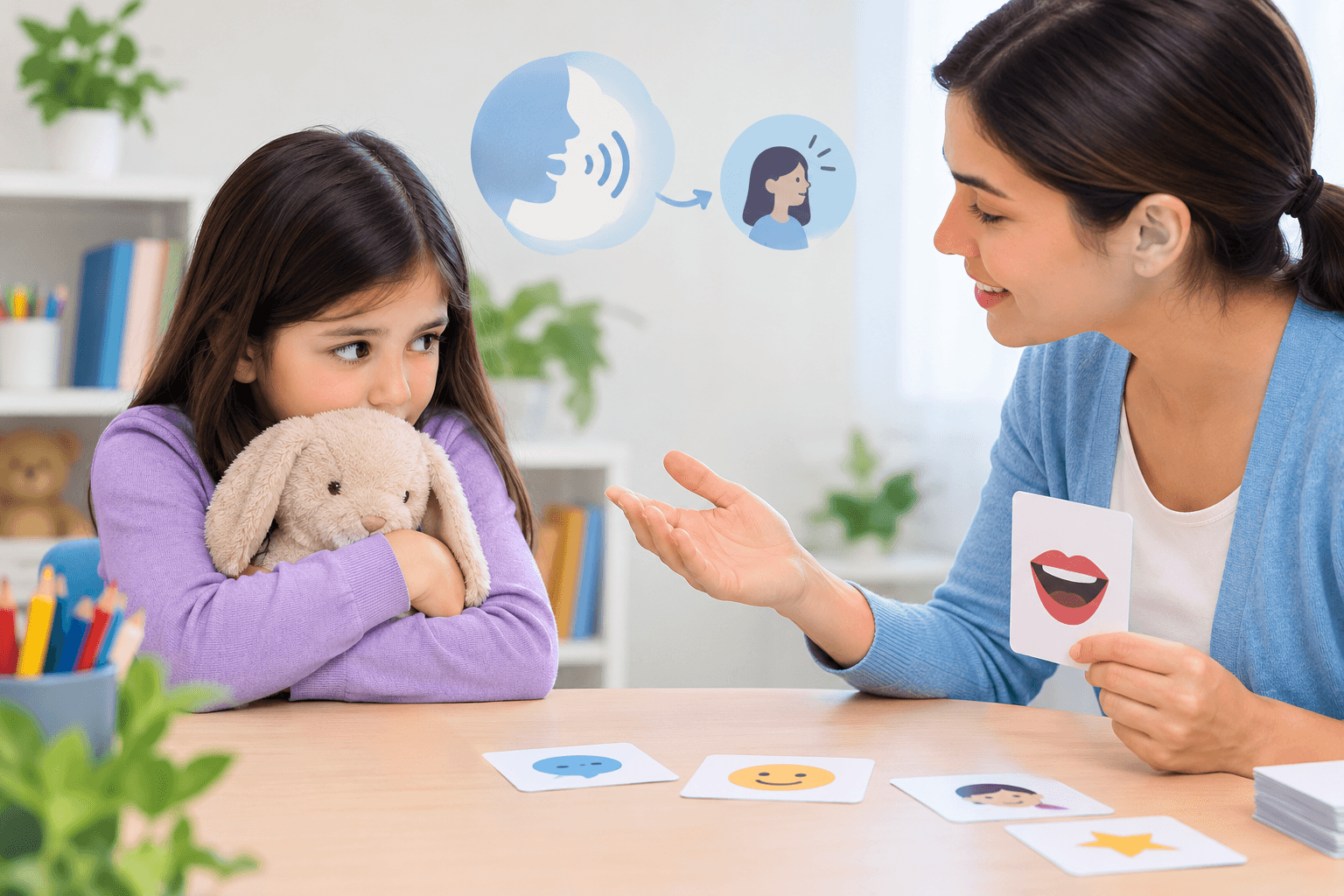
Early sessions might involve play, games, drawing, or shared activities where talking isn’t required. The therapist may start by simply being a safe, low-pressure presence. A child might whisper to a parent while the therapist is in the room, then whisper while the therapist sits slightly closer, then eventually say a word directly to the therapist.
Each of these steps looks tiny, but each one teaches the brain something. This person is not dangerous. Speaking here doesn’t lead to being judged. I can do this. Done repeatedly, those experiences quietly rewire the connection between context and fear.
Setting Realistic Goals
One of the most common questions we hear is about speech therapy goals for selective mutism. Parents want to know what progress is supposed to look like, and what the finish line is.
The honest answer is that goals should be small, specific, and measurable, and they shift as the person grows more comfortable. A typical progression might include:
Comfort goals. Staying calm in the therapy room, making eye contact or gestures, and participating nonverbally.
Sound and word goals. Producing a sound or a single word to a chosen person, even in a whisper.
Phrase and sentence goals. Answering simple questions and making short requests in a target setting.
Conversation goals. Holding back-and-forth exchanges with a teacher, peer, or relative.
Generalization goals. Carrying speech across new people, new places, and unexpected situations.
Notice that none of these says “talk more.” They’re built around the brain’s comfort level, not a performance target. If you’re searching for goals for selective mutism speech therapy, the best ones are always tied to a real situation that matters to the person, like ordering food, answering the teacher’s roll call, or saying hello to a neighbor.
Where Families Often Go Wrong
Many parents, understandably, want to help and end up making the freeze stronger. A few patterns to watch for:
Speaking for the child. It feels kind in the moment, but it removes any chance to practice.
Asking lots of direct questions. A flood of “Can you say hi? Can you tell her your name?” raises pressure fast.
Rewarding speech too loudly. Big celebrations can backfire because they make the person feel watched.
Waiting it out. Selective mutism rarely disappears by itself, and early support makes a big difference.
None of this is about blame. These are natural instincts that come from love. A good therapist will help you swap them for approaches that actually lower the threat.
When Support Matters Most
If you’ve noticed a pattern of silence in specific settings that has lasted more than a month, it’s worth speaking with a professional. That’s especially true if it’s affecting school, friendships, or confidence. Early support tends to lead to faster, smoother progress, but it’s never too late. Teens and adults make real gains too.
If you aren’t sure where to begin, you don’t have to figure it out alone. You can book a free stuttering consultation and talk through what you’re seeing with someone who understands how the brain handles speech under pressure. It’s a no-pressure conversation, and it can help you decide on a sensible next step.
The Role of Safety in Speech
Think of speech as something the brain only does freely when it feels safe. A relaxed brain produces speech almost automatically. A threatened brain holds it back, either by freezing, as in selective mutism, or by disrupting the flow, as in stuttering.
This is why so many traditional approaches fall short when they focus only on the mouth, the voice, or the words. If the nervous system keeps sounding the alarm, no amount of technique will fully override it. The most lasting progress comes when the person’s brain genuinely learns that speaking is safe.
That understanding shapes everything we do. Rather than drilling speech mechanics, we focus on calming the response underneath. When the alarm quiets, the voice tends to follow.
Practical Ways to Support Progress at Home
While professional therapy does the heavy lifting, families play a big part. A few things that tend to help:
Keep the home a pressure-free zone. Let speech happen naturally without quizzing or correcting.
Arrange low-stakes social time. Short, predictable playdates with one familiar person work better than big groups.
Talk about anxiety openly. Explain that the freeze is a brain reaction, not a flaw, so the person doesn’t feel ashamed.
Stay consistent with the therapist’s plan. Small steps practiced regularly beat big leaps attempted rarely.
Be patient with setbacks. A rough week doesn’t erase progress. The brain is still learning.
Above all, aim for warmth rather than urgency. When someone feels accepted exactly as they are, the pressure drops, and that’s where growth starts.
Hope Is Built Into the Brain
If you take only one thing from this article, let it be this: selective mutism isn’t a permanent trait. It’s a learned association between certain situations and fear, and what’s learned can be unlearned.
With patient, gradual, brain-informed support, people move from silence to whispers, from whispers to words, and from words to confident conversation. We’ve seen how life opens up when the weight of that silence lifts. Friendships form, classrooms feel survivable, and a person’s real personality finally gets room to be heard.
If you’d like to understand the science behind this approach in more detail, you can read about neuroscience stuttering and how retraining the brain’s response to speaking can change what feels possible.
Ready to Put This Into Practice?
Download the app and start practicing today
Reading is the first step. Real progress comes from consistent daily practice. Use StopStutter to build confidence and improve your speech every day.