


ReviewSeptember 11, 2026
Stuttering Blocks: What They Are and How to Get Through Them
You know exactly what you want to say. The sentence is ready, your mouth is set, and then nothing comes out. Your jaw tightens, your breath catches, and one second stretches into something that feels endless. If that sounds familiar, you already know what stuttering blocks feel like.
Stuttering blocks are one of the three core types of stuttering, and they’re often the hardest to explain to other people. From the outside, a block can look like a long pause. From the inside, it feels like a fight you never signed up for. In this guide we’ll cover what a speech block actually is, the different types of stuttering blocks, why they happen, and what helps. If you want the wider picture, our main page on how to Overcome stuttering is a good companion to this article.
One quick note before we start. Everything here is general education, not a diagnosis, and a certified speech-language pathologist should assess your speech. If you’d like to work with a team that focuses on what’s going on in the brain, our online stuttering therapy program was built for exactly that.
What Is Blocking in Stuttering? (And What Is a Speech Block?)
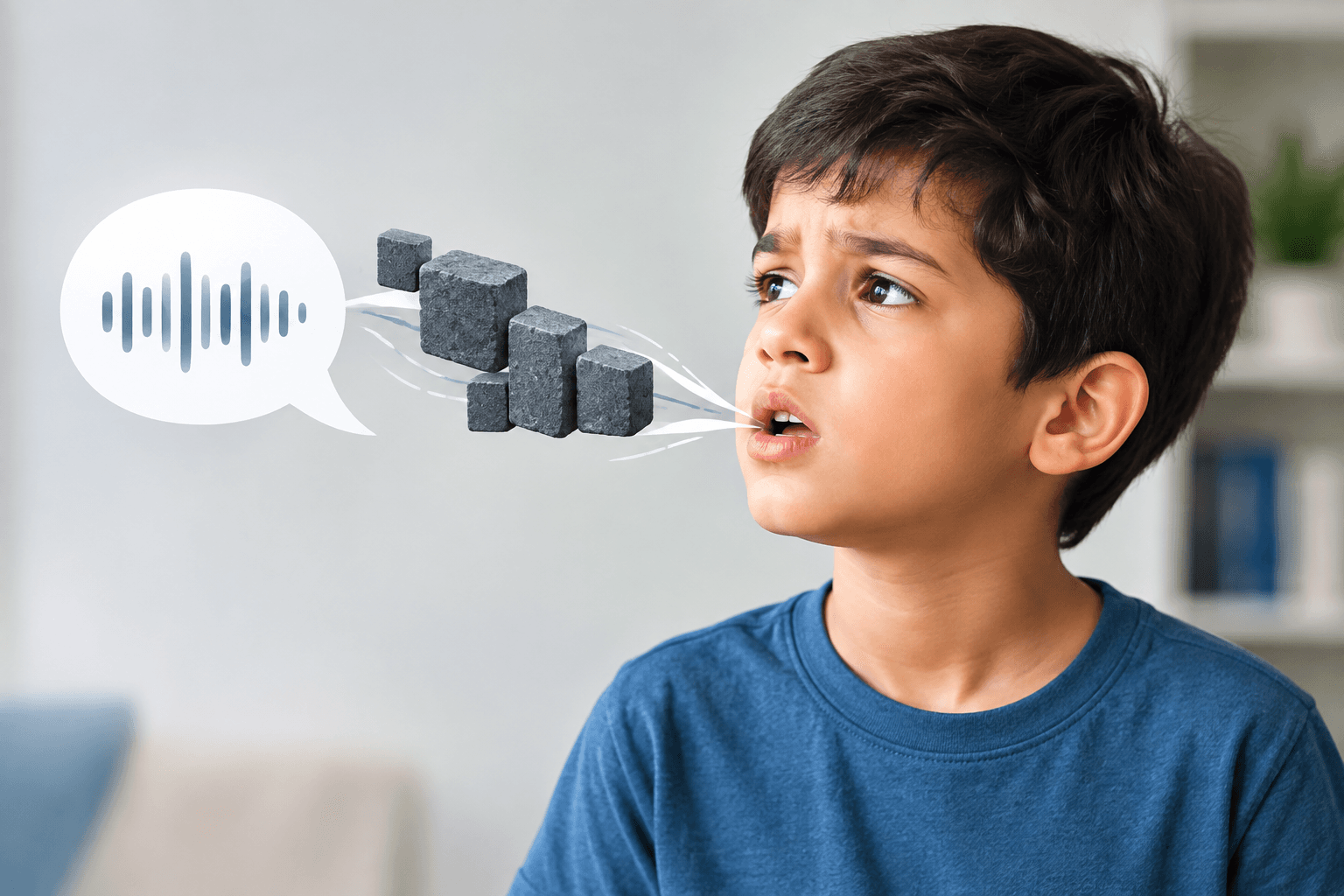
A speech block, also called a stuttering block, is a moment when speech stops and no sound comes out, even though you’re trying to talk. Your mouth is ready, but the airflow or voice is held up, usually with tension in the jaw, lips or throat. A block can last a split second or several long seconds.
So if you’ve ever wondered what is blocking in stuttering, the short answer is silence where a sound should be. Speech-language pathologists usually describe stuttering in three forms: repetitions repeat a sound or word, prolongations stretch a sound out, and blocks stop it entirely.
Common signs of a stuttering block include:
A silent mouth, open or pressed shut, where a sound should start
Held breath or a tight throat
Tension in the lips, jaw or neck
Eye blinks, head movements or other visible effort
A sudden burst of speech when the block finally lets go
Types of Stuttering Blocks
Not every block looks or feels the same. Clinicians often describe them by where the tightness shows up, and most people notice a mix.
Breath blocks. Your breath gets held or cut off just before you speak, so there’s no airflow to carry the sound.
Voice-box blocks. The vocal folds clamp shut, or sometimes stay open without making voice, so the sound can’t get started.
Mouth blocks. Your lips press together, your tongue locks against the roof of your mouth, or your jaw freezes in place.
Blocks also differ in how much struggle shows. Some come with a strained face, a shaky jaw or a held breath. Others are almost invisible.
Silent Blocks in Stuttering: The Ones Nobody Hears
Silent blocks are the version most people picture. Your mouth is set, your lips or tongue are in position, and nothing comes out. No repeated sound, no stretched sound, just a gap. Because there’s nothing to hear, listeners often read a silent block as shyness or someone hunting for a word, which is a big reason it can feel so lonely.
Block Stuttering Example: What a Block Feels Like From the Inside
Ask ten people who stutter to describe a block and you’ll hear ten versions of the same thing. “My throat just locks.” “The word is behind glass.” “I can see the whole sentence but I can’t get the first sound out.”
Take something small, like saying your name in a meeting. You’ve said it thousands of times. But as your turn gets closer, your chest tightens and you start scanning for an easier way in. When you finally try, your lips press together and the sound won’t start. Two seconds pass and it feels like twenty. Then the word either releases in a rush, or you give up and say something else.
Here’s how the three types of stuttering might look written out. A repetition sounds like “I’d like a c-c-coffee.” A prolongation sounds like “I’d like a cooooffee.” A block sounds like “I’d like a...” followed by two seconds of nothing, a tight jaw, and then “coffee” arriving all at once. Same word, three very different experiences.
That gap between the word you wanted and the word you said is where most of the frustration lives. It’s also why one stuttering block can make someone dread the next phone call, the next introduction, the next simple question.
Stuttering Blocks vs Repetitions and Prolongations
With repetitions and prolongations, some sound still reaches the listener. They can hear you’re working on a word. Blocks are different. There’s only silence.
Why Speech Blocks Get Mistaken for Hesitation
Because speech blocks make no sound, people assume you’re thinking, hesitating or have lost your train of thought. That’s one reason blocks can feel like the most isolating type, and why many people work so hard to hide them.
Blocks also tend to show up later than repetitions. A child may repeat sounds easily at first. Years of bracing for the next difficult word can turn that easy repetition into a tight, silent block.
Why Block Stuttering Happens: What Research Tells Us
Let’s be honest: there’s no single cause of block stuttering, and anyone who gives you one neat answer is oversimplifying.
Speaking is one of the most complex things your body does. Your brain has to plan the words, then time and sequence dozens of tiny muscle movements across your breath, voice box, tongue and lips, all within fractions of a second.
Brain imaging studies suggest that in people who stutter, the networks that coordinate this timing communicate a little differently. Genetics also play a real role, which is why stuttering often runs in families. Researchers have also found that blocks aren’t all the same physical event. In some, the vocal folds clamp tight. In others, they stay open, and it varies from person to person.
There’s a learned layer too. For some people, a block becomes a way of bracing against an expected stutter. You tense up so you won’t be heard stuttering, and the tension itself shuts the door. What’s clear is that blocks aren’t a sign of weakness, nerves or not trying hard enough.
Why Stuttering Blocking Gets Worse When the Pressure Is On
If you block more on phone calls, introductions or your own name, you’re not imagining it. Stuttering blocking tends to rise when the stakes feel high. The brain’s threat response raises muscle tension, and a tense speech system is more likely to lock up. Then the block seems to confirm the fear, and the loop tightens: anticipate, tense, block, dread, repeat.
This is also why willpower alone rarely fixes it. Pushing harder against a block usually makes it longer. What helps is changing what your brain and body do in the seconds before and during the word, and that’s easier with someone looking at your actual pattern. If you’d like that, you can book a free stuttering consultation and talk through what your blocks look like and where it makes sense to begin.
What Doesn’t Work (and Why)
Two habits feel like solutions in the moment, but they tend to backfire.
The first is word-swapping. If you change “coffee” to “a hot drink” every time you sense a block coming, you do get through the sentence, but your brain learns that the original word is dangerous. The fear grows, and the next block gets more likely.
The second is forcing. Squeezing the word out with more effort can sometimes break through, but it adds the very tension that creates blocks. Over time it makes speaking more tiring and the blocks more stubborn.
How to Get Through a Stuttering Block in the Moment
Speech-language pathologists commonly teach four ways to get through a block. You don’t need all of them, and most people end up leaning on one or two.
Ease in. Before a hard word, take a relaxed breath and start the first sound softly rather than forcing it out.
Pull out. If you’re already stuck, stop pushing, soften the tension, and slowly stretch the sound until the word comes free.
Cancel. After a block, pause, drop your shoulders and say the same word again, more gently.
Let a little sound in. If silent blocks keep happening, let some voice leak out instead of holding everything back.
None of these is a magic trick. They take practice, ideally somewhere low-pressure first, like reading aloud alone or talking with someone you trust.
Speech Therapy for Stuttering Blocks: What Happens in a Session
If you’ve been looking into blocked speech therapy sessions, it helps to know what they usually involve. A session focused on blocks tends to start with listening. Your clinician wants to see where your blocks happen, in your breath, voice box, lips or tongue, and what you do right before and after one.
From there, most sessions mix three things: awareness work so you can catch tension building before the block, practice with in-the-moment tools in easy settings first and harder ones later, and work on the fear and avoidance around difficult words, since that’s often what keeps blocks stubborn.
A few good questions to ask any clinician: Have they worked with teens or adults who stutter? How do they handle avoidance and word-swapping? What will you practice between sessions? If you’re in the US, you can search for a certified speech-language pathologist through ASHA’s ProFind directory, and school-age kids can often get an evaluation through their school district at no cost to the family.
Can Stuttering Blocks Be Reduced Over Time?
Many people find their blocks become less frequent, shorter and less tense with the right support, though results vary and no honest clinician can promise a specific outcome. What tends to make the biggest difference is addressing both sides of the problem: the speech-motor timing and the fear loop that builds on top of it.
That’s the thinking behind our approach to neuroscience stuttering work. Instead of treating a block as a flaw to be forced away, it focuses on how your brain predicts, plans and reacts around speech, and on retraining those patterns step by step.
When to Get Help for Stuttering Blocks
If blocks are making you avoid calls, meetings, ordering food or saying your own name, that’s reason enough to talk to a professional. You don’t have to wait until it feels “bad enough.” A stuttering block is a moment, not a verdict on you or your voice.
Stuttering Blocks: Frequently Asked Questions
What is a stuttering block?
A stuttering block is a moment when you try to speak and no sound comes out. Your lips, tongue, throat or breath get stuck in position for anywhere from a split second to several seconds.
What are silent blocks in stuttering?
Silent blocks are blocks where nothing is heard at all, no repeated sound and no stretched sound. The mouth is set to speak, but airflow or voice is held back.
What causes block stuttering?
There isn’t one cause. Research points to differences in how the brain times speech movements, plus genetics. Stress and fear of stuttering can add tension that makes a block more likely.
Can speech therapy help with stuttering blocks?
Many people find their blocks get shorter and less tense with the right support, though no clinician can promise a specific result. A certified speech-language pathologist can help you work out where to start.
Ready to Put This Into Practice?
Download the app and start practicing today
Reading is the first step. Real progress comes from consistent daily practice. Use StopStutter to build confidence and improve your speech every day.


