ReviewOctober 14, 2026
Syllable timed speech
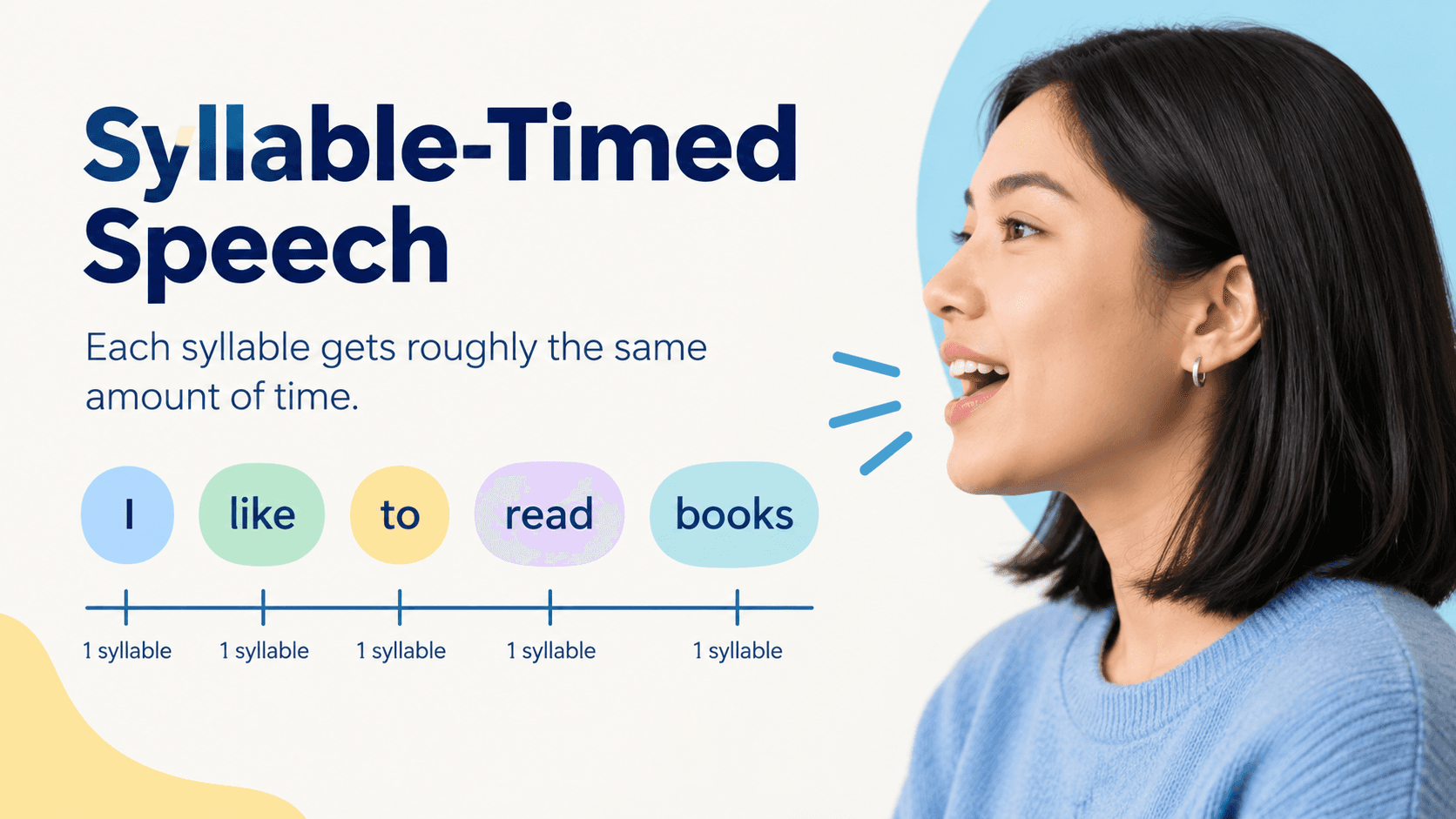
Syllable timed speech is a speaking pattern where every syllable gets about the same length and stress, like a steady beat. Instead of the usual rise and fall of English rhythm, you speak in an even, metronome-like flow. Research shows it can sharply reduce stuttering, often within minutes. If you want the bigger picture of how to stop stuttering, this technique is one useful tool, not the whole answer.
This guide covers how it works in the brain, how to practice it, and where it falls short.
How Syllable Timed Speech Works
Most English speakers use stress-timed rhythm. Some syllables are long and loud. Others are short and quick. That uneven pattern asks your brain for constant, fine-tuned timing.
Syllable timed speech flattens it. Every syllable gets the same beat. Think of the even tap-tap-tap cadence of French or Spanish.
Compare the two:
Normal English: “I’d LIKE to ORder a LARGE cofFEE.”
Syllable timed: “I’d-like-to-or-der-a-large-cof-fee,” every beat equal.
What the research shows
Studies on adults and children who stutter report big drops in stuttered syllables when speakers use this pattern. Some people become almost fluent in the moment. That effect is real and measurable.
Why it helps in the moment
An outside rhythm gives your brain a timing cue it doesn’t have to build alone. Many researchers believe the timing circuits linking the basal ganglia and motor areas work less smoothly in people who stutter. A steady beat supports those circuits.
Why Rhythm Quiets the Stuttering Alarm
Timing is only half the story. The other half is prediction.
The neuroscience method starts from a clear principle. Core disfluency has a genetic and neurodevelopmental basis. That part is not your fault, and it is not a bad habit you can simply cure.
But stuttering has learned layers on top of that base:
Anticipatory fear: your brain predicts a block before you speak.
Physical tension loops: your jaw, throat, and breath tighten to “prevent” it.
Avoidance traps: you swap words, skip calls, or stay quiet.
These learned layers can be retrained through neuroplasticity. That is where rhythm gets interesting.
The prediction error effect
Your brain predicts: “This word will block.” You speak with an even beat, and the word comes out smoothly. The prediction was wrong. That mismatch is a prediction error.
Enough prediction errors teach your brain that the threat was overestimated. Your nervous system alarm drops. The learned block weakens.
One honest caveat: weakened pathways don’t vanish. They can resurface under heavy stress, fatigue, or pressure. That’s normal, not failure.
Syllable Timed Speech vs. Traditional Speech Therapy
Some people think speech therapy only trains the mouth: slower rate, softer starts, controlled breathing. That’s outdated. Modern speech-language pathologists use mind-body approaches too, including cognitive behavioral therapy (CBT), desensitization, and work on avoidance and confidence.
Syllable timed speech sits inside that wider toolbox. It belongs to the fluency shaping family, which changes how you speak. Other approaches change how you relate to speaking.
Where each approach helps most
Rhythm-based techniques: fast, visible drops in stuttering
CBT and desensitization: less fear and shame around speaking
Brain-based retraining: targets the predictions and tension loops that keep blocks alive
The best results usually come from combining them. If you want guided support, online stuttering therapy can walk you through that mix with a coach who understands the brain-based model.
How to Do Syllable Timed Speech: Step by Step
The technique is simple to describe and harder to master. Keep it relaxed. A tense, robotic delivery defeats the purpose.
The basic mechanics
Give every syllable equal length. No stretching, no clipping.
Keep volume even. Don’t punch the “important” syllables.
Use a comfortable pace. Slightly slower than usual is fine.
Breathe at phrase breaks. Don’t force a whole sentence onto one breath.
Stay loose. Check your jaw, tongue, and throat.
Start small
Begin alone. Read a paragraph aloud and tap a finger on each syllable. The tap keeps your timing honest. When that feels easy, drop the tapping. Speak to a mirror, then a pet, then a safe person.
Common mistakes
Speaking too fast and losing the beat
Gripping the muscles of your face and neck
Using it only on “scary” words, which feeds avoidance
Expecting it to sound natural right away
The Limits of Syllable Timed Speech
Here’s the part many articles skip. Rhythm is a powerful crutch, but a crutch is not a cure.
Why fluency can fade
It sounds unnatural. Many people drop it in real conversations.
It takes effort. Under stress, you slip back to old patterns.
It can become a safe behavior. If you lean on it to dodge blocks, your brain never learns that a block is survivable.
That last point matters most. A technique used from fear reinforces the fear. A technique used as an experiment builds evidence against it.
The better way to use it
Treat rhythm as a training wheel. Use it to create early wins and lower your alarm. Then let your natural speech return, with less fear driving it.
A Real-World Script: Rhythm as a Prediction Error
Here’s what this looks like at work. Maya has to introduce herself in a team meeting. Her name has always been a trigger word.
Setting: Monday meeting. Eight people on video. Maya is next.
Boss: “Maya, want to introduce yourself to the new team?”
Maya: (feels her chest tighten and her brain shouts “you’ll block on your name”; exhales slowly and drops her shoulders) “Hi... everyone.”
Maya: (unclenches her jaw, lets her tongue rest, sets a steady beat in her head) “I’m-May-a-Sing-h, and-I-just-joined-the-de-sign-team.”
Boss: “Welcome, Maya!”
Maya: (notices her heart rate settling and thinks: “I predicted a block. It didn’t happen.”) “Thanks! Glad-to-be-here.”
What just happened
She named the prediction instead of hiding from it.
She released tension first, then spoke.
She logged the mismatch between fear and reality. That is the learning moment.
Her speech didn’t need to be perfect. It needed to teach her brain something new.
Your Daily Syllable Timed Speech Protocol
Practice little and often. Ten focused minutes beat an hour of strain.
Daily routine
☐ Minutes 1-2: Drop your shoulders. Breathe low and slow. Soften your jaw.
☐ Minutes 3-5: Read aloud, tapping one finger per syllable.
☐ Minutes 6-7: Repeat without tapping. Keep the beat in your head.
☐ Minutes 8-9: Say three phrases you usually fear. Predict a block, then notice what happens.
☐ Minute 10: Write one line: “I predicted ___. What happened was ___.”
Weekly progression
☐ Week 1: Practice alone, with taps.
☐ Week 2: Use it in low-stakes talk, like ordering a drink or saying hello.
☐ Week 3: Use it on one planned phone call or meeting comment.
☐ Week 4: Speak naturally and drop the rhythm on easy sentences. Keep it for hard moments.
Track your wins
Count prediction errors, not perfect sentences. Each time you expect a block and it doesn’t come, you’ve retrained a little more of the learned layer.
Frequently Asked Questions
What is syllable timed speech?
It’s a speaking style where every syllable has equal length and stress. Think of a steady beat, not a natural English rhythm. Studies show it can reduce stuttering sharply.
Does syllable timed speech cure stuttering?
No. It reduces stuttering while you use it. Core disfluency has a neurodevelopmental basis, so lasting change needs more than rhythm alone.
How long does it take to learn?
Many people feel the effect in one session. Making it comfortable and flexible usually takes weeks of short, daily practice.
Why does it sound robotic?
Equal stress removes the usual rise and fall of English. A slower, relaxed delivery with gentle phrasing sounds more natural over time.
Can children use syllable timed speech?
Yes, and studies include children. A qualified speech-language pathologist should guide it so it stays playful, low-pressure, and matched to the child.
Is it better than speech therapy?
It’s a tool within therapy, not a replacement. Combining rhythm with CBT, desensitization, and brain-based retraining works best for most people.
Where to Go From Here
Rhythm gives you a quiet window. Use it to gather proof that your brain’s alarm is wrong, one small prediction error at a time. Your genetics set the starting point, but fear, tension, and avoidance are learned, and anything learned can be retrained. Start with ten minutes today, stay curious instead of perfect, and let syllable timed speech be your first step toward speaking with less fear.
Ready to Put This Into Practice?
Download the app and start practicing today
Reading is the first step. Real progress comes from consistent daily practice. Use StopStutter to build confidence and improve your speech every day.