


ReviewNovember 12, 2026
Toys to Help With Speech Delay: What Really Works, and Why Your Child's Brain Cares
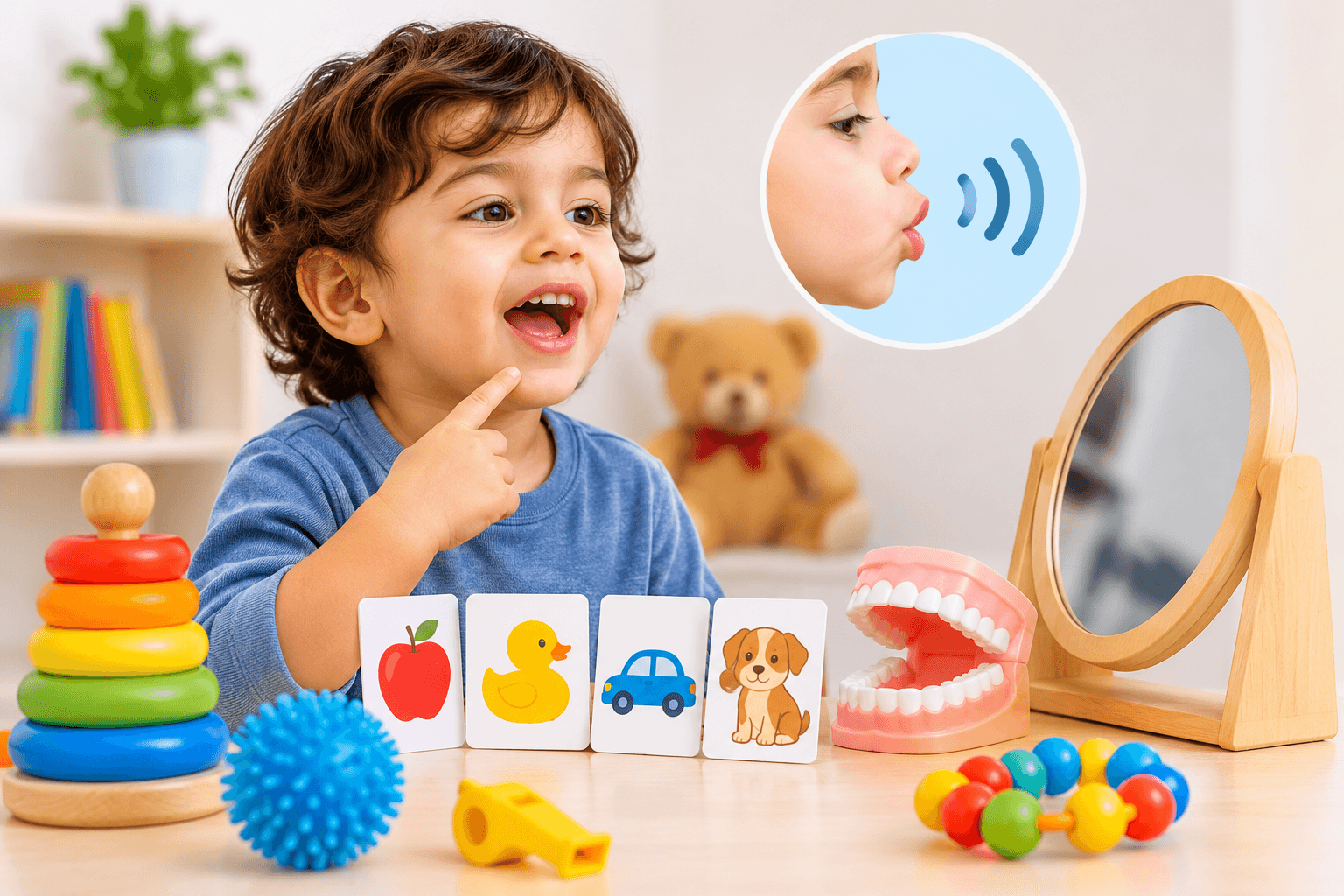
If you're standing in a toy aisle right now, or scrolling at midnight with a dozen tabs open, trying to work out which toys to help with speech delay are actually worth buying, take a breath. You're not alone, and you're not behind. Every box on the shelf promises to "boost language." Most of them are just noisy plastic. And here's the honest truth: no toy talks for your child. What a good toy does is create a moment where talking feels worth the effort.
We spend our days at Stop stuttering working with the brain circuits behind speech, and one thing becomes obvious fast. Speech isn't just words. It's timing, movement, attention and emotional safety, all landing at once. Stuttering and speech delay aren't the same thing, but both come down to how a brain learns to coordinate all of that. So the way we think about toys comes straight from neuroscience.
First, a quick definition. A speech delay means a child is saying fewer words, or using simpler sounds and sentences, than most children their age. Some kids are late talkers who catch up with very little help. Others need real support. A toy can't tell you which group your child belongs to, and it's no replacement for an evaluation. But the right toys, used the right way, give you one of the best tools there is: daily, low-pressure practice.
If your older child is also repeating sounds or getting stuck on words, that's a different path, and our online stuttering therapy is designed for exactly that. For everyone else, let's talk toys.
What Happens in the Brain When a Child Learns to Talk
Between birth and about age three, a child's brain builds connections at a staggering pace. Language doesn't live in one spot. Hearing areas, the movement areas that control lips and tongue, memory and attention all have to talk to each other first. Every time your child hears a word while looking at something they care about, those connections get a little stronger. Neuroscientists call this experience-dependent plasticity, which is a fancy way of saying the brain builds what it uses.
Two ingredients matter most. The first is joint attention, meaning you and your child are looking at the same thing at the same time. The second is repetition with a little variety. And there's a bonus ingredient: excitement. A child who's delighted is a child whose brain is primed to learn. That's why a plain wooden spoon your toddler loves will beat an "educational" gadget they ignore, every single time.
How to Choose Toys to Help With Speech Delay
Before any list, here are four rules worth keeping in your pocket.
Simple beats electronic. A toy that talks leaves no room for your child to talk. You want toys where you are the voice.
Open-ended beats one-trick. A set of blocks can become a tower, a phone, a sandwich. More uses means more words.
Repeatable beats novel. Kids learn words through hearing them again and again in the same situation. Don't rotate toys too fast.
Shared beats solo. If a toy works without you, it's probably not doing much for language.
Best Toys to Help With Speech Delay, Sorted by What They Do
There isn't one magic product, so here are the best toys to help with speech delay grouped by the kind of talking they invite.
Pretend play sets. A toy kitchen, a doll with a blanket, a farm set or a tea party. These bring out everyday words like "more," "stir," "hot" and "night-night." Pretend play also builds symbolic thinking, the mental leap that one thing can stand for another, and that leap sits right underneath language.
Cause-and-effect toys. Ball ramps, pop-up toys, wind-ups. They come with built-in words: "go," "again," "uh-oh," "stop." The payoff is big and instant, so your child has a reason to ask for more.
Chunky blocks and stacking toys. Up, down, crash, more, my turn. Building and knocking down is predictable, and predictability is gold for a brain learning patterns.
Bubbles and balloons. Not strictly toys, but they work beautifully. Kids ask for "pop," "more" and "open," and blowing bubbles gives lips and breath a gentle workout.
Board books and lift-the-flap books. Short, repetitive and full of pointing and naming. Read the same one fifty times. Yes, really.
Simple instruments. A drum, a shaker, a small xylophone. Rhythm and speech lean on shared timing circuits in the brain, so banging along together quietly trains turn-taking and timing at the same time.
Shape sorters and knob puzzles. Perfect for tiny, repeatable phrases like "in," "out," "on" and "your turn."
Animal sets. "Moo," "baa" and "woof" are easy first sounds, and a child who can't say "cow" yet can often say "moo" with total confidence.
Toys That Sound Helpful but Usually Aren't
A few categories get marketed hard to worried parents. Button-heavy talking toys, tablet apps and flashcard drills tend to be passive: your child taps, the toy talks, and nobody has a conversation. Early language research keeps pointing to the same thing, which is that back-and-forth interaction with a real person drives progress. None of these are "bad," exactly. They just can't do the job you can.
When Toys Alone Aren't Enough
Toys are support, not treatment. If your child isn't using any words by around 16 months, isn't putting two words together by about age two, or you simply have a nagging feeling something's off, trust it. Early help works best because young brains are at their most adaptable. A hearing check is also a smart first step, since muffled hearing can look a lot like a speech delay.
If you're not sure where your child falls, you can book a free stuttering consultation and talk it through with our team. If it turns out your child needs a different kind of support, we'll help you work out where to go next. No pressure, just clarity.
How to Play So the Toy Actually Works
The toy is the stage. You're the main act. A few habits make a big difference:
Get down to their level. Face to face, so they can see your mouth.
Wait. Count slowly to ten in your head. Silence feels awkward to adults, but it's an invitation to a child.
Narrate, don't quiz. "You're pushing the car. Vroom!" works better than "What's this? What color is it?"
Expand. If they say "ball," you say "big ball" or "red ball." You're adding one step, not correcting.
Offer choices. "Do you want the bubbles or the blocks?" Holding both up gives them something to point at or try to name.
Follow their lead. If they're obsessed with the spinning wheel, spin the wheel. Attention is the doorway.
A Simple 10-Minute Routine
Pick one toy. Sit on the floor. Play for ten minutes with no phone nearby. Use three or four repeated words, like "go," "more," "again" and "stop." Pause and wait before every turn. Do it once or twice a day. That's it. Consistency matters far more than variety, and ten relaxed minutes beats an hour of pressure.
Final Thoughts
The best toys to help with speech delay are rarely the fanciest ones. They're the ones your child loves, that you can play with together, and that give you a reason to say the same few words over and over in a warm voice. That's how the brain learns language: through connection, repetition and joy.
If you'd like to see how we apply brain-based principles to speech and fluency, read more about our neuroscience method. And whatever you do, be kind to yourself. You're already doing the most important thing, which is showing up.
Ready to Put This Into Practice?
Download the app and start practicing today
Reading is the first step. Real progress comes from consistent daily practice. Use StopStutter to build confidence and improve your speech every day.


