


ReviewSeptember 30, 2026
Types of Dysfluencies
Speech feels effortless for most people until it does not. A word gets stuck. A sound repeats. A silent block freezes the mouth open with nothing coming out. If you have ever lived through moments like these, you already know the different types of dysfluencies from the inside, even if you have never had a name for them. Understanding these patterns is the first honest step toward finding real answers, and for many people that search begins with learning how to stop stuttering through methods that address the root cause instead of masking it.
For a long time, stuttering was misread as a habit, a nervous tic, or a lack of confidence. None of those explanations hold up under modern brain science. The different types of dysfluencies are not personality quirks or bad habits. They are patterns rooted in how the brain plans and produces speech. That is why traditional fluency shaping so often falls short and why more people today are exploring online stuttering therapy that works with the brain rather than against it.
Before we get into each type of dysfluency, it helps to know that not all dysfluent speech is stuttering. Everyone has moments of hesitation. A toddler learning to talk, a professor searching for the right term, a nervous speaker at a wedding, all of them will trip over words now and then. What separates typical dysfluencies from stuttering is the pattern, the frequency, and usually the physical tension that comes with it. Someone who occasionally says "I, I mean" is doing something very different from someone whose throat locks up every time they try to say their own name.
For anyone who has spent years trying to hide, push through, or "get over" their stutter without lasting relief, learning about the different forms of dysfluencies can be genuinely eye-opening. It reframes the experience from personal failure to a nervous system response, and that shift changes everything about the path forward.
The Main Types of Dysfluencies
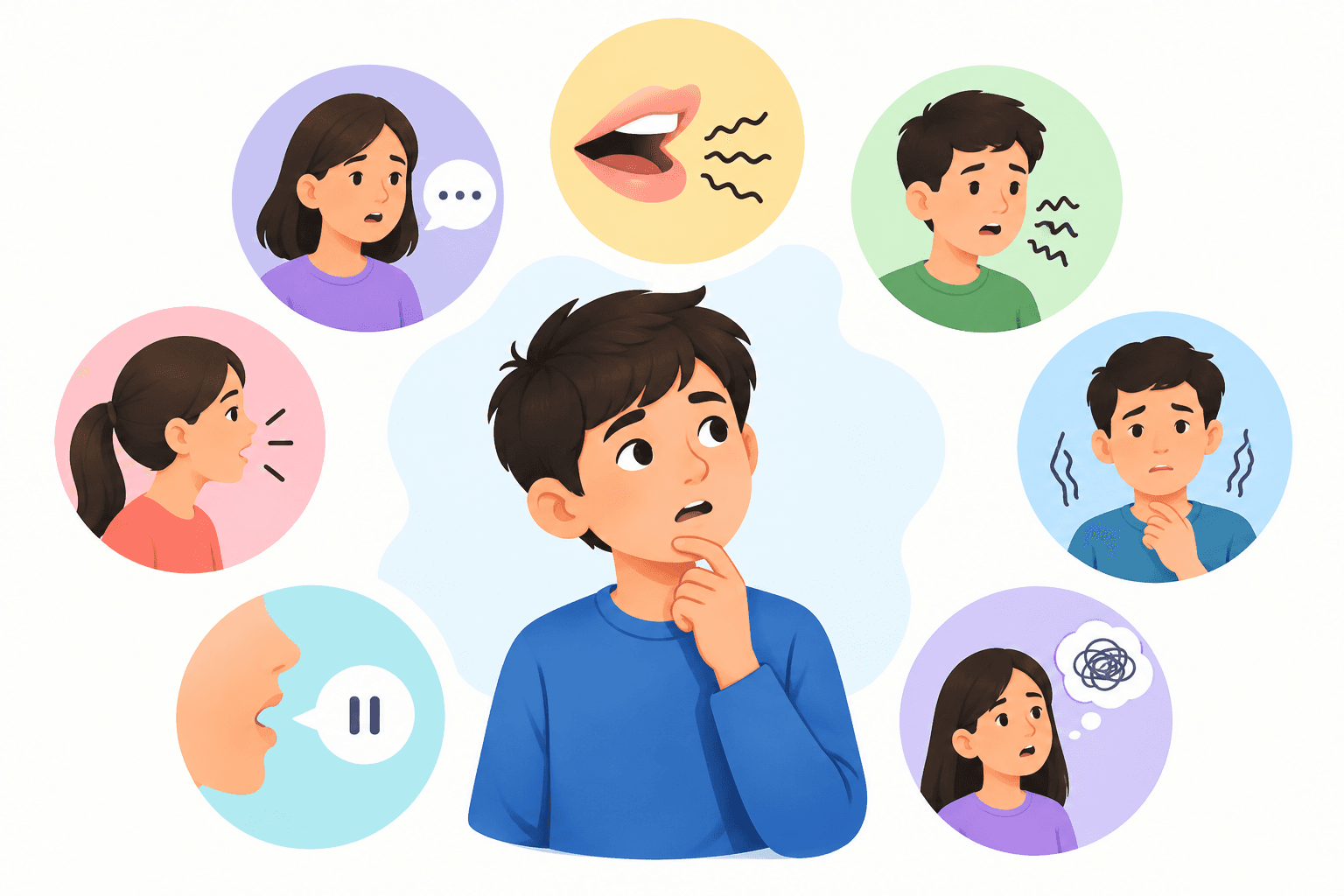
Researchers and speech clinicians usually group dysfluencies into a handful of core categories. You may recognise one or several in your own speech, or in the speech of someone you love.
Sound and Syllable Repetitions
This is often what people picture when they think of stuttering. It sounds like "b-b-b-but" or "ta-ta-ta-table." A single sound or syllable repeats before the speaker can move forward. In young children, occasional repetitions are part of normal language development. When repetitions become frequent, forceful, or continue past the preschool years, they usually point to something deeper happening in the brain's speech circuits.
Word Repetitions
Instead of a sound, the whole word repeats. "I-I-I want to go home." Word repetitions can look softer than sound repetitions, but they still reflect the brain stalling at the moment of speech execution. Many adults who stutter say word repetitions feel like a warm-up they cannot skip, as if the brain needs several attempts to launch the sentence cleanly.
Phrase Repetitions
Whole chunks of a sentence get repeated. "Can we, can we, can we leave now?" These are often considered typical when they happen occasionally, but they can also appear alongside more classic stuttering behaviours, especially when the speaker is trying to buy time before a word they anticipate blocking on.
Prolongations
A prolongation is when a sound stretches out longer than it should. "Sssssssssometimes I feel stuck." The speaker knows exactly what they want to say. The sound simply will not release on time. Prolongations feel physically effortful and can be exhausting over the course of a day, especially for people whose work involves a lot of talking.
Blocks
Blocks are among the most frustrating types of dysfluency. The mouth is open, the breath is ready, and nothing comes out. It can feel like being frozen mid-sentence. Silent blocks may last a second or ten, and they often carry the heaviest emotional weight because listeners do not always understand what is happening. Children with blocks are sometimes wrongly assumed to be shy, slow, or not paying attention.
Interjections
Fillers like "um," "uh," "like," and "you know" fall into this group. Everyone uses them, but people who stutter sometimes lean on them heavily to delay or avoid a word they anticipate blocking on. Over time, this can become almost invisible even to the speaker themselves.
Revisions and Abandoned Utterances
This happens when a speaker starts a sentence, senses trouble coming, and reworks or drops it. It looks like: "Can we go to the, let's just head to the park." Many adults who stutter become experts at this without even realising it. On the surface it can look fluent. Underneath, the effort is enormous, and the constant self-editing takes a toll on confidence.
Broken Words
A word gets split by a pause in the middle. "Base....ball." The break is not a natural breath. It is a moment where speech production stalls partway through, right when the brain is trying to string the syllables together.
Typical Dysfluencies Versus Stuttering
It is worth saying again: not every dysfluency is a stutter. Typical dysfluencies tend to be occasional, easy, and mostly whole-word or phrase repetitions. Stuttering dysfluencies are more often sound repetitions, prolongations, or blocks, and they usually come bundled with physical tension, avoidance behaviours, or emotional strain. A child who says "I want, I want juice" once in a while is doing something very different from a child who says "j-j-j-j-juice" while their eyes squeeze shut and their shoulders tense up.
Why These Dysfluencies Happen: A Neuroscience Perspective
For decades, stuttering was blamed on nervousness, weak breathing, poor muscle control, or even poor parenting. None of that has held up under scrutiny. Modern brain imaging has shown clear differences in how the brains of people who stutter plan and execute speech. The regions that coordinate timing, motor sequencing, and auditory feedback fire differently. Signals meant to travel smoothly between the planning and speaking areas of the brain get out of sync, and the result shows up as one of the types of dysfluencies described above.
This is not a flaw in the person. It is a wiring pattern, and wiring patterns can change. That is the core insight behind the neuroscience stuttering approach. Instead of teaching someone to slow down, breathe in a special rhythm, or force their way through blocks, a neuroscience based method targets the underlying brain activity that creates the dysfluencies in the first place. It uses what we now understand about neuroplasticity, the brain's ability to form new pathways at any age, to build genuinely fluent speech from the inside out.
People who have tried every technique out there often find this approach different because it does not ask them to manage their stutter for the rest of their lives. It works to resolve it. The techniques are gentle, they are backed by current brain research, and they do not rely on tricks that fall apart under real-world pressure.
How the Brain Rewires Itself for Fluent Speech
Neuroplasticity is not wishful thinking. It is a well documented process by which the brain forms new connections in response to targeted, repeated input. When someone learns a new language, recovers movement after a stroke, or builds a new motor skill, neuroplasticity is doing the work behind the scenes. Speech production runs on the same principle. When the brain is guided through the right sequence of experiences, the timing between planning and speaking can be retrained.
That is very different from being told to "just relax" or "think about what you want to say before you say it." Advice like that ignores the actual mechanics of what is happening. A neuroscience based approach works with those mechanics directly. It gives the brain new signals to follow, and it lets fluency emerge as a natural byproduct rather than something forced through effort.
Which Type of Dysfluency Do You Have
Most people who stutter show a mix. You might block on certain sounds, prolong others, and repeat a few. The specific blend can shift over time, with age, with stress, and even depending on who you are speaking to. That is normal, and it is another sign that stuttering is a brain level phenomenon rather than a fixed defect.
Paying attention to your own patterns is not about labelling yourself. It is about understanding what your nervous system is doing so you can work with it instead of fighting it. Once you can name what is happening in a given moment, it loses some of its grip.
Where to Go From Here
Recognising the types of dysfluencies in your own speech is the beginning of a much bigger shift. Once you understand that stuttering has a neurological basis, the old advice of "just try harder" starts to fall away. You stop fighting yourself and start working with your brain. That change alone can lift years of shame and self-blame.
If any of this resonates, the best next step is to speak with someone who has walked this path and understands the science behind lasting change. Booking a free stuttering consultation can help you figure out whether a neuroscience based programme is the right fit for you or your child, without pressure and without the usual therapy jargon.
Your speech is not broken. It is a pattern. And patterns, with the right approach, can be rewritten.
Ready to Put This Into Practice?
Download the app and start practicing today
Reading is the first step. Real progress comes from consistent daily practice. Use StopStutter to build confidence and improve your speech every day.


