


ReviewOctober 12, 2026
What Is Baby Sign Language
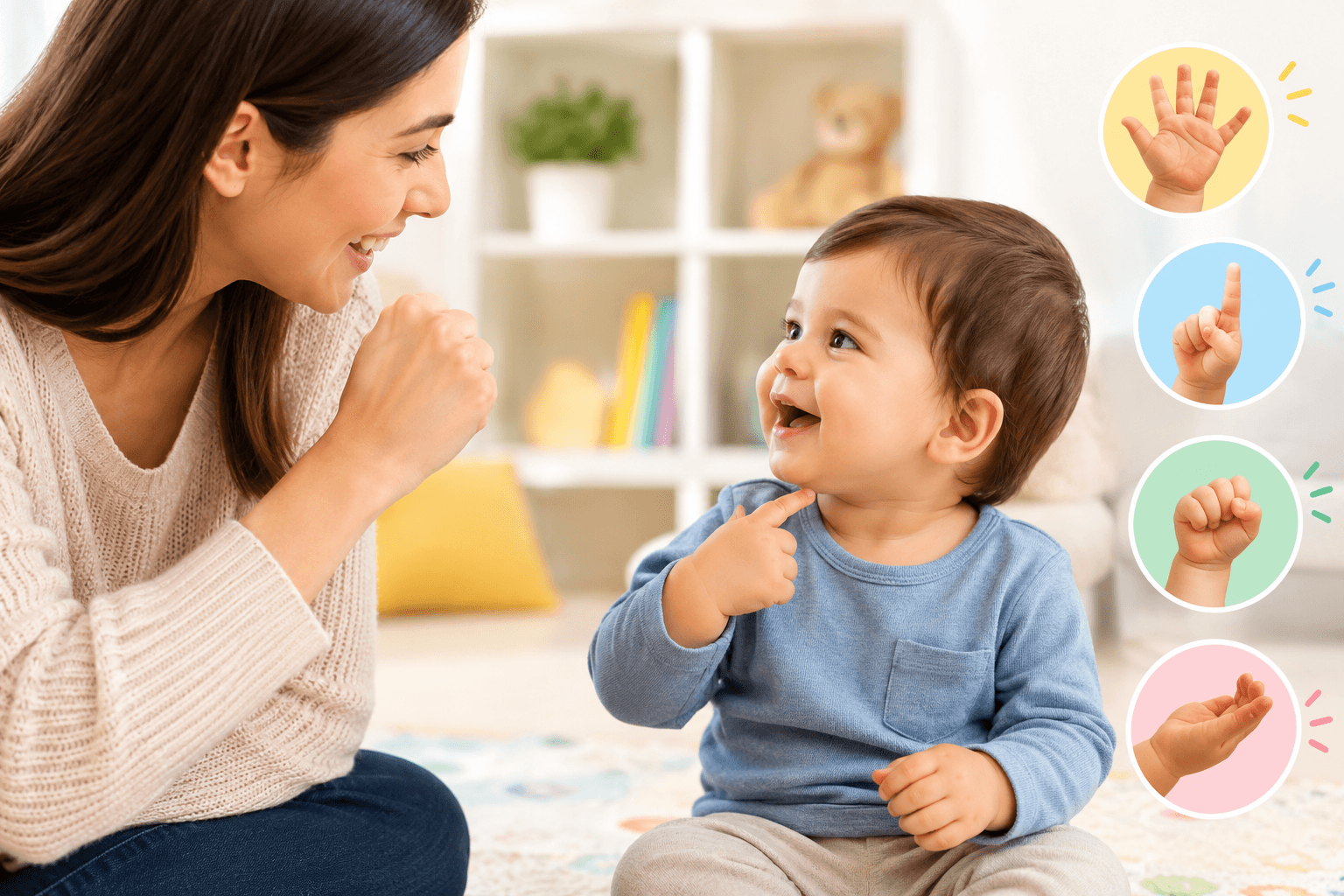
If you’ve ever watched a nine-month-old bang their tiny fingertips together and stare at you like they’ve just said something brilliant, you’ve already seen the idea behind baby sign language. So, what is baby sign language? In simple terms, it’s a set of easy hand gestures, usually borrowed from a real sign language like American Sign Language (ASL), that hearing babies and toddlers use to communicate before their mouths can form words.
I want to go a bit deeper than the usual “milk, more, all done” list, because what’s happening underneath is fascinating. Your child’s brain treats gesture and speech as close relatives, and understanding that relationship can change how you think about early communication, including why some children later struggle with fluent speech.
If your family is already worried about speech, whether it’s a repetition, a block, or a long silence before a word comes out, it’s worth reading about how to stop stuttering from a brain-first perspective. Everything in this article ties back to one idea: communication is a whole-body skill, wired in the brain long before the first word.
Some parents also come to us after noticing something unusual in their child’s speech and wondering whether a gesture-heavy approach helped or hurt. The short answer is that gestures are rarely the problem. And if speech difficulties do show up, online stuttering therapy can now reach families wherever they live, without waiting months for a local appointment.
So, What Is Baby Sign Language, Really?
Baby sign language is not a full language the way ASL is. Think of it as a small, friendly vocabulary of 10 to 50 signs that parents and babies use in daily routines. The signs usually cover things babies care about most: food, comfort, play, and the people around them.
Babies typically can’t say “more” or “milk” until somewhere around their first birthday, sometimes later. But their hands are often ready sooner. The fine motor control needed to tap two fingertips together is easier for a baby than the precise tongue, lip, and breath coordination needed to say “mmm-ore.” Signing gives them a bridge between understanding and speaking.
Most families start when their baby is around six to nine months old, using the signs consistently during everyday moments. First signs often appear around eight to twelve months, though every child moves at their own pace. There’s no deadline and no test.
What Is Baby in Sign Language? And How Do You Sign It?
One of the most common questions parents search is “what is baby in sign language?” In ASL, the sign for baby is wonderfully intuitive: you cradle your arms as if you’re holding an infant and gently rock them side to side. Many parents love teaching this one because babies find it endearing, and older siblings pick it up in seconds.
It’s a good example of why signs work so well. Many are iconic, meaning they look like what they mean. That makes them easier for a baby’s developing brain to link a gesture, an object, and a feeling.
What Is “More” in Sign Language for Babies?
Another favorite is the sign for “more.” Parents often ask, “what is more in sign language for babies?” In ASL, you bring the fingertips of both hands together, forming little flat “O” shapes, and tap them against each other a couple of times.
“More” is often the first sign babies learn because it’s so useful. It works for food, songs, bubbles, peek-a-boo, and bedtime cuddles. And here’s the sweet part: when a baby signs “more,” they’ve just discovered that they can make something happen with their own communication. That tiny moment of cause and effect is a big deal for the developing brain.
What Neuroscience Says About Gesture and Speech
Here’s where things get really interesting. Brain imaging research has long suggested that gesture and speech share overlapping neural networks. Areas around the left frontal region, including Broca’s area, which is strongly tied to speech production, also become active when we use hand movements. In other words, your brain doesn’t file “talking” and “gesturing” in separate drawers. They’re closely linked systems that develop together.
Babies also learn through joint attention, that shared moment when you and your baby look at the same thing and you name it. When you sign “more” while saying the word out loud, you’re giving your child’s brain a visual, a movement, a sound, and an emotional connection all at once. That’s multi-sensory input, and it tends to strengthen how the brain organizes meaning.
Another piece is timing. Early childhood is a period of rapid neural pathway formation. The more varied and responsive the communication environment, the more chances the brain has to build and refine the circuits it’ll rely on for speech later.
Does Baby Sign Language Help Speech Development?
This is where I want to be honest, because a lot of articles oversell it. The research is mixed. Studies consistently show that baby signing can make parents more responsive and tuned in to their child’s cues, and many families report less frustration and fewer tantrums. But evidence that signing makes children talk earlier or boosts IQ in the long run is limited.
What research doesn’t show is harm. Signing does not appear to delay speech. Babies don’t “choose” gestures over words and stay stuck there. As spoken language arrives, signs naturally fade, usually because speaking is faster and more rewarding. So if you’re wondering whether baby sign language is worth trying, the realistic answer is yes, for connection and communication, as long as you don’t treat it as a speech-acceleration trick.
Can Baby Sign Language Cause or Prevent Stuttering?
Parents often ask whether using signs could lead to stuttering, or whether signs could somehow prevent it. Neither is supported by evidence. Stuttering is understood today as a neurodevelopmental difference in how the brain coordinates the timing and sequencing of speech movements. It tends to appear between ages two and five, often runs in families, and has nothing to do with using gestures or being a “nervous” parent.
That’s a point worth repeating, because guilt shows up fast when a child starts repeating sounds. Nothing you did with signs, flashcards, or bedtime stories caused it. What actually matters is what you do next, and how early you get informed, supported guidance.
Some families find it reassuring to talk to a specialist before deciding anything. You can book a free stuttering consultation to get clear answers about what you’re noticing, whether it’s within normal early development, and what the next steps might look like. No pressure, just clarity.
How to Start Baby Sign Language at Home
You don’t need a course or a special kit. Start small and keep it joyful.
Pick two or three signs. “More,” “milk,” and “all done” are classics. Add “baby” if you have a sibling or a favorite doll.
Sign while you speak. Always say the word out loud as you sign. Your baby needs to hear the word and see the gesture together. That pairing is what builds the link in their brain.
Use signs in real moments. Sign “more” when you’re actually offering more food, not randomly. Meaning comes from context.
Be patient with messy signs. A baby’s version of “more” might look like a clap or a fist bump. That counts. Respond to it like it’s perfect.
Celebrate every attempt. The point is back-and-forth connection, not perfect hand shapes.
If your child is already speaking in short phrases, you can keep signing for fun, but you don’t need to push it. Natural spoken language will take over at its own speed.
Signs Your Child May Need Extra Support
Baby sign language is a lovely tool, but it’s not a screening method. If you notice any of the following, it’s worth speaking to a professional:
Your child isn’t using gestures like pointing or waving by about 12 months
There’s very little babbling by 12 months
Your toddler seems to lose words or skills they once had
Your child repeats sounds or syllables, prolongs sounds, or seems to get “stuck” before speaking, especially if they look tense or frustrated
Early advice doesn’t mean something is wrong. It simply means you’re giving your child’s brain the best chance to build smooth, confident communication.
Why the Brain-Based View Matters
Most traditional speech advice focuses on what a child says. A neuroscience-informed approach looks at how the brain is organizing speech, timing, attention, and emotion. That matters because the same child might talk freely when relaxed and get stuck when excited, tired, or put on the spot. That isn’t random. It reflects how the speech system responds to load and timing.
Gesture is a lovely example of this in everyday life. When a baby signs “more” and then eventually says it, you’re watching two systems cooperate. When we understand that cooperation, we can support speech in ways that feel natural rather than forced, and that’s exactly the kind of thinking that guides modern stuttering support.
The Bottom Line
So, what is baby sign language? It’s a simple, warm way to give your baby a voice before words arrive, using gestures like cradling your arms for “baby” and tapping your fingertips for “more.” It won’t turn your child into a prodigy, but it can reduce frustration, deepen connection, and give you a front-row seat to how your baby’s brain learns to communicate.
And if your child’s speech journey takes an unexpected turn, you don’t have to figure it out alone. Understanding the science behind it can make everything feel less scary. If you’d like to see how brain-based support actually works, you can read the full explanation of neuroscience stuttering and what it means for children and adults alike.
Ready to Put This Into Practice?
Download the app and start practicing today
Reading is the first step. Real progress comes from consistent daily practice. Use StopStutter to build confidence and improve your speech every day.


