


ReviewOctober 28, 2026
What Is Dialogic Reading? A Neuroscience-Based Guide for Parents
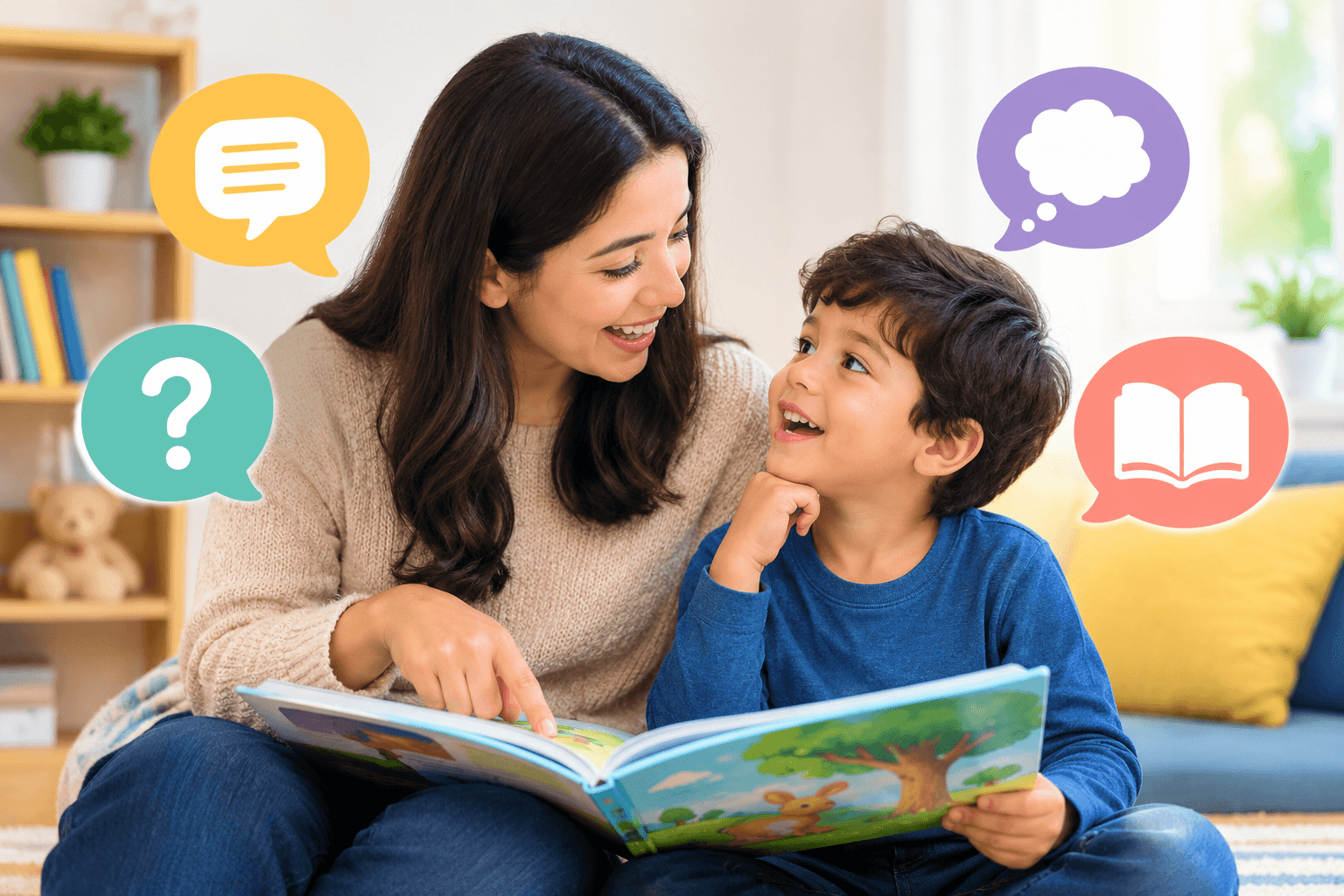
If you’ve ever read a bedtime story and felt like you were the only one talking, you already know the problem dialogic reading is built to solve. So, what is dialogic reading? It’s a way of reading picture books where the child becomes the storyteller and the adult becomes the listener. You stop performing the book and start talking about it together.
That small change matters more than it sounds. When a child is pulled into the conversation, their brain works very differently than when they’re listening passively. For children who are late talkers, who hesitate, or who are developing a stutter, that difference can be significant. Many parents who are looking up overcome stuttering in their little one are surprised to find that how they read together at home is one of the most powerful tools they already have.
What Is Dialogic Reading, Exactly?
Dialogic reading was developed by psychologist Grover Whitehurst and his colleagues in the late 1980s. The idea is simple: during a picture book, the adult asks questions, listens to the answers, adds a little more information, and encourages the child to say more. The conversation is the point. The book is the starting place.
It’s usually taught through two easy-to-remember tools. The first is PEER, a four-step loop you repeat as you read:
Prompt the child to say something about the picture (“What’s happening here?”)
Evaluate their response (“Yes, the dog is running!”)
Expand on it by adding a little (“He’s running really fast toward the park”)
Repeat the prompt so the child can try the longer version (“Can you tell me what the dog is doing?”)
The second tool is CROWD, which is a set of prompt types you can mix and match: Completion (leaving a gap in a familiar phrase), Recall (asking what happened earlier), Open-ended (asking the child to describe what they see), Wh- questions (who, what, where, why), and Distancing (connecting the story to the child’s own life, like “Have you ever seen a big dog like that?”).
You don’t need to use every prompt on every page. In fact, you shouldn’t. A good dialogic reading session feels like a relaxed chat that happens to have pictures in it.
Why Dialogic Reading Works: The Brain Science
Here’s where it gets interesting. Understanding what dialogic reading is on the surface is useful, but understanding what it does inside the brain is what makes parents take it seriously.
It builds language networks through active use
Language develops in a network of regions, mostly on the left side of the brain, that connect hearing, meaning, and speech movement. When a child only listens, the hearing and comprehension parts of that network do most of the work. When a child has to answer, they also activate the planning and motor systems that turn thoughts into words. Neuroscientists often describe this with a simple principle: connections that fire together get stronger. Every time your child finds a word and says it, that pathway gets a little more efficient.
It trains joint attention
When you and your child look at the same picture and talk about it, you’re practicing joint attention, which is the shared focus that lets children learn new words quickly. It engages attention networks and social-reward circuits at the same time. The brain registers the moment as both interesting and safe, and that combination is ideal for learning.
It uses reward to make speaking feel good
Every time you respond warmly to what your child says, their brain gets a small hit of reward signaling, driven largely by dopamine. That matters because speech is partly a habit loop. When talking leads to a pleasant response, the brain wants to repeat it. When talking feels risky or rushed, the brain can start to tighten up around it.
It teaches turn-taking and timing
Conversation has a rhythm, and the brain learns that rhythm through practice. The timing circuits that connect the cortex with deeper structures like the basal ganglia help coordinate when to speak, how fast to go, and how to move smoothly from one sound to the next. Dialogic reading gives a child hundreds of low-stakes chances to practice those turns, with an adult who waits patiently instead of finishing their sentences.
The Research Behind It
Studies of dialogic reading, mostly in preschool-aged children, have found gains in expressive vocabulary, longer and more complex sentences, and stronger early literacy skills compared with typical read-aloud routines. The effects tend to be strongest when parents are coached on how to do it and when the sessions happen regularly at home. Imaging studies of reading experiences in young children have also linked rich, interactive home reading with stronger activity in language-related regions of the brain.
It’s worth being honest about the limits. Dialogic reading is not a treatment for a speech or language disorder, and it won’t replace professional support. What it does is create the kind of daily environment in which a developing brain gets more practice, more patience, and less pressure. That’s valuable for every child, and it’s especially valuable for a child who struggles to get words out.
How to Do Dialogic Reading at Home
You can start tonight. A few practical tips:
Pick a picture-rich book. Books with a lot to look at and not too much text give you more to talk about.
Slow down and follow your child’s lead. If they’re fascinated by the corner of a page, stay there. Their interest is the best teaching moment you’ll get.
Ask one question at a time. Stacking several questions makes it harder for a child to answer, and for a child who stutters, it adds pressure.
Wait. Count silently to five before you jump in. That pause feels long to adults and perfectly normal to a child’s brain.
Expand, don’t correct. If your child says “doggy run,” you say, “Yes, the doggy runs fast!” You’ve modeled the better sentence without telling them they got it wrong.
Keep it short and fun. Ten relaxed minutes beat thirty tense ones. Stop while your child is still enjoying it.
Dialogic Reading and Stuttering: What Parents Should Know
This is the part many parents ask about. Can this kind of reading help a child who stutters?
The honest answer is that it can support a healthy communication environment, but it isn’t therapy. Stuttering involves differences in how the brain coordinates the timing and sequencing of speech movements. Pressure doesn’t cause it, but pressure and rushing can make moments of stuttering feel harder. Dialogic reading naturally lowers that pressure. There’s no performance, no right answer, and no one finishing the child’s sentences. The child learns that talking is safe even when it’s bumpy.
A few things to keep in mind if your child stutters:
Use a calm, unhurried pace in your own speech. Children copy rhythm more than they copy words.
Don’t ask the child to “slow down” or “take a breath.” Instead, slow down yourself.
Avoid questions that feel like quizzes. Open comments like “I wonder what he’s going to do next” often work better than direct questions.
Celebrate the ideas, not just the clean sentences.
If stuttering has lasted more than a few months, if it’s getting more frequent, or if your child shows tension, avoidance, or frustration, it’s smart to get a professional opinion early. Early support gives young brains the best chance to build smooth, confident speech patterns. Structured online stuttering therapy can give you and your child a plan that goes well beyond what story time alone can do, and it’s available from home.
When to Reach Out for Support
Dialogic reading is a gentle, everyday habit. But some signs are worth a conversation with a specialist:
Your child is not using many words by age two
Speech is hard for others to understand well past the expected age
Repetitions, blocks, or stretched sounds are showing up regularly
Your child avoids speaking, stops talking in certain situations, or seems upset about their speech
There’s a family history of stuttering or other speech and language concerns
You don’t have to wait for things to get worse before asking. If you’re unsure what you’re seeing, you can book a free stuttering consultation and talk it through with someone who works with this every day. It’s a low-pressure way to find out whether what you’re noticing is typical development or something worth acting on.
Making It a Habit That Lasts
The brain learns through repetition, and the same is true for parents. Pick one regular time, like after dinner or right before bed, and protect it. Keep a small pile of favorite books nearby. Let your child choose, even if it’s the same book for the twentieth time. Re-reading is actually a feature, not a bug: familiar stories let children focus on telling instead of figuring out, which builds fluency and confidence.
Over time, you’ll notice the shift. Your child starts anticipating the questions. They begin telling you what’s on the next page before you turn it. They bring in their own experiences and make up details. That’s the language network doing exactly what it’s supposed to do, and it’s happening in the warmest setting you could offer.
The Bigger Picture
So, what is dialogic reading? It’s a simple, research-backed way of turning a picture book into a back-and-forth conversation that strengthens vocabulary, attention, turn-taking, and the connections between thinking and speaking. It doesn’t require special materials, training, or money. It requires patience, curiosity, and a willingness to let your child do most of the talking.
For children whose speech doesn’t flow easily, that patient, pressure-free practice is a real gift. And when you want to understand what’s happening beneath the surface, including why speech timing can be tricky for some brains and what can be done about it, you can explore the research-led approach explained in neuroscience stuttering. Knowing how the brain handles speech often turns worry into a clear plan.
Tonight, pick up a book, ask one open question, and wait. You may be surprised by what your child has to say.
Ready to Put This Into Practice?
Download the app and start practicing today
Reading is the first step. Real progress comes from consistent daily practice. Use StopStutter to build confidence and improve your speech every day.


