ReviewOctober 9, 2026
What Is Masking? Signs, Causes & How to Speak Freely as Yourself
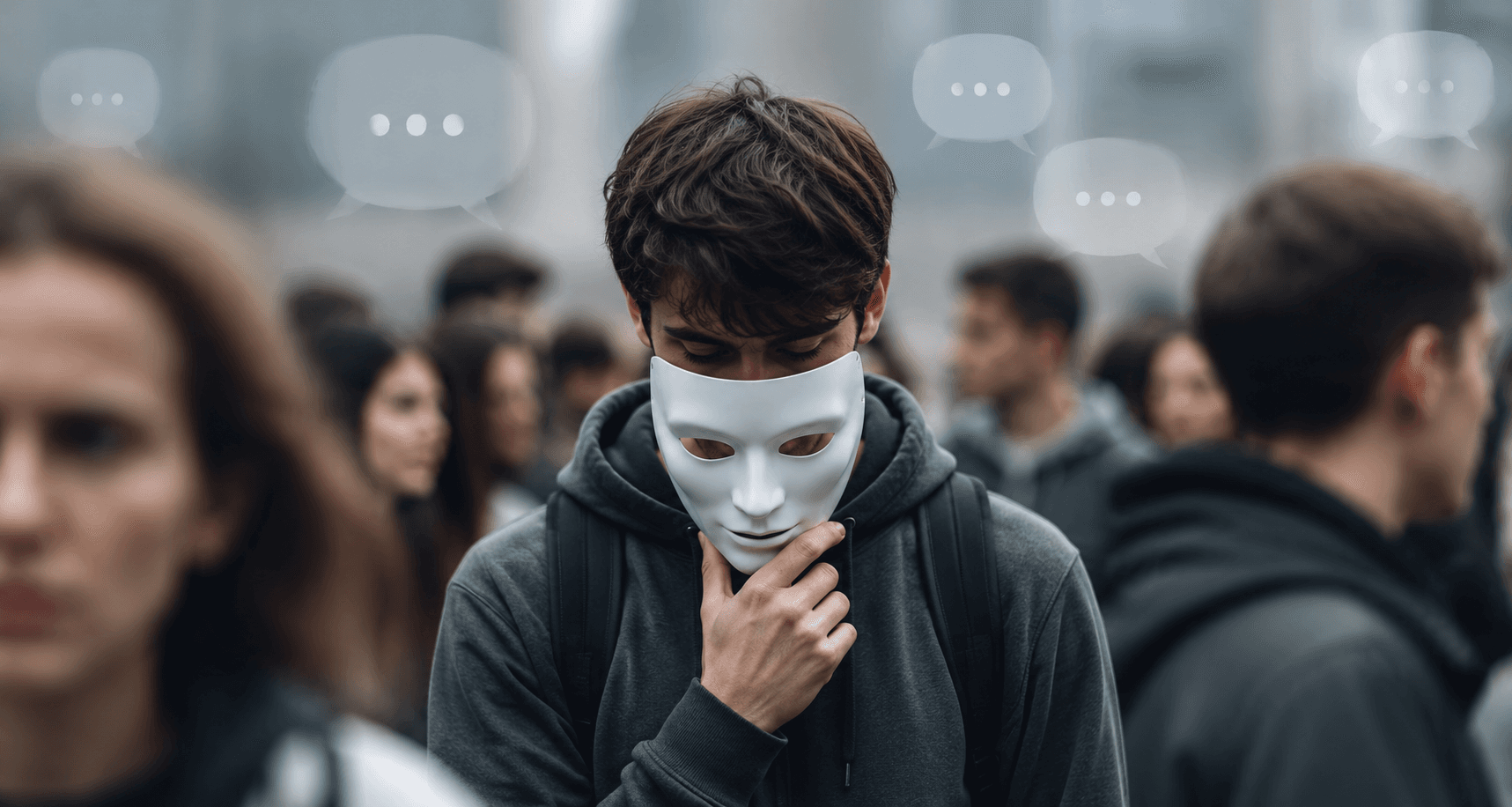
What is masking? Masking is covering up your natural emotions, traits, or speech so that others will accept you. The brain learns it as protection against social danger. Over time, it can drain your energy and strengthen both anxiety and speech blocks.
Masking takes many shapes. One person smiles brightly while panicking inside. Another hides a neurodivergent trait. Someone else hides a stutter by swapping words, going silent, or letting calls go to voicemail. If you want to stop stuttering or simply stop hiding it, understanding the mask is a useful first step.
This guide explains how masking works, how it affects your nervous system and your voice, and how to loosen its grip safely. It also shows how stuttering therapy and a brain-based approach can support that process.
What Does Masking Mean?
Masking means behaving in a way that conceals your true self or your true feelings.
Everyone shifts their style a bit. You talk one way to your manager and another way to your sibling. That is healthy flexibility. Masking is different. It runs nonstop, takes real effort, and comes from a belief that being seen as you are will cost you.
Flexibility: You pick a tone that suits the moment and still feel like yourself.
Masking: You police every word, facial expression, and movement because being fully seen feels risky.
Masking in Psychology: Where the Idea Comes From
Psychologists describe masking as managing your outward behavior to hide what is happening inside. The idea of a "social mask" has several roots. Carl Jung used the word "persona" for the public face a person presents to the world. Sociologist Erving Goffman wrote about impression management, the way we shape how others see us. More recently, researchers have studied "camouflaging" in autistic people, and clinicians have described safety behaviors in social anxiety.
These ideas overlap, but they are not identical. A flexible persona helps you work, date, and belong. Trouble starts when the persona swallows the private self. The widening gap between who you are and who you act like produces steady, low-grade stress.
What your brain is doing
Your brain constantly predicts what comes next. If people mocked, corrected, or talked over you in the past, it may expect the same again. Masking is the strategy it picks to sidestep that predicted pain, and your nervous system keeps a quiet alarm humming in the background.
That alarm sits at the center of the neuroscience method, which views learned fear and avoidance as layers the brain can retrain through neuroplasticity.
What Is Social Masking?
Social masking is showing a polished, adjusted version of yourself to blend in, stay safe, or dodge criticism. Sometimes you do it on purpose, like practicing a calm face before a presentation. Other times it runs on autopilot, and you stop noticing it.
Where social masks come from
Teasing or bullying that taught you your real self wasn't welcome.
High-pressure homes, schools, or workplaces that rewarded perfection.
Neurodivergent traits that others called "odd" or "too intense."
Speech differences like stuttering, which can attract awkward reactions.
Common Types of Social Masks
These are the masks people describe most often:
The "I'm good" mask: You say everything is great while you're barely holding on.
The people-pleaser mask: You go along with everyone to keep the peace.
The comedian mask: You joke your way around anything serious or vulnerable.
The poised mask: You project certainty while your hands shake.
The silent mask: You say little so nobody hears your voice wobble.
The fluent mask: You hide a stutter by changing words, restructuring sentences, or skipping certain situations.
That last one is known as covert stuttering. The person sounds smooth, yet the effort behind each sentence is huge. The stuttering iceberg captures this well: the visible part is small, while the fear, shame, and avoidance below the surface are massive.
Unmasking a stutter doesn't have to mean hiding it better or eliminating it. For some people, it means choosing to stutter openly, on their own terms. Listener reactions matter too: impatience, interruptions, and stigma are major reasons people hide, so the challenge is not only inside the person who stutters.
What Masking Looks Like in Real Life
Masking rarely looks dramatic. From the outside, it appears like ordinary politeness or shyness. That's exactly why many people carry it for years without a name for it.
What others can see
Silently scripting what you'll say, then editing it again.
Mirroring someone else's slang, laugh, or posture.
Holding a smile or steady gaze you don't actually feel.
Steering around certain words, names, or phone calls.
Saying nothing in a meeting, then replaying it for hours.
What stays hidden
Watching faces for the first sign of disapproval.
A tight jaw, throat, chest, or shoulders.
Holding your breath just before you speak.
Many of these match the secondary behaviors of stuttering, which people build to push through or conceal a block. Because they are learned, they can be unlearned.
"I avoided going out completely. I used to feel so insecure. After a certain time, I realized that being like this wouldn't work. I needed to face my fears and put myself in situations where I was exposed to them, to normalize public interactions for my nervous system. And it worked."
— A person who used to stutter
Where Masking Shows Up Most
Masking tends to intensify when the stakes rise or the audience grows. These moments often set it off:
Video meetings, especially when you dread being put on the spot.
Job interviews, where you present a flawless version of yourself.
Ordering food or coffee, particularly if certain words feel risky.
Introductions, when even your own name feels hard to say.
Phone calls, where you have no facial cues to lean on.
First dates and small talk, where you worry about being "too much" or "not enough."
If your chest tightens in moments like these, you may be facing communication anxiety or a deeper fear of being judged when speaking. Both can keep the mask in place.
Masking and Social Anxiety
Do people with social anxiety mask? Often, yes. The core fear in social anxiety is negative judgment, and a mask feels like armor. Common versions include:
Keeping busy at gatherings so nobody pulls you into conversation.
Gripping a cup or your phone to keep your hands occupied.
Over-planning what to say in every exchange.
Looking relaxed while your body runs a full alarm.
Anxiety can also affect speech directly. Many people find that nerves increase disfluency, a link explored in can anxiety cause a stutter. Anxiety does not create the underlying stutter, which has a genetic and neurodevelopmental basis. It does add pressure, and pressure can make blocks stronger.
Why the mask feels like it works
Many people say wearing a mask helps their social anxiety, and in the short run that is accurate. The mask shrinks the threat, spares you an awkward moment, and gives your brain quick relief. But the same pattern has a cost:
Relief rewards the habit. Each time the mask "works," your brain treats it as a win.
Avoidance starves you of proof. You never find out whether people would accept the unmasked you.
Untested fear grows. The less you challenge it, the larger it can get.
The mask protects you today and can feed the fear for tomorrow.
Masking and Neurodivergence
Masking is also widely discussed in autism and ADHD communities, where it is often called camouflaging. People may suppress stimming, rehearse eye contact, or copy others' social behavior to avoid being judged. Many of the same costs apply: exhaustion, a sense of not being yourself, and difficulty getting support because the struggle is hidden. If this is your experience, a clinician who understands neurodivergence can help you sort out what to keep, what to drop, and what you need in order to feel safe.
Am I Masking? Common Signs
If you keep asking "am I masking?", compare yourself with the signs below.
Social events leave you wiped out, even fun ones.
You seldom say exactly what you think.
Your voice, vocabulary, or personality shifts with every audience.
You feel like a visitor in your own life.
You dodge words, places, or people to avoid a speech block.
No one in your life knows how hard speaking really is for you.
You may also notice a friend or coworker who always says they're "fine," withdraws without explanation, or seems calm in the moment but exhausted afterward. These can be signs of masking, but they can have other causes too, so it's kinder to check in than to assume.
Is Masking Good or Bad?
It is both, depending on the situation.
When masking helps
It can keep you safe in a hostile or unsafe setting.
It can carry you through one short, high-pressure moment.
When masking hurts
It keeps your nervous system on high alert.
It blocks genuine connection, since people can only bond with the real you.
It reinforces avoidance, and avoidance reinforces fear.
It is associated with burnout, low self-esteem, and depression in many people.
Masking is not a flaw in your character. It is a protective habit your brain built. The aim is to need it less, not to shame yourself for having used it.
Masking Fatigue: Why Hiding Is So Exhausting
Masking fatigue is the heavy tiredness that follows nonstop self-monitoring. Your brain juggles two tasks at once: holding the conversation and managing the impression you make.
Brain fog after meetings or gatherings.
Short temper once you get home.
Needing hours alone to reset.
Body tension, headaches, or a tight throat.
For people who stutter, concealing blocks adds another cost. Swapping words and rebuilding sentences on the fly burns mental energy with every sentence. Fatigue matters for a second reason too. Learned speech-block patterns can weaken with retraining, but they may resurface under heavy stress, tiredness, or pressure. Rest and a calmer nervous system are part of the work, not a luxury.
How to Stop Masking, Step by Step
Begin small. Dropping the mask all at once feels unsafe, and your nervous system will resist.
Success doesn't have to mean perfect fluency. For many people, it means speaking openly, with or without stuttering.
Step 1: Check that it's safe
Not every setting is ready for the unmasked you. Start with people and places where the risk is low, such as a supportive friend, a family member who listens, a friendly cashier, or a practice group. You can keep a more formal version of yourself in settings where you don't feel safe.
Step 2: Give your brain new evidence
Each time you show up without the mask and nothing terrible happens, your brain records a prediction error: the feared outcome never arrived. With repetition, the alarm tends to turn down.
The same principle drives the work on how to stop stuttering. Core stuttering has a genetic and neurodevelopmental basis. The secondary layers, including anticipatory fear, physical tension loops, and avoidance traps, are learned behaviors that neuroplasticity allows you to retrain.
Step 3: Practice in real moments
Here is how a prediction error can play out in an everyday moment. This speaker normally avoids saying their name and points at the menu instead.
Barista: "Hi! What can I get started for you?" You: (notice your shoulders creeping up; breathe out slowly and let them fall) "Hi. A medium latte, please." Barista: "You got it. Name for the order?" You: (feel the pull to give an easier name; relax your jaw instead) "Daniel." (the first sound catches for a second; you pause there and let it release without forcing) Barista: "Thanks, Daniel. Coming right up!"
Most of the time, the reaction is easy like this. Occasionally it won't be: someone may look impatient or finish your word. That doesn't mean you failed. Note it, take a slow breath, and remind yourself that one awkward reaction is a single data point, not a verdict on you. The goal is repeated practice, not a perfect result every time.
A 5-minute daily practice
Calm the alarm (1 minute): Exhale slowly for six counts, three times. Drop your shoulders and unclench your jaw.
Pick one mask habit (1 minute): Choose a small behavior to drop today, such as saying your real name, using a word you'd normally avoid, or leaving a sentence unedited.
Say it aloud (1 minute): Practice the unmasked version once, slowly, in private.
Test it (1 minute): Use it in one real conversation today.
Record the evidence (1 minute): Write one line: "I predicted ___. What actually happened was ___."
For more on anxiety and speech, how to stop stuttering when nervous makes a useful next read.
When to Get Professional Support
Self-help practice works best alongside guidance when masking is tied to heavy anxiety, burnout, or a lifetime of hiding a stutter. Modern speech-language pathologists do much more than train mouth movements. Many use mind-body approaches such as cognitive behavioral therapy (CBT) and desensitization to address fear, avoidance, and confidence alongside fluency. Some people also choose online stuttering therapy for structured, flexible support at home. If masking is affecting your mood, sleep, or daily functioning, a licensed mental health professional can help too.
Frequently Asked Questions About Masking
Is masking a mental illness?
No. Masking is a coping behavior, not a diagnosis. It often shows up alongside anxiety, ADHD, autism, or speech differences.
Can masking cause burnout?
It can. Nonstop self-monitoring uses up mental energy and may lead to exhaustion, irritability, and withdrawal.
Is masking the same as being fake?
No. Masking is self-protection, not deception. Most people mask out of fear of rejection, not a wish to mislead.
Can you mask a stutter?
Yes. Many people hide a stutter with word swaps, avoidance, or silence. This is called covert stuttering, and it often carries a heavy emotional cost.
Do I have to stop masking completely?
No. The goal is to mask less out of fear and choose more freely. Some settings will always call for a more formal version of you.
How long does it take to stop masking?
It varies from person to person. Many people notice small shifts after several weeks of repeated practice. Old habits can return under stress, and that is normal, not failure.
Final Thoughts
Masking is a protective habit your brain learned, and a learned habit can be retrained. Start with one small moment in a safe setting, gather one piece of new evidence, and repeat. If you arrived here asking what masking is, the short answer is a mask worn out of fear, and with steady practice you can set it down.
The goal isn't to sound a certain way. It's to feel free to speak as yourself, whatever your speech sounds like.
Ready to Put This Into Practice?
Download the app and start practicing today
Reading is the first step. Real progress comes from consistent daily practice. Use StopStutter to build confidence and improve your speech every day.