


ReviewOctober 5, 2026
Why Does Stuttering Occur? What Science Says About the Stuttering Brain
If you stutter, or you love someone who does, you’ve probably asked this question more times than you can count: why does stuttering occur? Why can a person say a word perfectly while talking to their dog, then get stuck on the very same word in a meeting?
The short version is that stuttering isn’t caused by nervousness, low confidence or bad parenting. It comes from differences in how the brain times and coordinates speech, and genetics play a big part. Once you see it that way, a lot of the shame around stuttering starts to lift.
Stop stuttering is a goal we hear from almost everyone who reaches out, and it starts with understanding what’s really going on in the brain, not with fighting yourself.
And if you’d like structured support, online stuttering therapy lets you work from home, with guidance built around how your brain actually handles speech.
New to this? Join our free Saturday Speech Club at 12 PM EST and meet people who get it. Register free.
Why Does Stuttering Happen? The Short Answer
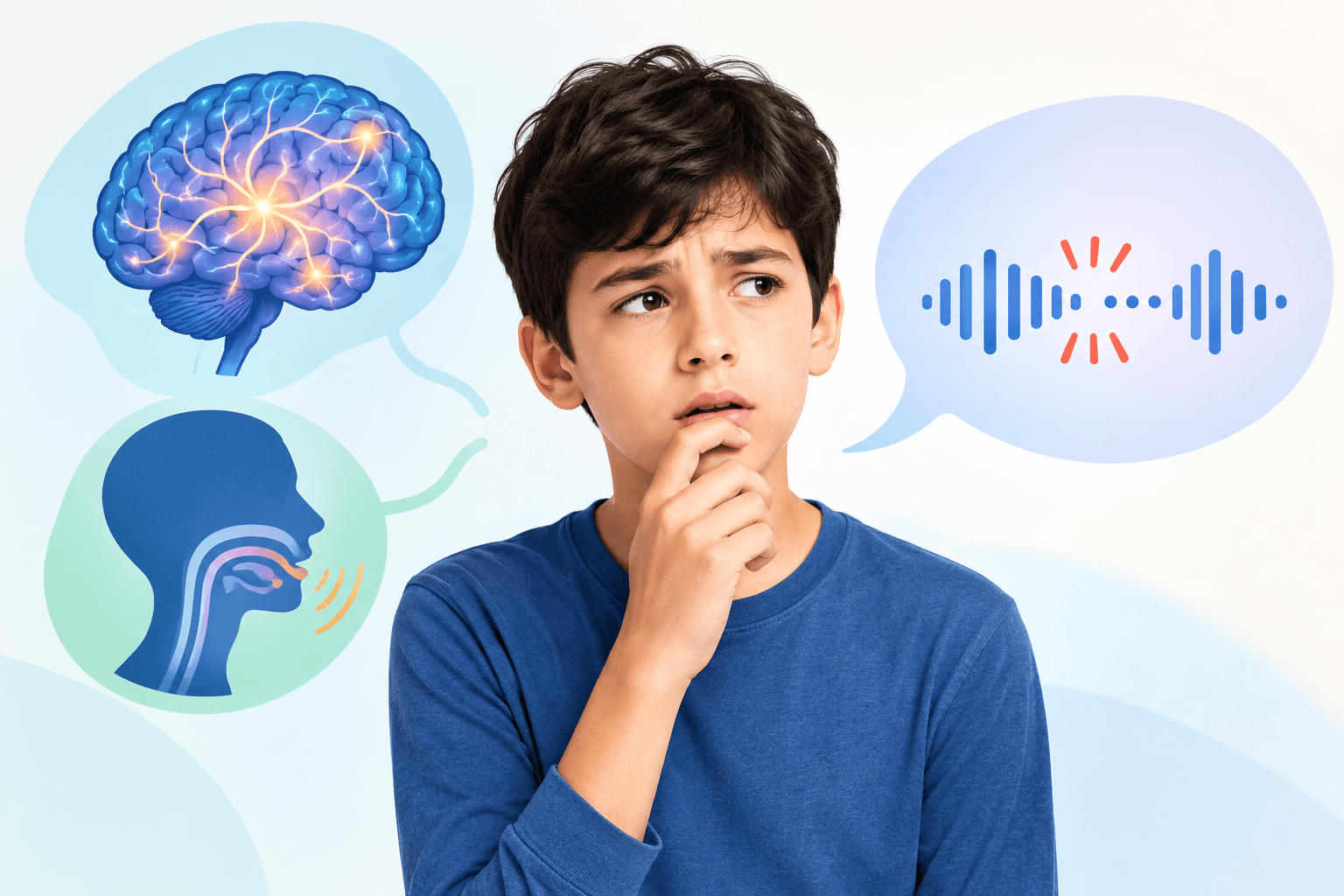
Stuttering occurs because the brain’s speech timing network works differently. Genetics, differences in areas like the basal ganglia, and less smooth coordination between hearing and movement circuits make it harder to release the next sound on cue. It is not caused by nervousness, bad parenting, or a lack of confidence.
Researchers point to a few things working together:
Genetics. Stuttering runs in families, and large studies have now linked it to dozens of genes.
Brain timing and wiring. The circuits that start and sequence speech movements appear to work a little differently.
Development. Speech skills grow fast between ages two and five, and some young brains struggle to keep pace.
Learned reactions. Fear, tension and avoidance can pile on top and make stuttering more noticeable.
To be fair, nobody has found one single cause. The National Institute on Deafness and Other Communication Disorders says the exact mechanisms are still not fully understood. But the research keeps pointing the same way: this is about how the brain is wired, not how hard someone tries.
How Does Stuttering Work in the Brain?
Talking feels effortless because your brain hides the work. A single sentence asks for a huge amount of coordination. You pick the words, build the grammar, plan the sounds, then send precise timing signals to your lips, tongue, jaw, vocal cords and lungs. All of it happens in a fraction of a second, and in the right order.
So how does stuttering happen? Fluent speech depends on several brain areas passing information back and forth with near-perfect timing. When that handoff slips, even slightly, you get a repeated sound, a stretched-out sound, or a silent block where the word just won’t come out.
That’s why the most useful way to think about why stuttering occurs is as a timing and coordination issue in the speech network. It isn’t a thinking problem. People who stutter know exactly what they want to say.
The Stuttering Brain: What Research Has Found
Brain imaging over the past few decades has given us a clearer picture of the stuttering brain. Researchers keep finding differences in a few places.
The basal ganglia and its circuits. This deep brain region helps start and sequence movements, including the tiny, rapid ones of speech. Think of it as an internal metronome that tells your brain when to release the next sound. In people who stutter, that “go” signal seems less reliable.
Auditory and motor connections. Your brain constantly listens to your own voice and adjusts in real time. In many people who stutter, communication between hearing areas and movement areas appears less smooth, so the feedback loop drifts out of sync.
White matter pathways. These are the cables connecting brain regions. Some studies find differences in left-side pathways that carry speech planning forward, and when those carry the message a little less efficiently, timing suffers.
Studies don’t agree on every detail, and researchers are still sorting out which differences are a cause and which are an effect of years of stuttering. But none of this means the brain is damaged. It’s wired a little differently for one very demanding skill, which is why someone can be highly intelligent and still stutter.
Why Do People Stutter? Genetics and Family History
Stuttering runs in families. Roughly six in ten people who stutter have a relative who stutters too, according to MedlinePlus, and twin studies suggest heredity accounts for a large share of the risk.
The science here has moved fast. In 2025, researchers at Vanderbilt University Medical Center published a huge study in Nature Genetics. They compared nearly 100,000 people who stutter with more than a million who don’t, and linked 57 regions of the genome and 48 genes to stuttering risk.
That matters beyond the lab. Many families carry guilt for no reason. Parents wonder if a stressful event, a move, or something they said caused it. Current research doesn’t support that. Stress can make stuttering more visible, but it doesn’t create the underlying difference.
Wondering what this means for you or your child? Talking it through can make things clearer. Book a free stuttering consultation. It’s relaxed, no pressure, and a good way to find out which approach could fit.
Why Stuttering Usually Starts in Early Childhood
Most stuttering begins between ages two and five, right when kids are building language at top speed. Parents often ask why a child who was chatting happily last week suddenly stutters. The best explanation is that the speech system is being asked to do more and more, quickly, and for some children the timing network can’t keep pace with their growing ideas.
According to the NIDCD, roughly 5 to 10 percent of children stutter at some point, and about 75 percent of them recover. About 3 million Americans stutter today, and by the teen and adult years males outnumber females about four to one. Nobody can say for certain which children will outgrow it, which is why early attention beats waiting and hoping.
Why Stuttering Happens More Some Days Than Others
This is one of the most confusing parts. You might speak smoothly when you sing, talk along with someone, whisper, or chat with a pet, then struggle on a simple phone call.
Those patterns are a real clue. When you sing or speak in unison, the brain switches to a different way of timing speech. An outside rhythm or voice takes over part of the pacing job, so your shaky internal timing isn’t carrying the whole load. That tells us the problem isn’t the words or the mouth. It’s internal timing.
Situation matters too. Pressure, fear of judgment and time limits add extra load to a system that’s already working hard, which is why many people stutter more when they’re tired, rushed or anxious.
Does Anxiety Cause Stuttering?
No, though the relationship is easy to misread. Anxiety doesn’t cause stuttering, but stuttering can create anxiety over time. After years of getting stuck, the brain starts to expect trouble. You scan ahead for hard words, swap them for easier ones, avoid phone calls, or stay quiet in groups.
Each habit makes sense in the moment, yet together they feed a loop: fear raises tension, tension disrupts timing, disrupted timing produces stuttering, and stuttering raises fear. Many visible struggle behaviors, like eye blinks or jaw tension, are learned reactions rather than the root cause.
This matters for therapy. Treat only the fear and the timing difference remains. Treat only the speech and the fear remains. Real progress usually needs both.
Can Stuttering Start in Adulthood?
Usually, no. But it can appear later, most often after a stroke, a serious head injury or another neurological event. This is called neurogenic stuttering, and it’s much rarer. If stuttering shows up suddenly in an adult, see a doctor promptly so the cause can be checked.
Common Myths About Why Stuttering Happens
Plenty of advice rests on the wrong idea of the cause. You can find more in our guide to stuttering facts and myths. Here’s the quick version:
“They just need to relax.” Relaxing helps some, but it doesn’t fix a timing difference.
“Slow down and take a breath.” Helpful short term, rarely lasting, and it can make people feel they’re failing.
“It’s low confidence.” Plenty of confident, highly articulate people stutter.
“Parents caused it.” Research doesn’t support this.
“Finishing their sentences helps.” It usually adds pressure and makes the person feel rushed.
What This Means for Treatment
If the cause is timing, fear and learned habits, good treatment has to address all three. Pushing harder on willpower doesn’t work, because willpower was never the missing piece. Approaches that retrain how the brain paces speech, while also easing avoidance and fear, tend to hold up best. If you want to compare specific options, our guide to stuttering therapy techniques that actually work breaks them down.
FAQs: Why Stuttering Happens
Why do people stutter?
Differences in how the brain times and coordinates speech, with genetics playing a major role. It isn’t caused by nervousness, low intelligence or how someone was raised, though stress can make it more noticeable.
Do children outgrow stuttering?
About 75 percent do, according to the NIDCD, but it’s hard to predict who. If it lasts more than a few months or you’re worried, ask a speech-language pathologist to take a look.
Can anxiety make stuttering happen?
Anxiety doesn’t cause it, but it can make it worse, and stuttering can create anxiety over time. Good support looks at both the speech and the fear around speaking.
Why does stuttering come and go?
The timing load on the brain changes. Singing or speaking in unison shares the pacing job with an outside rhythm, while pressure and tiredness add load.
What to Do Next
If this sounded like your experience, here are three gentle first steps.
Notice when your speech is easiest and hardest. Patterns tell you a lot.
Try to stop hiding. Avoidance feeds the loop, and small moments of speaking openly help.
Talk to someone who understands the brain side of stuttering, not someone offering generic advice.
The Takeaway
So, why does stuttering occur? Because speech is one of the most finely timed things your brain does, and in people who stutter that timing works differently, shaped by genetics and development, then amplified by fear. It was never about effort or character.
Understanding that is the first real step. The next one is working with your brain instead of against it, which is exactly what the neuroscience method is built around.
Ready to Put This Into Practice?
Download the app and start practicing today
Reading is the first step. Real progress comes from consistent daily practice. Use StopStutter to build confidence and improve your speech every day.


