


ReviewNovember 5, 2026
Will AI Replace Speech Therapists? What Neuroscience Tells Us
If you’ve spent any time online lately, you’ve probably asked it yourself: will AI replace speech therapists? Chatbots can write essays, apps can listen to your voice, and every week there’s a new tool promising to “fix” your speech in ten minutes a day. It’s fair to wonder whether a real person on the other end of the session is still necessary.
The short answer is no, AI isn’t going to replace speech therapists. But it will change how therapy gets delivered, and that’s worth understanding properly, especially if you or someone you love is trying to stop stuttering. The reason has less to do with technology and more to do with how the human brain actually learns to speak.
Let’s walk through where AI genuinely helps, where it falls short, and what the neuroscience says about the gap.
What AI Can Actually Do Well
It would be dishonest to pretend AI is useless here. It isn’t. Speech recognition has improved enormously, and some tools can transcribe your speech, count repetitions, and track patterns over weeks. For someone practising at home, that kind of feedback is handy.
AI is also good at the boring, repetitive parts of therapy: generating practice sentences, reminding you to do your exercises, logging progress, and sorting through data a clinician would otherwise tally by hand. For clinicians, that frees up time. For clients, it can make practice feel less lonely between sessions.
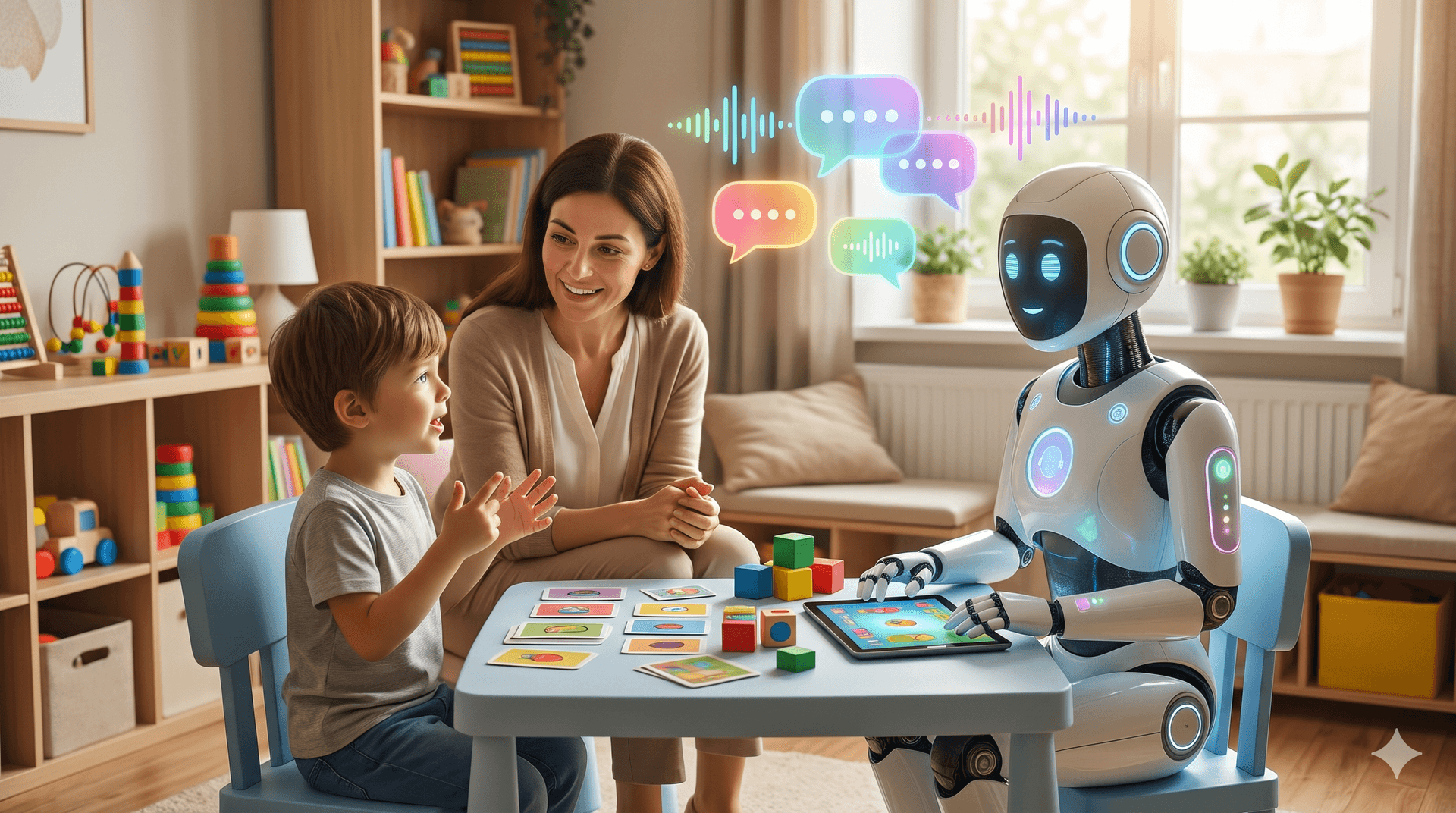
This is also why online stuttering therapy has grown so quickly. Technology has made it possible to work with a specialist from your living room, wherever you live. But notice what’s doing the real work there: a trained human guiding you, with technology as the delivery channel. That distinction matters a lot.
What AI Can’t See: The Person Behind the Speech
Here’s the thing speech therapy is really about. It isn’t just sounds and syllables. It’s a person trying to communicate while carrying a lot of history: the teacher who sighed, the job interview that went sideways, the phone call they’ve been avoiding for years.
Stuttering, in particular, is rarely just a mechanical problem. Two people can produce identical blocks on the word “coffee” and feel completely different about it. One shrugs. The other quietly rearranges their entire order to avoid saying it. An algorithm hears the block. A good therapist hears the avoidance, the tension in the shoulders, the half-second hesitation before the person even opens their mouth.
Reading those cues, adjusting in the moment, and knowing when to push and when to simply sit with someone is a deeply human skill. A tool that predicts the next likely word isn’t built for it.
The Neuroscience: Why Speech Is More Than Pattern Matching
Speaking looks effortless, but it’s one of the most complex things your brain does. Dozens of muscles in your lips, tongue, jaw, larynx, and lungs have to fire in a precise sequence, often within fractions of a second. Several networks have to cooperate to pull that off:
The motor planning regions map out the movement sequence before you speak.
The basal ganglia and thalamus help initiate and time each sequence, acting like a conductor for the whole thing.
The auditory system monitors what you hear yourself saying and feeds corrections back.
The emotional centres, especially the amygdala, tag the moment as safe or threatening, and that tag changes how smoothly everything else runs.
Research on people who stutter has repeatedly pointed to differences in how these timing and coordination networks communicate. That’s not a character flaw or a lack of effort. It’s a difference in wiring and timing, and it’s very sensitive to stress, expectation, and past experience.
Now think about what that means for therapy. If the problem lives in the interaction between movement, timing, and emotion, then change has to happen at that same level. You can’t just correct the output. You have to retrain the system.
Neuroplasticity Needs Relationship, Not Just Repetition
The good news is that the brain stays adaptable throughout life. This is called neuroplasticity, and it’s the reason therapy works at all. When you practise a new way of speaking, you strengthen certain pathways and weaken older, less helpful ones.
But plasticity isn’t triggered by repetition alone. Learning is shaped by attention, emotion, motivation, and feedback. A brain that feels safe and understood learns differently from one that feels judged or rushed. This is where a therapist earns their place. They notice the moment you tense up, they adjust the task so it’s challenging but not overwhelming, and they celebrate the small wins that actually register as meaningful to you.
An app can tell you that you repeated a sound four times. It can’t tell that the fifth sentence mattered more than the previous forty because it was the first time you said something real, out loud, without bracing for it.
Where AI Falls Short in Real Therapy
Let’s be specific, because “AI can’t replace humans” is a vague line without examples. Here are the gaps that show up most often.
It can’t build a diagnosis from the whole picture. Assessment involves case history, observation, family context, and judgement calls about what’s typical and what isn’t. Misreading these can mean missing a problem or labelling a normal phase as a disorder. A clinician carries accountability for that decision. A tool doesn’t.
It can’t personalise in real time. Therapy isn’t a fixed curriculum. A skilled therapist changes the plan mid-session because your voice sounded different today, or because you mentioned a presentation next week that’s been keeping you up at night.
It struggles with emotion and avoidance. Much of stuttering lives beneath the surface, in situations people avoid and words they swap out. Those hidden patterns rarely show up in a transcript.
It can reinforce perfectionism. Constant automated scoring can quietly teach people to chase “clean” speech, which often increases tension and makes stuttering worse. A therapist helps you separate progress from perfection.
It can’t offer genuine human connection. For many people who stutter, the experience of being listened to patiently, without finishing their sentences, is itself therapeutic. That experience calms the threat response in the brain. It’s hard to get that from a screen that processes your words as data.
So What Will AI Actually Change?
Realistically, the future looks like collaboration. AI will probably take over a lot of administrative work: notes, scheduling, progress tracking, and practice generation. It will make therapy more accessible, especially for people in areas with few specialists. And it will give clinicians better data to work with.
What it won’t do is replace the judgement, empathy, and adaptability that make therapy effective. Think of how calculators changed mathematics. They didn’t remove the need for mathematicians. They changed what mathematicians spent their time on. Speech therapy is heading the same direction, with technology handling the routine so humans can focus on the part only humans can do.
If anything, the clinicians who thrive will be the ones who understand both the technology and the brain well enough to use one in service of the other.
How to Use AI Tools Wisely If You Stutter
If you’re curious about AI-assisted practice, you don’t need to avoid it. Just use it with some care.
Treat it as a practice partner, not a therapist. Let it prompt you and track habits, but don’t let it decide what “good” speech means.
Watch your reaction to the feedback. If an app score makes you tense, anxious, or hyper-focused on fluency, that’s a signal to step back.
Pair it with real guidance. Tools work best when a professional has already helped you understand what you’re practising and why.
Be wary of big promises. Anything claiming a quick, guaranteed fix for stuttering is oversimplifying a complex neurological and emotional picture.
What Good Therapy Looks Like
Effective stuttering therapy works on several layers at once: how your speech system coordinates movement, how your brain responds to pressure, and how you feel about speaking in the first place. That means calming the threat response, building new motor habits, and slowly widening the situations where you feel confident.
It’s also personal. Your triggers, your history, and your goals shape the plan. That’s why many people find the most progress when they start with a real conversation about what’s been going on rather than jumping straight into exercises. If you’re unsure where to begin, you can book a free stuttering consultation and talk through your situation with someone who understands both the speech and the brain behind it. There’s no pressure, and it’s a simple way to find out what approach might suit you.
The Bottom Line: Technology Is a Tool, Not a Therapist
Will AI replace speech therapists? Based on how the brain learns, how communication works, and what people actually need from therapy, very unlikely. AI can sharpen tools, speed up admin, and extend access. It can’t sit with the person whose voice is shaking before a big meeting, or notice the tiny shift that means they’re finally relaxing into their own speech.
Speech is human, social, and emotional, and the brain changes best in the presence of safety, attention, and trust. Those are things people give each other.
If you’re ready to understand stuttering through the lens of the brain rather than just another list of tips, take a look at the neuroscience method. It explains how retraining the speech system from the inside can lead to more natural, confident communication, with a real human guiding every step.
Ready to Put This Into Practice?
Download the app and start practicing today
Reading is the first step. Real progress comes from consistent daily practice. Use StopStutter to build confidence and improve your speech every day.


