


ReviewOctober 12, 2026
Echolalia: What It Really Means and What the Brain Is Doing
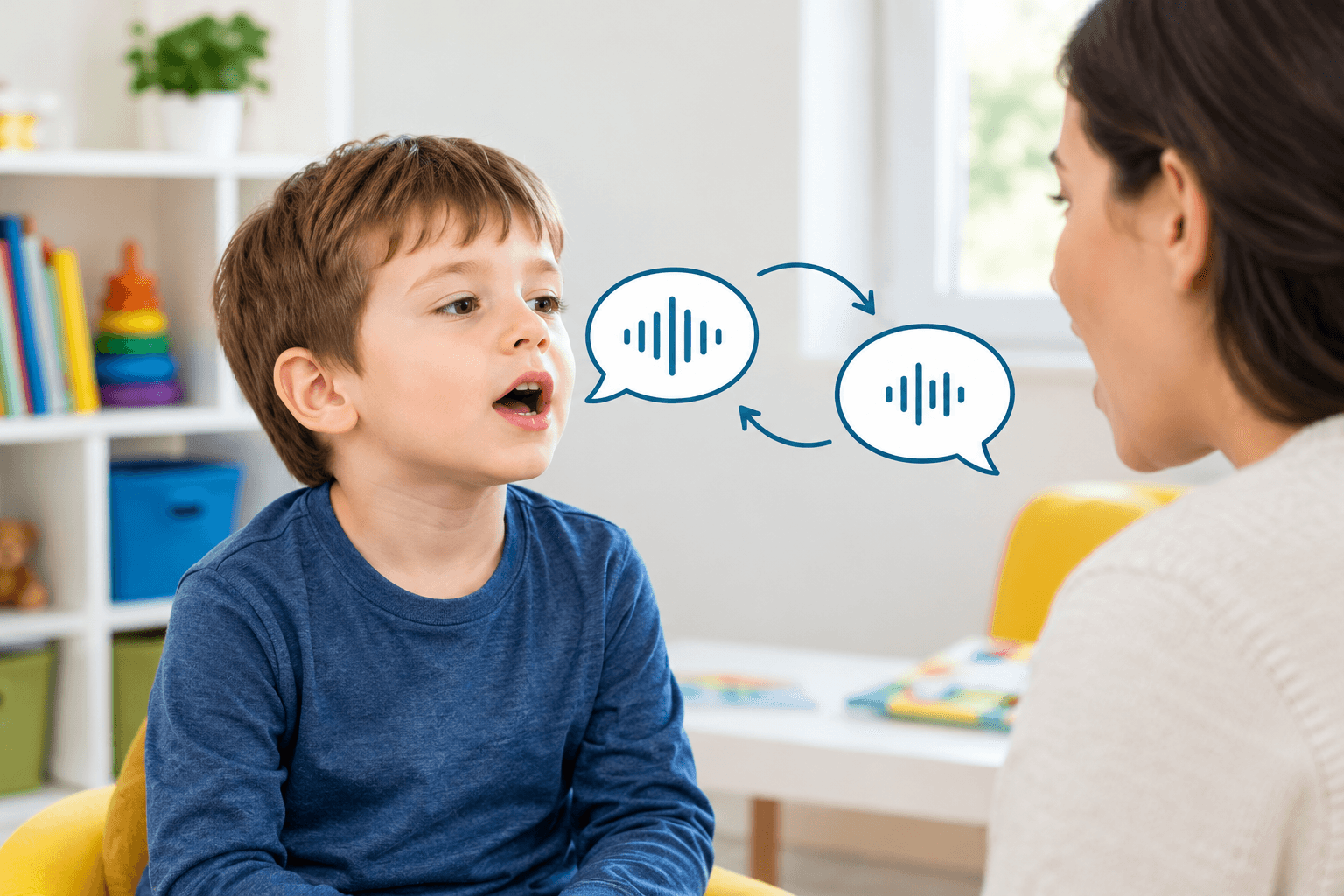
Your toddler hears “Do you want juice?” and answers “Want juice?” in the exact same sing-song tone. Or a teenager drops a full line from a cartoon at the perfect moment. If you’ve seen something like that, you’ve probably wondered what echolalia is, and whether it’s something to worry about.
Here’s the short version: echolalia is the technical name for repeating what someone else has said. It isn’t a disease. It’s a speech pattern with several possible causes, and the brain is doing something very specific when it happens.
I work in the world of speech and fluency, so I tend to look at repetition through the lens of how the brain plans and times speech. If you’re here because you want to Stop stuttering, start there, then come back. Repetition shows up in both stuttering and echolalia, but for very different reasons, and we’ll get to that.
And if repeated sounds or words are affecting your own speech, online stuttering therapy lets you work on it from home. For echolalia itself, the best first step is usually an evaluation by a speech-language pathologist (SLP) who knows the person’s communication profile. This article will help you understand what you’re looking at.
Jump to: What is echolalia · Types · Psychiatry · Adults · Verbigeration · Brain science
What Is Echolalia? The Technical Name for Repeating What Someone Else Has Said
Echolalia is the repetition of words or phrases someone else has said, either right away or after a delay. It’s common in toddlers learning to talk and in autistic children and adults. It can also appear after a stroke or brain injury, or alongside conditions like dementia or Tourette syndrome.
Echolalia Meaning in English: Simple Definition and Pronunciation
Echolalia (say it “ek-oh-LAY-lee-uh”) is a noun. Its meaning in English is the automatic repetition of words or phrases someone else has just said. The word comes from two Greek roots, one for “echo” and one for “speech,” so it literally means “echo speech.”
Picture a shout bouncing back off a canyon wall. The words go in, and the same words come out.
Clinical sources all describe it about the same way: an echo of heard language, often with very little change. What those definitions can’t capture is that echolalia often carries meaning. The words are borrowed, but the intent behind them is real.
Types of Echolalia
Immediate Echolalia
This is repeating something right after hearing it. A child asked “Are you hungry?” says “Are you hungry?” Sometimes it means “I’m still working out my answer.” Sometimes it means “yes.”
Delayed Echolalia
Here the repetition comes minutes, hours, or even days later. A child might recite a line from a favorite show while melting down in a grocery store. It looks random, but it’s often a way of reaching for a feeling or a situation the phrase once matched.
Mitigated Echolalia
The repeated phrase gets a small change, like a swapped word or a new tone. This one is a good sign in many children, because it shows they’re starting to play with language instead of only copying it.
Functional (Communicative) Echolalia
The repeated words are doing a job. They might request something, protest, comfort, or take a turn in conversation. Researchers have pointed this out since the early 1980s, and it’s why many SLPs now treat echolalia as communication to understand, not just behavior to stop.
Echolalia Meaning in Psychiatry
In psychiatry, echolalia is a sign to interpret, not a diagnosis on its own. You’ll most often see it listed alongside echopraxia (copying someone else’s movements) as a feature of catatonia. It can also turn up in schizophrenia and in some neurological conditions.
The key word is context. A three-year-old echoing while they learn language, an autistic adult using a favorite phrase to stay in a conversation, and an adult who suddenly starts repeating what others say after a head injury are three very different situations, even though the behavior looks alike. That’s why clinicians ask how and when it started, whether it seems to have a purpose, and what else is going on with speech, movement, mood, and thinking.
Echolalia in Adults: Autism, Stroke, Dementia and More
Echolalia isn’t only a childhood thing. In adults, it usually falls into one of two groups: echolalia that’s been there since childhood, and echolalia that’s brand new.
Long-standing echolalia is common in autistic adults, who often keep using scripts and quoted phrases, sometimes for comfort and sometimes to bridge a gap in conversation. Many describe it as a language they’re fluent in, not a problem to fix.
New-onset echolalia is a different story. When an adult suddenly starts echoing, doctors think about neurological causes first, such as a stroke, a traumatic brain injury, certain types of aphasia, or dementia. A psychiatric condition like catatonia is also on the list. Sudden changes in speech always deserve a prompt medical look.
Is Echolalia a Sign of Autism?
This is one of the most common questions, and the honest answer is: sometimes, but not always. Echolalia is common in autism, but it isn’t exclusive to it. Think of it as a clue, not a diagnosis. Look at the wider picture: age, social communication, play, sensory patterns, and development overall.
Echolalia vs Verbigeration (and Palilalia)
These three get mixed up all the time. The easiest way to separate them is to ask whose words are being repeated, and why.
Echolalia repeats someone else’s words.
Palilalia repeats your own words or phrases, often getting faster and quieter as it goes. It’s linked to conditions like Parkinson’s disease and Tourette syndrome.
Verbigeration is a stuck, repetitive stream of words or phrases that doesn’t seem connected to the conversation. It’s an older psychiatric term, usually described in catatonia and some psychotic disorders.
So when people ask about verbigeration vs echolalia, the short version is this: echolalia copies what was heard, while verbigeration keeps cycling words on its own, often with little or no communicative purpose. If your search was “echolalia but repeating yourself,” palilalia is probably closer to what you mean.
Echolalia vs Stuttering: Same Repetition, Different Brain Story
In stuttering, the person knows exactly what they want to say, but the timing of speech movement breaks down. The repetitions, prolongations, and blocks happen because the brain’s speech-timing network struggles to launch the sequence smoothly. If you want to see how that plays out with whole words and phrases, our guide to phrase repetition in stuttering walks through real examples.
Echolalia is the opposite situation. The speech system usually works fine. What’s different is where the words come from. They’re copied from what was just heard, or pulled from memory as a ready-made chunk.
Is the repetition in your own speech? Echolalia and stuttering can look similar from the outside, but they’re very different things. If you’re not sure which one you’re dealing with, a free stuttering consultation is a no-pressure place to start.
What Is the Brain Doing During Echolalia?
Normally, hearing and speaking are connected by a loop. Auditory areas process what you hear, and motor areas plan how to say something back. Between them sits a kind of checkpoint that lets you decide whether to respond with your own words or not.
In echolalia, that loop runs a little too directly. The heard words slide straight into the speech motor system with less editing in between. In a toddler, that’s just the brain practicing. Children learn language partly by copying, and the checkpoint is still being built. In autism, many people process language in whole chunks (often called gestalt language processing), so a full phrase is the natural unit, and echoing it makes sense. After a stroke or injury, the checkpoint itself may be damaged.
That’s also why the stuttering comparison is useful. Both patterns are about timing and control, just in different parts of the circuit. If you’re curious about the stuttering side of that story, our post on why stuttering occurs explains it in plain language.
Does Echolalia Go Away?
Often, yes, especially in young children. As vocabulary and sentence building grow, echoing tends to drop off or shift into mitigated, more flexible language. For autistic children and adults, it may stay for life, and that’s okay. The goal usually isn’t to erase it. It’s to help the person build more ways to communicate, so the echoing becomes one tool among many.
A few things that tend to help:
Respond to the meaning, not just the form. If your child echoes “Want juice?” give them the juice and model “I want juice.”
Keep language short and clear, and pause to give them time.
Avoid correcting or shaming the repetition. It usually makes it more stressful, not less.
When to Seek Help
Reach out for an evaluation if echolalia seems to be the only way a child communicates past age three, if it appears suddenly in an adult, or if it comes with other changes in thinking, movement, or mood.
In the U.S., children under 3 can be evaluated through their state’s Early Intervention program, and parents can usually request that evaluation themselves. For older kids, you can ask your school district or a private SLP. For adults, a primary care doctor or neurologist is a good first stop, followed by a speech-language pathologist. ASHA’s ProFind directory can help you find one near you.
Final Thoughts
Echolalia looks simple on the surface, but behind it is a brain doing something clever with the words it hears. Sometimes it’s learning, sometimes it’s comfort, sometimes it’s a signal worth checking out. The more you understand the pattern, the better you can respond to it.
If you’re curious how the brain times and starts speech, and why that matters for fluency, you can read more about our neuroscience method and how it works.
Ready to Put This Into Practice?
Download the app and start practicing today
Reading is the first step. Real progress comes from consistent daily practice. Use StopStutter to build confidence and improve your speech every day.


