ReviewOctober 13, 2026
Fear of Stuttering: A Fear Hierarchy Guide to Speaking With More Ease
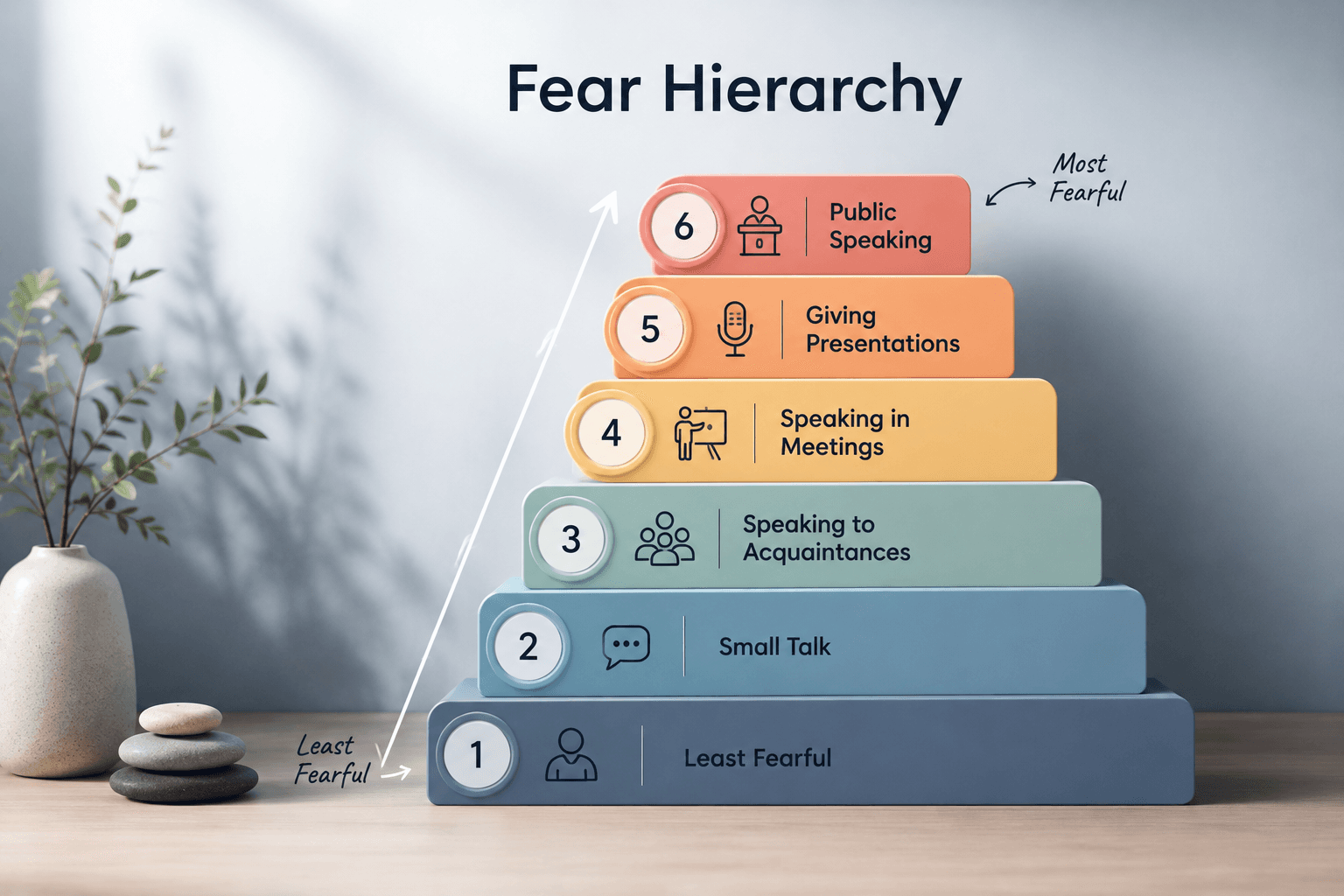
Fear of stuttering is the dread of getting stuck on a word, and for many people it becomes a bigger problem than the stutter itself. A fear hierarchy is a ranked list of speaking situations, ordered from least to most frightening, that you face one step at a time to teach your brain that speaking is safe. It turns a vague dread of talking into a clear ladder you can climb. Each rung gives your nervous system new evidence that the feared moment is survivable.
This approach sits at the heart of the neuroscience method, which treats the fear, tension, and avoidance around stuttering as a learned layer you can retrain. If you are searching for how to stop stuttering at the root and not just hide it, this is where the work starts. Many people also add online stuttering therapy for guided, personalized support.
How to build a fear hierarchy in 5 steps
Write down every speaking situation you fear or avoid.
Score each one from 0 to 100.
Sort them into rungs, lowest to highest.
Plan your tools, then face the lowest rung.
Repeat each rung until your fear score drops, then climb.
What Is Fear of Stuttering?
Fear of stuttering is anticipatory fear: dreading a word, a person, or a moment before you speak. It is common among people who stutter, and it can build for years. Research suggests that adults who stutter report more social anxiety than fluent adults, but anxiety does not cause stuttering. It makes stuttering more noticeable and more costly.
Signs of Fear of Stuttering
Scanning ahead for words or sounds you might get stuck on
Swapping words, rewording sentences, or staying silent
Dreading phone calls, introductions, or being called on
Tightening your jaw, throat, or breath before you speak
Replaying conversations afterward and feeling shame
Is There a Name for Fear of Stuttering?
There is no widely accepted clinical name for it. It is usually called anticipatory anxiety, speech anxiety, or social anxiety. Glossophobia describes fear of public speaking, and some sources use informal terms such as lalophobia for fear of speaking. When the fear is intense and lasting, it may be social anxiety disorder, which is treatable. See speech anxiety and can anxiety cause a stutter.
Why Fear Keeps Stuttering Blocks Alive
The Core Layer and the Learned Layer
Stuttering has a genetic and neurodevelopmental basis. That core disfluency is not your fault, and it does not simply switch off on command.
But a second layer grows on top of it, and that layer is learned:
Anticipatory fear: dreading a word before you say it
Physical tension loops: clamping the jaw, throat, or breath to “force” the word out
Avoidance traps: swapping words, skipping calls, staying silent in meetings
Learned behaviors can be retrained. That is where neuroplasticity comes in. Our guide on secondary behaviors of stuttering breaks down this layer in more detail.
How the Brain’s Alarm System Predicts Trouble
Your brain is a prediction machine. After enough painful moments, it files certain words, people, and places under “danger.” The alarm fires before you even open your mouth.
That alarm raises muscle tension and shortens your breath. Tension makes a block more likely. The block confirms the fear. The loop locks in.
A prediction error breaks the loop. It happens when you expect disaster and something milder occurs. Repeat that often enough and the brain updates its forecast.
A Note on Setbacks
Old fear pathways weaken over time, but they can resurface under heavy stress, fatigue, or pressure. A bad week does not erase your progress. It means the old circuit got a brief signal, and you have the tools to quiet it again. You can map your own triggers for stuttering to see which situations stir it up most.
What Is a Fear Hierarchy for Stuttering?
A fear hierarchy is the map behind exposure therapy. You list your feared speaking situations, rank them, and move up one rung at a time. Each rung is hard enough to teach you something and manageable enough to stay in learning mode, not survival mode.
It does three things:
Replaces vague dread with a clear, ordered list
Breaks a huge fear into small steps you can actually do
Collects evidence that the feared outcome is less likely, or less costly, than your brain predicted
Building Your Ranked List of Speaking Fears
Step 1: Write Down Every Feared Situation
Do not edit yet. Include the obvious ones and the sneaky ones you already avoid. Many people find that their phone call anxiety sits high on this list, along with introductions and ordering food.
Step 2: Score Each One From 0 to 100
Clinicians call this a Subjective Units of Distress Scale. Use a simple version:
0: no fear at all
50: uncomfortable, but you would still do it
100: you would do almost anything to avoid it
Go with your gut. A rough score is enough.
Step 3: Sort the List Into Rungs
Low rungs (0 to 30)
Saying your name to a mirror
Reading aloud to a pet or an empty room
Sending a voice note to a close friend
Middle rungs (40 to 60)
Ordering at a café
Asking a store employee where something is
Speaking up once in a small meeting
High rungs (70 to 100)
Introducing yourself to a group
Making a work call to a stranger
Presenting to a room
If you hide your stutter well, you may be a covert stutterer. Add your avoidance habits to the list too. Every word swap and skipped call is a rung you have been stepping around.
How to Make a Smooth Gradient
If the jump between rungs feels too big, change only one variable at a time:
Who is listening: a friend, then a colleague, then a stranger
How many people: one, a few, a group
How it’s delivered: alone, face to face, then phone
Time pressure and stakes: relaxed, then rushed, then high stakes
The words: easy words first, then the ones you avoid
Two Sample Ladders
Phone calls
10: read a phone script aloud alone
25: voice note to a close friend
35: call a friend you trust
50: leave a voicemail for a business
60: call a business to ask about opening hours
75: call a doctor’s office to book an appointment
90: an unscripted work call to a stranger
Social and school
15: say your name to a mirror
30: order at a café with a friend nearby
45: ask a stranger for directions
55: speak up once in a small group
70: introduce yourself to a group
85: give a short talk to a familiar group
95: present to a large audience
Add a Plan to Every Rung
Facing your fears works best with preparation. If you keep walking into a hard moment unprepared and struggling, the fear can grow instead of shrink. So plan each rung before you climb it:
Define the situation. Who, where, and what exactly will you say?
Choose your tools. A slow exhale, a soft start on the first sound (see easy onsets), short phrases, and pauses.
Rehearse in layers. Silently first, then in a whisper, then in your normal voice, then with another person.
Go in and allow the stutter. Stay present, and don’t swap words.
Debrief. Compare what you predicted with what happened.
If a rung leaves you stuck or overwhelmed several times in a row, step down one rung and add more preparation. That is not failure. It is pacing.
What a Prediction Error Looks Like in Real Life
Here is a middle-rung example. The speaker is ordering coffee and fears the “C” in “cappuccino.”
The old pattern: The alarm fires, so the person swaps the word to something easier. The fear stays untouched.
The retraining pattern:
Barista: “Hi there, what can I get you?”
You: (feel your shoulders creeping up; drop them and let your jaw hang loose) “Hi. I’d like a... c-c-cappuccino, please.” (a short block; keep your face soft, do not push, let the word finish)
Barista: “Sure, one cappuccino. Anything else?”
You: (exhale slowly through your nose; notice your heart is racing but nothing bad happened) “No, that’s all. Thanks.”
Look at what your brain just recorded. You said the feared word. You stuttered. The barista did not flinch. The world carried on. That gap between predicted disaster and actual outcome is the prediction error.
Why You Stay on One Rung Until It Is Boring
One success does not rewrite a pattern. Repeat each rung until your fear score drops by about half. Then move up.
Exposure Therapy for Stuttering: The Science Behind the Ladder
Exposure therapy is a well-studied approach from cognitive behavioral therapy (CBT). You face a feared situation in small, planned doses until your brain stops treating it as a threat. A fear hierarchy is the map that makes this possible.
What Exposure Therapy Targets (and What It Doesn’t)
Exposure work does not change the core, neurodevelopmental side of stuttering. It targets the learned layer:
Anticipatory fear before speaking
Avoidance of words, people, and situations
The tension loops that fire when the alarm goes off
Studies of CBT-based approaches in adults who stutter suggest they can reduce social anxiety, while effects on stuttering itself vary. When the fear and tension calm down, many people find speech becomes easier and less effortful, and they feel far less shame around the moments they do stutter. If the fear of judgment is your biggest barrier, our post on the fear of being judged when speaking goes deeper.
Why Gradual Beats Forced
Exposure is not about throwing yourself into the scariest moment and hoping for the best. Jumping straight to your biggest fear can overwhelm your nervous system and deepen the dread. A ladder works because each rung is challenging but manageable.
Two Ways to Practice
Real-life exposure: speaking in the actual situation, like ordering food or asking a question in a meeting
Imagined exposure: vividly picturing a feared moment while staying relaxed, useful for rungs that feel too high to start with
Many people begin with imagined exposure on the top rungs and use real-life exposure on the lower ones.
What Actually Changes in the Brain
Older models said fear simply “wears out” with repetition. Current research suggests something more useful: you build new, competing memories that say “this was safe.” The old fear memory weakens, but it can come back under stress or fatigue. That is why returning to your ladder works.
Make Each Exposure Count
Stay in the moment. Do not swap words or rush to escape.
Tell tools from hiding. A skill you have practiced, such as an easy onset, is a tool. Hiding your stutter, avoiding eye contact, or swapping words is avoidance, and it blocks the lesson.
Notice what happened. Compare your prediction with the outcome.
Repeat. One win is a data point. Many wins change the forecast.
From Fear of Stuttering to Easier, More Fluent Speech
Progress rarely arrives all at once. A common order looks like this:
Fear drops first. The same situation scores lower than it did.
Avoidance drops. You say the word, make the call, and speak up.
Tension drops. Your jaw, throat, and breath loosen.
Speech gets easier. Blocks may be shorter, less frequent, and less effortful.
Fluency often follows less fear, but not always. There is currently no cure for stuttering, and outcomes vary from person to person. For some people the goal is smoother speech. For others it is easier, less avoidant speaking, with stuttering still present. Both are real progress.
How to Track Progress
Each week, write down three numbers:
Your fear score on a rung you practiced
How many situations you avoided
How many times you spoke anyway
Lasting change comes from repetition over months, so look for small trends, not perfect days.
A Daily Protocol You Can Start Today
Keep it small and consistent. Ten minutes a day beats one heroic hour a month.
Your Step-by-Step Routine
☐ Pick one rung from your list, ideally a 20 to 40
☐ Rate your fear from 0 to 100 before you begin
☐ Scan your body: jaw, throat, shoulders, breath
☐ Release tension with one slow exhale
☐ Rehearse silently, then softly, then in your normal voice
☐ Speak, and allow any stutter to happen without forcing or swapping words
☐ Rate your fear again right after
☐ Write one line: “I expected ___. What happened was ___.”
☐ Repeat the same rung until the score drops, then climb
On Hard Days
Step down a rung. Do not skip the practice entirely. A tired nervous system needs gentler evidence, not none. Slow, steady breathing helps too, and our post on how to stop stuttering when nervous offers more ways to settle your body first.
How Speech Therapy Fits Into the Picture
Some people think traditional speech therapy only trains the mouth. That is outdated. Modern speech-language pathologists use mind-body approaches such as CBT, desensitization, and avoidance reduction. A skilled clinician can help you:
Rank fears honestly, including the ones you hide
Choose rungs that stretch you without overwhelming you
Spot tension loops you cannot feel yourself
Use tools like paradoxical intention, where you stutter on purpose to drain the fear of its power
Working with a coach or therapist also gives you someone to celebrate wins with. That matters more than most people expect.
When to Get Extra Support
Consider talking to a doctor or mental health professional if fear of stuttering is intense, lasts for months, or limits your work, school, or relationships. It may be social anxiety disorder, which is treatable. If you ever feel hopeless or think about harming yourself, contact your local emergency number or a crisis line right away.
Frequently Asked Questions
What is a fear hierarchy in simple terms?
It is a list of scary situations ranked from mild to intense. You face them in order, starting small. Each success teaches your brain the threat is lower than predicted.
What is fear of stuttering called?
There is no standard clinical name. It is usually called anticipatory anxiety, speech anxiety, or social anxiety. When it is intense and lasting, it may be social anxiety disorder.
Does a fear hierarchy cure stuttering?
No. It does not erase the genetic core of stuttering. It does reduce the learned layer: fear, tension, and avoidance. Many people speak with more freedom and less struggle.
Is exposure therapy safe for people who stutter?
Yes, when it is gradual and paced to your level. Start with low rungs and step down when you feel overwhelmed. An SLP trained in CBT can guide the harder rungs.
How long does it take to work?
It varies by person and by rung. Many people notice shifts in a few weeks of daily practice. Lasting change comes from repetition over months.
Can I build a fear hierarchy on my own?
Yes, you can start alone with the steps above. Guidance from an SLP or coach helps you pace it safely and keeps you from avoiding the hardest rungs.
Your Next Rung
Open a notepad and write your first five feared situations right now. Score them, pick the lowest, plan your tools, and do it today. Small, repeated proof is what retrains a brain that learned to expect danger. Every rung you climb weakens the old alarm a little more, and a well-built fear hierarchy gives you a clear, patient path from fear of stuttering toward a calmer, freer voice.
Ready to Put This Into Practice?
Download the app and start practicing today
Reading is the first step. Real progress comes from consistent daily practice. Use StopStutter to build confidence and improve your speech every day.