


ReviewSeptember 29, 2026
Freudian Slip
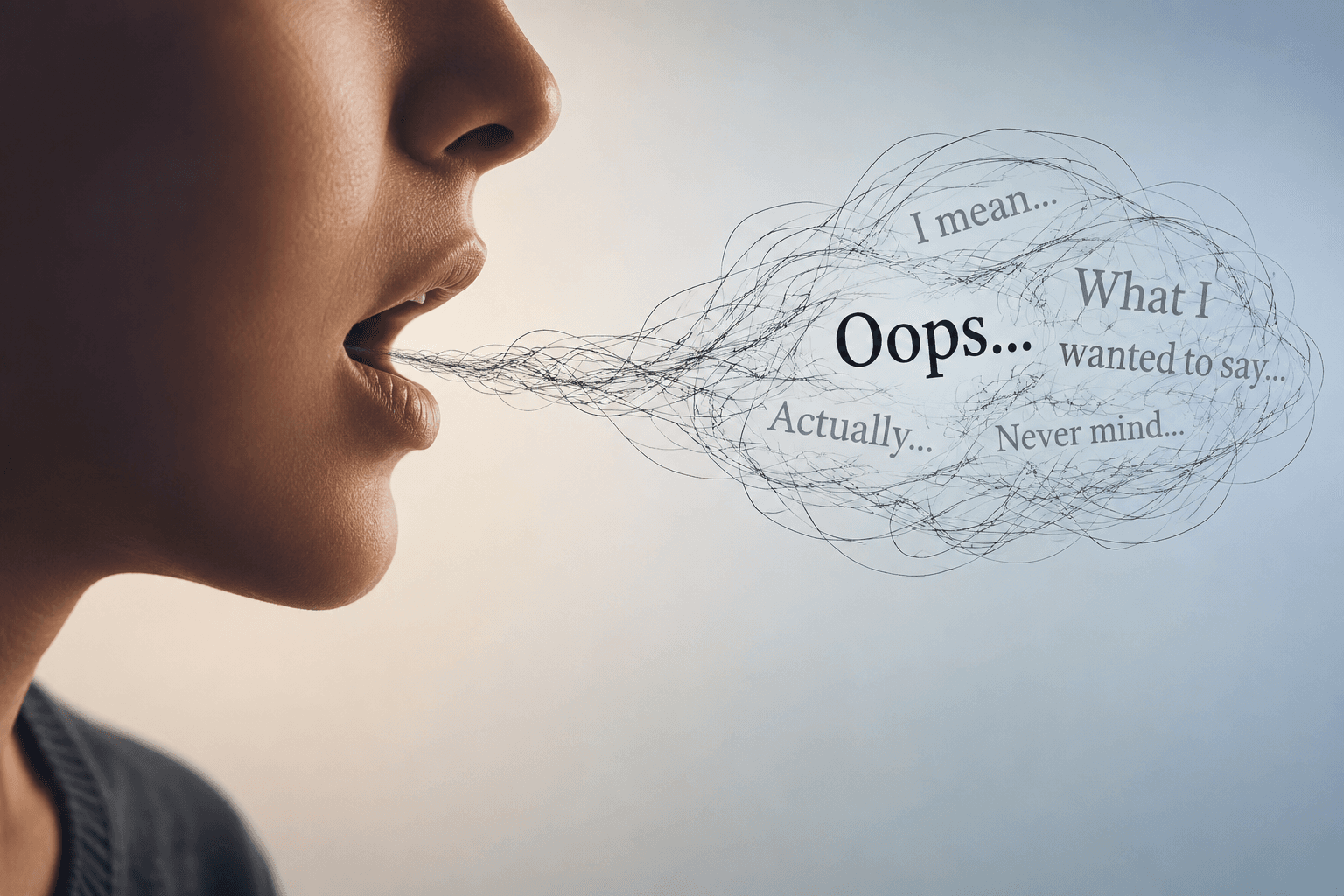
Freudian slip meaning goes far beyond a funny verbal mistake. A Freudian slip is a moment when a person says one word but means another, and Sigmund Freud believed these errors were tiny windows into the subconscious mind. Modern neuroscience takes the idea further, showing that these slips are the product of overlapping brain systems that plan speech, filter thought, and manage emotion at lightning speed. Whether you called your boss "mom," said "sex" instead of "six," or blurted out a name you weren't supposed to mention, your brain wasn't malfunctioning. It was showing you something real. Understanding Freudian slips, what causes them, and how the brain produces them helps explain not just occasional slips of the tongue, but also broader speech patterns like blocks, disfluencies, and stuttering, all of which can be addressed through neuroplasticity-based approaches like the neuroscience method.
Freudian Slips: Where Psychology Meets Neuroscience
Freud coined the term in the early 1900s, calling it "parapraxis." But the modern picture is richer than his original theory.
Freud believed slips revealed hidden desires, unresolved feelings, or repressed thoughts pushing to the surface
Today's neuroscientists see slips as speech-planning errors, where competing signals in the brain break through the filter
Both views agree on one thing: what you say and what you meant to say are handled by overlapping systems, and sometimes those systems collide
For anyone dealing with speech difficulties or wondering how to stop stuttering, understanding this overlap matters. The same brain regions that produce Freudian slips are involved in stuttering blocks, which is why neuroscience-based methods work on both.
Freudian Slip Definition
A Freudian slip is an unintentional verbal or written error that appears to reveal a subconscious thought, emotion, or memory.
The formal term is parapraxis
It can happen in speech, writing, memory, or action
Not every slip is meaningful, some are simple speech-planning glitches
Others do seem to reveal genuine underlying thoughts
The line between "meaningless slip" and "revealing slip" is thinner than most people realise, because your brain is constantly processing more than it says aloud.
Freudian Slip Examples From Everyday Life
Real examples make the concept click. Here are some of the most common patterns.
Calling your partner by an ex's name during a serious conversation
Saying "bed" instead of "meeting" when you're exhausted
Writing "die" instead of "dye" in a stressful moment
Introducing a colleague by your rival's name at a networking event
Saying "I hate you" instead of "I ate too" when tired and irritable
Announcing "I'm pleased to seduce our speaker" instead of "introduce"
Public figures aren't immune either. Some famously mixed up "United Nations" with words their audience did not expect. These moments go viral precisely because they feel revealing.
Example of a Freudian Slip in a Relationship
Relationship slips are the most emotionally loaded of all.
Calling a new partner by an old partner's name
Saying "I have to leave" when you meant "I love you"
Writing "hate to see you go" as "have to see you go"
Are these subconscious signals or brain fatigue? Often both. The brain stores emotionally charged words in tightly linked networks. If a related feeling is active, even mildly, the wrong word can pop out.
Freudian Slips vs Regular Speech Errors
Not every mispronunciation is a Freudian slip. There are three distinct categories.
Slip of the tongue, a phonetic error, like mixing up sounds ("par cark" instead of "car park")
Freudian slip, a substitution that appears to reveal a hidden thought
Stuttering block, a physical inability to produce a sound despite knowing exactly what you want to say
Understanding the difference is important. Stuttering is not a Freudian slip and doesn't reveal a hidden thought. It's a neurological pattern that can be rewired through consistent practice, which is exactly what online stuttering therapy works on.
What Happens in the Brain During a Freudian Slip
Modern neuroscience identifies specific brain regions involved.
Broca's area plans speech and selects words
The motor cortex turns those plans into physical sound
The basal ganglia manage sequencing and timing
The amygdala injects emotion into word selection
The hippocampus pulls memories and associations into the mix
A Freudian slip usually happens when the amygdala or hippocampus contributes a signal that overrides Broca's careful selection. The word you thought about, feared, or associated with the moment sneaks past the filter.
This is exactly why the same five brain regions are involved in stuttering, and why the neuroscience method targets all of them together.
Why Tired Brains Slip More
Fatigue is one of the biggest causes of verbal slips.
Cognitive control weakens when you're tired
The prefrontal cortex, which acts as your brain's editor, slows down
Alternative words that would normally get filtered out slip through
Emotional and memory-based associations dominate more easily
If you've ever noticed yourself blurting out something odd at the end of a long day, this is why. It's not a personality flaw, it's neural fatigue.
Freudian Slips Under Stress
Stress and pressure change how the brain selects words.
The amygdala fires more actively, pushing emotional content forward
Working memory shrinks, making word retrieval harder
Attention narrows, so filtering slows down
The result is a higher chance of the "wrong" word landing first
This is closely related to what happens during stuttering under stress. The brain becomes overloaded, and speech production breaks down. The neuroscience method addresses this by calming the amygdala through mind training while retraining Broca's area through speech tools.
Common Situations Where Freudian Slips Happen Most
During arguments with a partner
When speaking about someone you have unresolved feelings about
In meetings where you're trying to hide an opinion
When exhausted or sleep-deprived
During anxious social interactions
When thinking about something you're consciously trying to suppress
That last one is key. The more you try not to say something, the more active it becomes in your brain. This is called ironic mental processing, and it plays a huge role in both slips and stuttering.
The Link Between Freudian Slips and Speech Anxiety
People with speech anxiety are often more prone to slips.
Anxiety keeps the amygdala highly active
The brain scans harder for potentially embarrassing words, which paradoxically makes them more accessible
Overthinking speech slows down natural word selection
Fear of slipping increases the chance of slipping
This same feedback loop is what fuels many stuttering blocks. Understanding it is the first step to breaking it.
Can You Prevent Freudian Slips?
Completely preventing them is impossible. Reducing them is not.
Get enough sleep, tired brains slip more
Reduce stress, especially before high-stakes conversations
Slow your speech pace to give Broca's area time to work
Practise breathing exercises before speaking
Avoid trying to suppress specific words, which only strengthens them
These same practices form part of the daily routines built into modern stuttering recovery programmes.
What Freudian Slips Teach Us About Speech Recovery
Here's the bigger insight. If your brain can produce the wrong word under stress, it can also be trained to produce the right one under stress.
The brain is plastic, meaning it can rewire based on repeated experience
Consistent practice strengthens the pathways you use most
Slips become less frequent as speech pathways become more stable
Stuttering blocks reduce as the same pathways get retrained
This is the foundation of neuroplasticity-based stuttering treatment. Freudian slips and stuttering blocks come from related brain systems. Both can be improved through the same underlying principle: rewiring the brain through repetition, mind training, and emotional regulation.
The Neuroscience Method and Speech Rewiring
The neuroscience method identifies five brain regions involved in speech disruption, the same five regions active during Freudian slips.
Broca's area is retrained through speech tools
The basal ganglia are rewired through fluency repetition
The motor cortex builds new movement patterns through reading aloud
The amygdala is calmed through mind training and affirmations
The hippocampus stores new speech memories through consistent practice
Whether the goal is to stop stuttering or simply speak more confidently under pressure, the underlying process is the same. Consistent, structured practice rewires the brain.
Fun Facts About Freudian Slips
Freud believed even forgetting a name counts as a form of slip
Some slips are actually confusions between similar words your brain accessed at the same time
Bilingual people slip between languages more often when tired
Writers experience "written slips" too, where the wrong word appears on the page
Speech-recognition software often mishears in patterns that mirror human slips
Why This Matters Beyond Curiosity
Understanding Freudian slips isn't just fun trivia. It reframes how you think about speech mistakes in general.
Slips don't mean you're broken
Stutters don't mean you're broken
Both are the result of overlapping brain systems working under pressure
Both can be improved through the same principle of rewiring
That's the shift that helps people move from shame to strategy. You stop treating speech errors as personal failures and start seeing them as neural patterns that can be changed.
Freudian Slip Meaning: The Bigger Picture
To recap the Freudian slip meaning in one line: it's what happens when your brain's speech planning is briefly overridden by emotion, memory, or fatigue. Freud saw slips as windows into the subconscious. Neuroscience shows them as evidence of how tightly linked our speech, emotion, and memory systems really are. And once you understand that link, you also understand why stuttering, speech blocks, and disfluencies respond so well to neuroscience-based training. The same brain that slips can be trained to speak fluently, calmly, and confidently, which is exactly what the neuroscience method is built for.
Ready to Put This Into Practice?
Download the app and start practicing today
Reading is the first step. Real progress comes from consistent daily practice. Use StopStutter to build confidence and improve your speech every day.


