


ReviewSeptember 17, 2026
Broca's Area
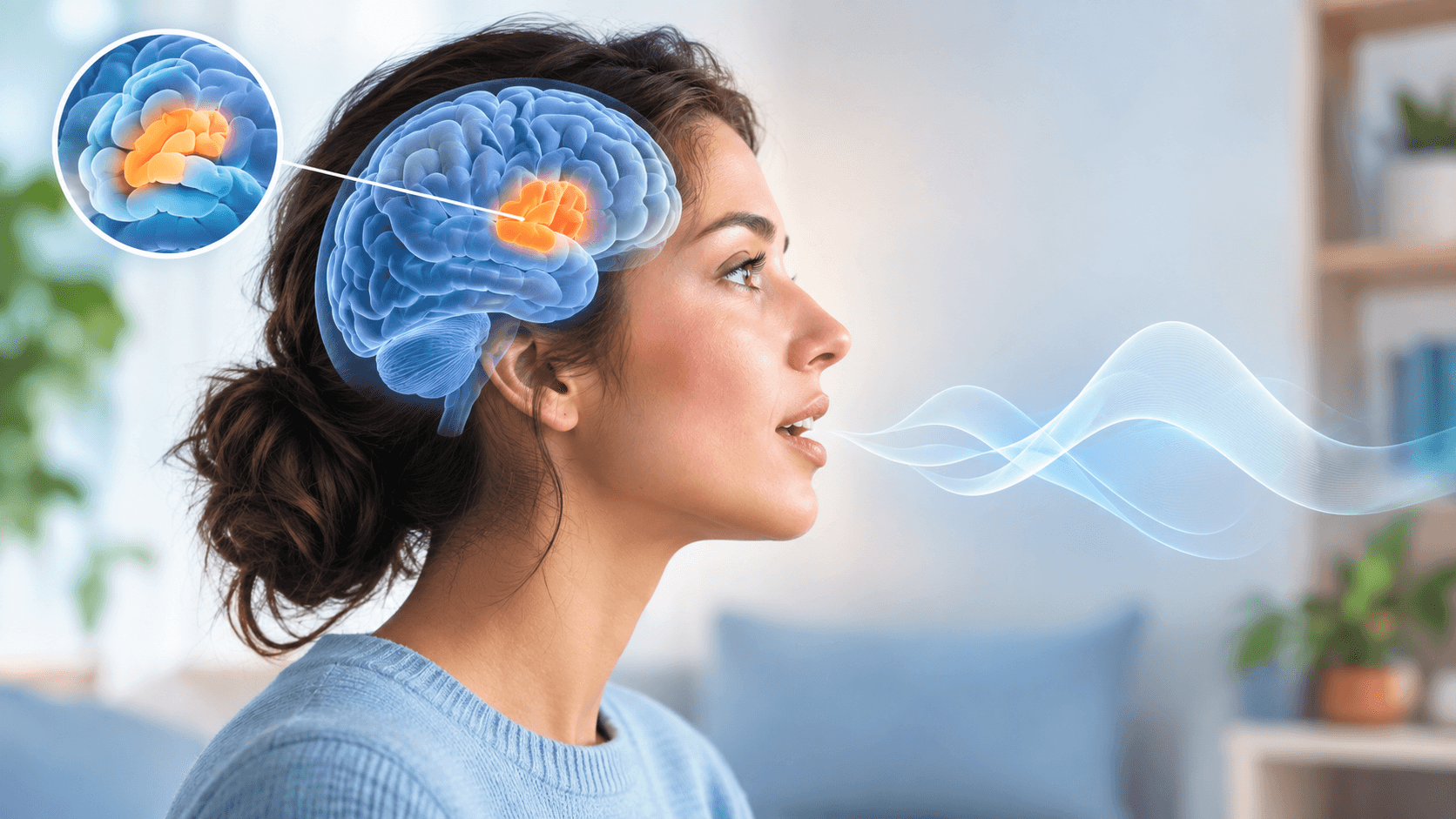
Broca's area is the small region in your brain that turns your thoughts into spoken words. Sitting in the left frontal lobe for most people, this patch of tissue handles the motor planning behind speech, and when it works well you never think about it. When it doesn't, everything from putting a sentence together to producing individual sounds falls apart. Anyone dealing with stuttering, aphasia, or unexplained speech blocks eventually runs into this name, and understanding what Broca's area actually does opens the door to why a neuroscience stuttering approach can succeed where traditional therapy struggles.
What Is Broca's Area?
Broca's area is a specialized brain region named after French physician Paul Broca, who identified it in the 1860s after studying patients who could understand language but couldn't produce it.
It sits in the inferior frontal gyrus of the frontal lobe
Most people have their Broca's area in the left hemisphere
A small percentage of left-handers have it in the right hemisphere instead
It's roughly the size of a large postage stamp
It works closely with several other brain regions to produce fluent speech
Broca's discovery was a landmark moment because it proved specific brain regions handle specific functions, rather than the brain working as one general-purpose organ.
Where Is Broca's Area Located?
Broca's area location is fairly specific, and knowing where it sits helps make sense of what happens when it gets injured.
Left frontal lobe, near the front and slightly above the ear
Inside the inferior frontal gyrus, in a region called Brodmann areas 44 and 45
Just above the lateral sulcus (the deep groove that separates frontal and temporal lobes)
Directly adjacent to the motor cortex that controls face and mouth muscles
Connected by nerve fibers to Wernicke's area further back in the brain
The proximity to the motor cortex is no accident. Broca's area sends signals directly to the muscles that produce speech, which is why damage there hits speech output so hard.
What Lobe Is Broca's Area In?
The short answer is the frontal lobe, specifically the left one in most people, and the deeper structure matters for understanding function.
Frontal lobe handles planning, decision-making, and voluntary movement
Broca's area lives at the back-lower portion of this lobe
Its position bridges cognitive planning and physical execution
The frontal lobe location is why speech and executive function are so tightly linked
Damage to nearby frontal areas often affects speech even without hitting Broca's directly
If you're working on how to stop stuttering, understanding the frontal lobe connection helps explain why anxiety and speech planning are so intertwined.
Broca's Area Function: What Does It Do?
Broca's area function goes beyond just "making speech happen." It coordinates several distinct processes that turn abstract thought into audible words.
Motor speech planning, or organizing which muscles move in what order
Grammar processing, especially for constructing correct sentence structure
Speech production timing, keeping words flowing at the right pace
Word retrieval from memory into the active speech pipeline
Coordination with breathing muscles to support fluent output
When any one of these processes falters, the effect shows up as some kind of speech difficulty, whether that's stuttering, word-finding trouble, or full aphasia.
Broca's Area vs Wernicke's Area: The Key Differences
Broca's area and Wernicke's area work together as the brain's language duo, but they handle opposite ends of the process.
Broca's area produces speech; Wernicke's area comprehends it
Broca's area is in the frontal lobe; Wernicke's area is in the temporal lobe
Damage to Broca's causes halting, effortful speech but preserved understanding
Damage to Wernicke's causes fluent but nonsensical speech
The two areas are connected by a fiber bundle called the arcuate fasciculus
The classic comparison is that Broca's area is where speech is built, and Wernicke's area is where meaning lives. Both are needed for normal conversation, but they can be damaged independently, which is why aphasia takes so many different forms. Read more on aphasia to see how each type presents.
Broca's Area Brain Diagram: What It Looks Like
If you've seen a labeled brain diagram, Broca's area appears as a shaded patch near the front-left side, roughly where you'd point if asked to indicate your left temple.
Picture a side view of the brain, facing left
Broca's area is the small region above and forward of the ear
It sits just in front of the primary motor cortex strip
Wernicke's area shows up further back, near the top of the temporal lobe
The two are connected by a curving fiber tract that arcs over the top
Visualizing the anatomy helps make sense of stroke reports and neurological exams, which often reference these regions by name.
Broca's Area Damage: What Can Go Wrong
Damage to Broca's area may cause a specific and recognizable pattern of speech difficulty, most commonly after a stroke.
Stroke in the left middle cerebral artery is the top cause
Traumatic brain injury from accidents or falls
Brain tumors pressing on or growing in the region
Neurodegenerative diseases like primary progressive aphasia
Surgical removal of tissue during epilepsy or tumor operations
The severity depends on how much of the region is affected and whether nearby areas are also damaged. Some people recover substantial function; others live with lasting changes.
Broca's Aphasia: When Speech Production Breaks Down
Broca's aphasia, sometimes called expressive aphasia, is what happens when the region itself takes a serious hit.
Speech becomes slow, effortful, and telegraphic (short, essential words only)
Grammar breaks down, so articles and prepositions get dropped
Understanding stays largely intact, which is often the most frustrating part
The person knows what they want to say but can't get it out fluently
Awareness of the difficulty usually remains, creating real emotional strain
Many people with Broca's aphasia describe it as being trapped inside their own head. For a related look at how neurological disruption affects fluency, neurogenic vs psychogenic stuttering breaks down the distinction between brain-injury-based and stress-based patterns.
Broca's Area Definition in Psychology
In psychology and neuroscience texts, Broca's area is defined by both its location and its role in language production, though modern research has expanded the picture.
Classically defined as the seat of speech production
Now known to also handle language comprehension in complex sentences
Involved in music processing and rhythm perception
Active during observation of others speaking (mirror neuron activity)
Plays a role in sign language production, not just spoken language
The old idea of Broca's area as a pure speech-output module has given way to a more complex view where it participates in many language-related tasks.
Motor Speech and Broca's Area
Motor speech planning is where Broca's area truly earns its reputation, because this is what makes fluent, coordinated speech possible.
Broca's area sequences the movements of the tongue, lips, and jaw
It syncs those movements with breath and vocal cord vibration
Signals move from Broca's to the motor cortex, then out to muscles
Timing precision at the millisecond level is required for smooth speech
Any disruption to this timing shows up as disfluency or blocks
This is exactly the system that misfires during a speech block, which is why the neurological angle matters so much for stuttering treatment.
How Broca's Area Connects to Stuttering
Stuttering research has increasingly pointed toward Broca's area and its connections as central to why fluent speech breaks down.
Brain scans of people who stutter show reduced activity in Broca's area during speech
The connections between Broca's area and other speech regions are often weaker
Timing coordination breaks down, producing the characteristic blocks and repetitions
The right-side counterpart of Broca's area often overactivates in stutterers, trying to compensate
These patterns show up even in kids as young as three or four
Understanding this changed the whole conversation about stuttering treatment. It's not a habit or a nervous tic. It's a wiring issue. Read what causes stuttering: the brain science behind it for a deeper dive.
Rewiring Broca's Area: The Neuroscience Method Approach
Traditional speech therapy tries to work around Broca's area problems by teaching compensatory techniques. The neuroscience method takes a different route by targeting the underlying wiring itself.
Uses neuroplasticity, the brain's ability to form new connections at any age
Trains the speech-motor circuits to fire in more coordinated patterns
Combines mental rehearsal with practical speaking practice
Addresses the fear response that makes Broca's area activity even more erratic
Delivers changes that hold up under real-world pressure
For adults who've spent decades with fluency-shaping techniques that never quite stuck, an approach built around online stuttering therapy grounded in neuroscience often becomes the breakthrough. See rewiring the brain for one person's real journey through this shift.
Frequently Asked Questions
What's the difference between Wernicke's and Broca's?
Broca's area produces speech and handles grammar; Wernicke's area processes what you hear and pulls meaning from language. Broca's damage leaves comprehension intact but breaks output, while Wernicke's damage produces fluent but nonsensical speech.
What happens if you damage the Broca's area?
Damage typically causes Broca's aphasia, marked by slow, effortful speech with dropped grammatical words. Understanding usually stays intact, which makes the condition especially frustrating for those living with it.
What is Broca's area and its function?
Broca's area is a region in the left frontal lobe that handles speech production, motor planning for talking, and grammar construction. It turns your thoughts into the coordinated muscle movements that produce audible words.
What are the functions of Wernicke's area and Broca's area?
Wernicke's area handles language comprehension and word meaning, while Broca's area handles speech production and grammar. Together they form the core of the brain's language network, connected by a fiber bundle called the arcuate fasciculus.
Final Thoughts
So what's the big picture on Broca's area? It's a small piece of brain tissue with an outsized job, translating everything you want to say into the physical movements that produce speech. Damage or disruption to Broca's area shows up in ways that range from full aphasia to subtle stuttering patterns, and the classic view of it as just a "speech center" understates how much it really does. For anyone dealing with fluency issues, understanding the role of Broca's area is the first step toward treatments that actually target the source of the problem, and a neuroscience-based approach is often the one that gets results where surface-level therapy falls short.
Ready to Put This Into Practice?
Download the app and start practicing today
Reading is the first step. Real progress comes from consistent daily practice. Use StopStutter to build confidence and improve your speech every day.


