


ReviewOctober 12, 2026
What Part of the Brain Controls Speech? The Full Map
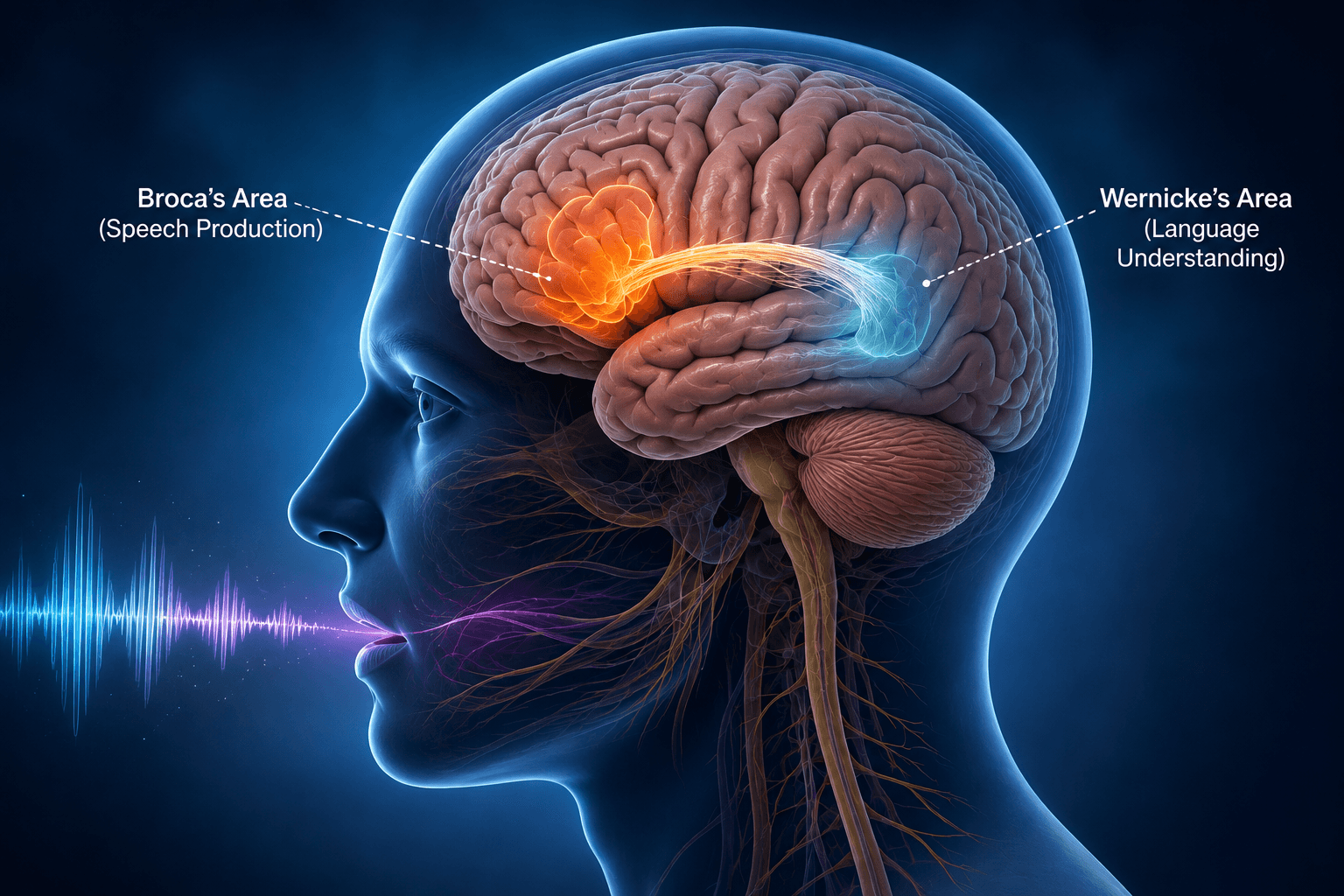
What part of the brain controls speech? No single part does. The part of brain responsible for speech is reallly a network, mainly Broca’s area (planning), Wernicke’s area (understanding), the motor cortex (movement), the cerebellum (coordination), and the basal ganglia (timing). In most people, the left hemisphere leads. When the network falls out of sync, speech can break down, and the learned parts of that breakdown can be retrained.
If you stutter, this map matters. Core stuttering has a genetic and neurodevelopmental basis, explained in our guide to what causes stuttering and the brain science behind it. But the layers built on top (anticipatory fear, physical tension loops, avoidance traps) are learned behaviors. Learned behaviors can be retrained through neuroplasticity. That is the foundation of how to stop stuttering with the neuroscience method: lower the nervous system alarm, create prediction errors, and let the brain update. For guided support, online stuttering therapy gives you structure and feedback.
This guide covers where speech lives in the brain, which side leads, what happens when an area is damaged, how stuttering fits in, and how to look after the circuits you rely on every day.
Speech Area in the Brain: The Key Regions
Speaking feels effortless because the brain works in milliseconds. Behind a single sentence, several regions pass signals back and forth, and each one has a specific job.
Quick Reference
Broca’s area (left frontal lobe): plans speech
Wernicke’s area (left temporal lobe): processes meaning
Arcuate fasciculus: connects the two
Premotor and supplementary motor areas: sequence and start movements
Motor cortex: commands the speech muscles
Cerebellum: coordinates and smooths movement
Basal ganglia: times each movement
Auditory cortex: checks what you said
Brainstem: controls breathing and carries signals to the muscles
The Speech Sequence
Idea: frontal and temporal regions choose what to say
Words: language areas pick vocabulary and build grammar
Plan: the brain converts words into ordered sounds and movements
Timing: deep circuits release each movement on cue
Execution: the motor cortex fires the lips, tongue, jaw, and breathing muscles
Check: the auditory cortex compares what you said with what you meant
Broca’s Area: The Planner
Broca’s area sits in the left frontal lobe. French physician Pierre Paul Broca described it in 1861. It helps turn thoughts into an organized plan of sounds, then hands that plan to the motor cortex.
Older textbooks called it the “speech production center.” Newer research, including a 2015 study by Flinker and colleagues, paints a subtler picture. Its activity peaks in the moments before you speak, then fades as the movement begins. Think of it as the planner, not the performer.
Premotor and Supplementary Motor Areas: The Starters
These regions sit just in front of the motor cortex. They help sequence speech movements and start them at the right moment. A planned sentence still needs a clean “go.”
The Motor Cortex: The Commander
Located in the frontal lobe, the motor cortex sends commands to the muscles of your face, lips, tongue, jaw, and throat. Speech uses some of the most finely controlled muscles in the body.
The Cerebellum: The Smoother
The cerebellum sits at the back of the brain. It coordinates voluntary movement and fine-tunes timing. Research suggests it also supports language processing, more than older models assumed.
The Basal Ganglia: The Timer
These deep structures help start each movement on cue so one syllable flows into the next. Imaging studies of people who stutter often show differences in this timing circuit. When the “go” signal wobbles, a block, repetition, or prolongation can follow.
The Auditory Cortex: The Checker
You hear yourself as you speak. The auditory cortex compares what came out with what you intended and feeds corrections back. This loop is why hearing loss can change speech over time.
The Brainstem and Cranial Nerves: The Wiring
The brainstem controls basic functions such as breathing. Cranial nerves carry commands from the brain to the muscles of the face, tongue, throat, and voice box. Breath is the fuel for speech, so this system matters more than people think.
Which Side of the Brain Controls Speech?
The left side leads in most people. This holds for nearly all right-handers and for most left-handers. Roughly 70 percent of left-handers are left-dominant for language, and the rest use the right side or both.
The two hemispheres connect through the corpus callosum, a thick band of nerve fibers. They constantly share information.
What the Right Hemisphere Adds
The right side still contributes. It helps with:
Tone and melody: the musical contour of your voice
Emotion: hearing and expressing feeling in speech
Context: understanding humor, sarcasm, and implied meaning
Why Singing Can Feel Easier
Many people who stutter sing smoothly. Singing leans more on melody and rhythm, which draws in the right hemisphere and changes how timing is cued. Read more in our guide on whether singing can help stuttering.
Which Part of the Brain Controls Language?
Language and speech are related but not identical. Language is ideas, words, and grammar. Speech is the physical act of producing sound. Different regions handle each.
Wernicke’s Area and the Temporal Lobe
The temporal lobe sits on the side of the brain, near the ears, and processes sound. Wernicke’s area, in the left temporal lobe, helps you understand spoken and written words and choose meaningful words when you talk. Karl Wernicke described it in 1876.
The Arcuate Fasciculus: The Cable
This bundle of nerve fibers links Wernicke’s area to Broca’s area, so “understanding” can talk to “planning.” Some research on stuttering reports differences in how these left-hemisphere connections are built and how they communicate.
Comprehension vs. Production
Comprehension: mostly temporal regions, led by Wernicke’s area
Production: frontal regions, led by Broca’s area and the motor system
Reading and writing: use overlapping parts of this same network
This split explains why some people understand everything but struggle to speak, and why others speak fluently yet make little sense.
What Part of the Brain Affects Speech When Damaged?
The symptoms depend on where the damage happens. Stroke is the most common cause. Head injury, tumors, and infections can also do it.
Aphasia: Trouble With Language
Aphasia is a problem speaking or understanding language. The type depends on the location:
Broca’s area (nonfluent aphasia): slow, effortful speech in short phrases. Understanding is often better preserved.
Wernicke’s area (fluent aphasia): smooth speech that carries little meaning, with wrong or invented words. The person may not notice.
Arcuate fasciculus (conduction aphasia): trouble repeating what was just heard.
Widespread damage (global aphasia): severe trouble speaking and understanding.
Slow decline (primary progressive aphasia): language fades gradually because of a degenerative brain condition.
Apraxia and Dysarthria: Trouble With Movement
Apraxia of speech is trouble planning the muscle movements for speech. Dysarthria is weak or poorly controlled speech muscles.
Can the Brain Recover?
Often, in part. Speech-language therapy helps many people improve after a stroke or injury. Full recovery is not always possible, and results depend on the cause and severity. Neuroplasticity is the reason therapy works: nearby areas can take on new roles with repetition.
When to Get Help
Sudden changes in speech are an emergency. Call emergency services right away. Gradual changes deserve a visit to a doctor or a speech-language pathologist.
How This Differs From Stuttering
Stuttering is not brain damage. In Wernicke’s aphasia, fluency stays and meaning is lost. In stuttering, meaning stays and fluency breaks. The network is intact. Its timing and coordination work differently.
The Stuttering Brain: What Is Inherited and What Is Learned
Think of stuttering as two layers.
Layer one is the core disfluency, It is neurodevelopmental, often inherited, and not caused by nerves, weak effort, or low intelligence. It usually starts in early childhood. See whether stuttering is genetic.
Layer two is the learned layer, It grows over years:
Anticipatory fear: dreading a word before you say it
Physical tension loops: squeezing the jaw, throat, or chest to push through
Avoidance traps: swapping words, skipping calls, staying quiet
What Brain Research Often Shows
Imaging studies of people who stutter commonly report differences in left-hemisphere speech connections, in the basal ganglia timing circuit, and in how the auditory and motor areas communicate. Some studies also find extra activity in the right hemisphere, which may be the brain compensating.
These are group patterns, not a diagnosis. Findings vary between studies, and no scan can tell one person they stutter.
The Auditory Loop Clue
Many people who stutter speak more fluently when they hear their voice changed or shared. Altered feedback and speaking in unison with others can both reduce stuttering for some. This hints that the hearing-to-movement loop plays a role. See our posts on frequency altered feedback and delayed auditory feedback.
Why Pressure Breaks Timing
When the brain senses threat, the alarm system competes with the speech system. The timing circuit is sensitive to this. That is why many people speak smoothly alone, to a pet, or while singing, and struggle in a meeting. The machinery is intact. The alarm changes the signal.
How Neuroplasticity Helps
The brain predicts. Before a feared word, it forecasts a block. The alarm fires, muscles tighten, the block appears, and the forecast feels confirmed. Each time you speak and the forecast fails, the loop weakens.
Old threat pathways weaken over time, but they can resurface under heavy stress, fatigue, or pressure. That is normal. It is not a setback. It is how learned patterns behave.
What Modern Therapy Covers
Traditional speech therapy is not just “training the mouth.” Modern speech-language pathologists (SLPs) use mind-body approaches, including Cognitive Behavioral Therapy (CBT) and desensitization. For more, read about secondary behaviors of stuttering and the role of speech anxiety.
Real-World Practice Scripts
Relaxing at home is step one. The brain changes when you test calm in a real moment. These two short scenes show what a prediction error looks like.
Script One: A Phone Call
Before the call (60 seconds): Breathe out slowly. Drop your shoulders.
You (internal): “My brain predicts a block on my name.”
Receptionist: “Dr. Rao’s office, how can I help?”
You: (Feel your feet on the floor. Soften your jaw.) “Hi.” (Small pause. Slow exhale.) “I’d like to book an appointment. My name is... (ease into the first sound, keep lips soft) ...Maya.”
Receptionist: “Sure, let me check the calendar.”
You: (Notice the pull in your chest. Let it pass. Don’t push.) “Thank you.”
What just happened: You expected a hard block. Your body stayed loose. Even if some disfluency showed up, the disaster didn’t. Your brain logged a prediction error: “I stayed calm, I spoke, I was safe.”
Script Two: Ordering Food
You (internal): “I want the word ‘chicken,’ and my brain wants to swap it. I’ll say it anyway.”
Server: “What can I get you?”
You: (Press your tongue gently to the roof of your mouth, then let it rest. Unclench your hands.) “I’ll have the... (pause, breathe out) ...chicken wrap, please.”
Server: “Great. Anything to drink?”
You: (Notice the urge to rush. Slow the next sentence by half.) “Just water, thanks.”
What just happened: You used the feared word instead of avoiding it. Whether it came out smooth or bumpy, the avoidance trap lost a little power. Stack enough of these and the learned layer loosens its grip.
How to Keep the Speech Parts of Your Brain Healthy
You can’t change your genetics. You can support the brain you have. These habits are linked to better overall brain health:
Protect Your Blood Vessels
Prevent stroke. Manage blood pressure, cholesterol, and blood sugar. Don’t smoke. Limit alcohol.
Move your body. Regular aerobic exercise supports blood flow to the brain.
Eat a balanced diet. Mediterranean-style eating is linked to brain health.
Protect Your Head and Ears
Wear a helmet for biking, skating, and contact sports. Head injuries can damage language areas.
Protect your hearing. Speech monitoring depends on what you hear.
Feed the Learning Brain
Sleep 7 to 9 hours. Sleep helps learning and memory consolidate.
Stay mentally active. Read aloud, learn a language, and have real conversations.
Stay socially connected. Talking with people exercises the whole network.
Calm the Alarm
Manage stress. Chronic stress keeps the alarm system on. Try box breathing and grounding techniques.
These habits support general brain health. They don’t treat stuttering or reverse brain damage. If you notice sudden speech changes, get medical help immediately.
Your Daily Speech-Brain Training Protocol
Calm the alarm
☐ Take 5 slow breaths before a hard speaking moment
☐ Drop your shoulders and soften your jaw
Work with prediction
☐ Write your prediction before a conversation (“I will block on my name”)
☐ Write what actually happened afterward
Build the habit
☐ Read aloud for 5 minutes at a slow pace (see why reading aloud helps)
☐ Do one neuroplasticity exercise
☐ Say one word you would normally avoid
☐ Allow one pause without rushing to fill it
Track wins
☐ Count the times you spoke despite fear
☐ Note one moment where your body stayed loose
A Simple Four-Week Build
Week 1: practice alone. Read aloud and note your tension.
Week 2: use the calm routine before one phone call or order each day.
Week 3: say one avoided word daily and log the prediction error.
Week 4: add one higher-stakes moment, such as a meeting comment.
Hard days will happen. Plan for them. A flare-up under stress or fatigue is normal, not failure.
Common Myths About Speech and the Brain
Myth: Speech lives in one spot. It runs on a network.
Myth: Stuttering means a damaged brain. It is neurodevelopmental, not injury.
Myth: Nervousness causes stuttering. Nerves can make it worse, but they are not the root cause.
Myth: Stuttering shows low intelligence. It has no link to intelligence.
Myth: You can’t retrain the adult brain. Adults keep the ability to change, with repetition and the right conditions.
Frequently Asked Questions
What part of brain damage affects speech?
Damage to the left frontal lobe (Broca’s area) disrupts speech output. Left temporal damage (Wernicke’s area) disrupts understanding. Motor and cerebellar damage can slur or scramble movement.
What are 5 signs your brain is in trouble?
Sudden trouble speaking or understanding, face drooping, weakness or numbness on one side, vision changes, and severe sudden headache or loss of balance. Call emergency services right away.
At what age is the amygdala fully developed?
No exact age exists. The amygdala works from birth and keeps maturing through adolescence. Its links with the prefrontal cortex continue developing into the mid-twenties.
What are the first signs of aphasia?
Trouble finding words, short broken sentences, mixing up words, and difficulty understanding or reading. If it starts suddenly, get emergency care, because it can signal a stroke.
Which side of the brain controls speech?
The left side, in most people, including most left-handers. A smaller group uses the right side or both.
Is the temporal lobe involved in speech?
Yes. It processes sound and houses Wernicke’s area, which supports understanding language. It works closely with the frontal lobe.
Can the brain change to improve stuttering?
Yes. Neuroplasticity lets the brain retrain the learned layers of fear, tension, and avoidance. Core disfluency may remain, but its impact can shrink.
Where to Go From Here
Speech is a team effort between understanding, planning, timing, and movement. A stutter doesn’t mean any part of your brain is broken. Once you see which layers are inherited and which are learned, you can train the ones that respond. So when someone asks what part of the brain controls speech, you can say it is a whole network, and that network can learn new patterns.
Ready to Put This Into Practice?
Download the app and start practicing today
Reading is the first step. Real progress comes from consistent daily practice. Use StopStutter to build confidence and improve your speech every day.


